
10th Science Unit 3 Thermal Physics Book Back Answers
10th Science Unit 3 Thermal Physics book back answers for all 28 questions in the 2026-27 Samacheer Kalvi (Tamil Nadu) textbook.
Unit 3 explains heat and temperature in a clear, scientific way. You will study temperature scales, absolute zero, thermal equilibrium, how heat flows between hot and cold bodies, the expansion of solids, liquids and gases, the gas laws, real and ideal gases, and the ideal gas equation. The book-back questions include multiple choice, fill in the blanks, true or false, short answers, definitions and numerical problems.
Answers at a glance
I. Choose the correct answer
III. State whether the following statements are true or false, if false explain why?
IV. Match the items in column-I to the items in column-II
- Q11 - d, 2 - e, 3 - a, 4 - b, 5 - c
V. Assertion and reason type questions
I. Choose the correct answer
The ideal gas equation is , where is the universal gas constant.
The textbook gives its value as (the value is Boltzmann's constant, not ).
d)
If a substance is heated or cooled, the change in mass of that substance is
One characteristic feature of heat transfer is that the mass of a system is not altered when it is heated or cooled.
Only the temperature, state or dimensions change; hence the change in mass is zero.
c) zero
If a substance is heated or cooled, the linear expansion occurs along the axis of
Linear expansion is the change in length of a body along one direction only, when its temperature changes.
So the expansion takes place along any one axis — either X or −X, or Y or −Y — that is, along (a) or (b).
d) (a) or (b)
The textbook defines temperature as the average kinetic energy (K.E) of the molecules of a substance (Section 3.1).
Total energy of a molecule, T.E = K.E + P.E, therefore K.E = T.E − P.E.
So temperature is the average difference in T.E and P.E of the molecules.
Option (b), the sum of P.E and K.E, is the total energy of the molecules, not the temperature.
c) difference in T.E and P.E
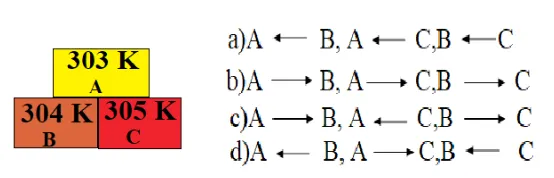
Heat always flows from the body at higher temperature to the body at lower temperature.
Temperatures: A = 303 K, B = 304 K, C = 305 K, so A is the coldest and C is the hottest.
Therefore heat flows B → A (written A ← B), C → A (written A ← C) and C → B (written B ← C).
a) A ← B, A ← C, B ← C
II. Fill in the blanks:
Avogadro's number () is the total number of atoms or molecules per mole of a substance.
Its value is per mole.
/mol
Both temperature and heat have only magnitude and no direction.
Hence they are scalar quantities.
scalar
One calorie is the amount of heat energy required to raise the temperature of _______ of water through______.
Calorie is a unit of heat energy defined for water.
One calorie raises the temperature of 1 gram of water through 1°C.
1 gram; 1°C
According to Boyle's law, the shape of the graph between pressure and reciprocal of volume is ________________
Boyle's law: at constant temperature.
So plotted against gives a straight line passing through the origin.
a straight line (passing through the origin)
III. State whether the following statements are true or false, if false explain why?
For a given heat in liquid, the apparent expansion is more than that of real expansion.
When a liquid in a container is heated, the container expands first, so the liquid level falls from to , and on further heating rises to .
Real expansion = and apparent expansion = . Since , real expansion is the larger value.
Apparent expansion ignores the expansion of the container, so it is always less than the real expansion.
False. For a given heat in a liquid, the real expansion is always more than the apparent expansion, because apparent expansion does not take into account the expansion of the container.
Thermal energy always flows from a system at higher temperature to a system at lower temperature.
Heat energy flows because of a temperature difference between two bodies.
It always flows from the body at higher temperature to the body at lower temperature, until both attain the same temperature (thermal equilibrium).
This is one of the characteristic features of heat energy transfer given in the text.
True
According to Charles's law, at constant pressure, the temperature is inversely proportional to volume.
Charles's law states that when the pressure of a gas is kept constant, the volume of the gas is directly proportional to its temperature.
That is, or constant, not .
Inverse proportionality between pressure and volume at constant temperature is Boyle's law, not Charles's law.
False. According to Charles's law, at constant pressure the volume of a gas is directly proportional to its temperature ().
IV. Match the items in column-I to the items in column-II
| Column-I | Column-II |
|---|---|
| 1. Linear expansion | (a) change in volume |
| 2. Superficial expansion | (b) hot body to cold body |
| 3. Cubical expansion | (c) |
| 4. Heat transformation | (d) change in length |
| 5. Boltzmann constant | (e) change in area |
Linear expansion – when a body is heated, its length changes, so it matches change in length (d).
Superficial expansion – heating increases the area of the solid, so it matches change in area (e).
Cubical expansion – heating increases the volume of the solid, so it matches change in volume (a).
Heat transformation – heat always flows from a system at higher temperature to one at lower temperature, i.e. hot body to cold body (b).
Boltzmann constant – its value is (c).
1 - d, 2 - e, 3 - a, 4 - b, 5 - c
V. Assertion and reason type questions
Assertion: If one end of the rod is heated, other end also is heated. Reason: Heat always flows from a region of lower temperature to higher temperature of the rod.
Assertion check: when one end of a rod is heated, heat is conducted along the rod, so the other end also becomes hot. The assertion is true.
Reason check: heat always flows from a region of higher temperature to a region of lower temperature, not the other way. So the reason as stated is false.
Hence the assertion is true but the reason is false.
c) Assertion is true but the reason is false.
Assertion: Gas is highly compressible than solid and liquid Reason: Interatomic or intermolecular distance in the gas is comparably high.
Assertion check: in gases the atoms/molecules are far apart, so gases are highly compressible compared with solids and liquids. True.
Reason check: the interatomic or intermolecular distance in a gas is comparatively large. True.
The large intermolecular distance is exactly why there is more free space to squeeze, so the reason correctly explains the assertion.
(Same idea as in the text: for a given rise in temperature a gas expands most, because its particles are forced further apart easily.)
a) Both the assertion and the reason are true and the reason is the correct explanation of the assertion.
VI. Answer in briefly
Calorie is a unit of heat energy (other than the SI unit joule).
One calorie is the amount of heat energy required to raise the temperature of 1 gram of water through .
Related unit: one kilocalorie raises the temperature of 1 kilogram of water through .
One calorie is the heat energy needed to raise the temperature of 1 g of water through .
Linear expansion: when a body is heated or cooled, the change is in the length of the body. It is also called longitudinal expansion; .
Superficial (areal) expansion: the increase is in the area of the solid due to heating; .
Linear expansion is measured by the coefficient of linear expansion , superficial expansion by the coefficient of superficial expansion ; both have the SI unit .
Linear expansion is the increase in length of a body on heating, while superficial (areal) expansion is the increase in its area.
When a solid is heated its volume increases; this is cubical or volumetric expansion.
The ratio of increase in volume of the body per degree rise in temperature to its unit volume is called the coefficient of cubical expansion.
It is given by and its SI unit is . Its value differs for different materials.
Coefficient of cubical expansion is the increase in volume per unit original volume per degree rise in temperature; SI unit .
Boyle's law: when the temperature of a gas is kept constant, the volume of a fixed mass of gas is inversely proportional to its pressure.
In symbols, .
Hence for an invariable mass of a perfect gas at constant temperature, constant.
At constant temperature, the volume of a fixed mass of gas is inversely proportional to its pressure, i.e. constant.
The law of volume is Charles's law, formulated by the French scientist Jacques Charles.
It states that when the pressure of a gas is kept constant, the volume of the gas is directly proportional to its temperature.
In symbols, or constant.
Charles's law: at constant pressure, the volume of a gas is directly proportional to its temperature ( constant).
Real gas: the molecules or atoms interact with each other with a definite amount of intermolecular or interatomic force of attraction.
Ideal gas: the atoms or molecules do not interact with each other; it is also called a perfect gas.
In practice no gas is ideal; every gas has some interaction among its molecules.
At very high temperature or low pressure the forces of attraction become weak, so a real gas behaves as an ideal gas. Ideal gases obey Boyle's law, Charles's law and Avogadro's law.
In a real gas the molecules attract one another, while in an ideal gas the molecules do not interact at all.
If a liquid is heated directly without using any container, the expansion observed is the real expansion of the liquid.
The coefficient of real expansion is the ratio of the true rise in volume of the liquid per degree rise in temperature to its unit volume.
Its SI unit is .
Coefficient of real expansion is the true increase in volume of a liquid per unit volume per degree rise in temperature; SI unit .
A liquid is always heated in a container, so part of the heat expands the container and part expands the liquid.
The expansion of a liquid observed without considering the expansion of the container is the apparent expansion.
The coefficient of apparent expansion is the ratio of the apparent rise in volume of the liquid per degree rise in temperature to its unit volume; SI unit .
Real expansion is always greater than apparent expansion.
Coefficient of apparent expansion is the apparent increase in volume of a liquid per unit volume per degree rise in temperature; SI unit .
VII. Numerical problems
Find the final temperature of a copper rod. Whose area of cross section changes from to due to heating. The copper rod is initially kept at . (Coefficient of superficial expansion is )
Given: original area , final area , so change in area ; initial temperature ; coefficient of superficial expansion .
Formula for superficial (areal) expansion: , so .
Substituting: .
Rise in temperature: .
Final temperature .
Final temperature of the copper rod (rise in temperature )
Calculate the coefficient of cubical expansion of a zinc bar. Whose volume is increased from due to the change in its temperature of .
The printed data mean the volume of the zinc bar increases from to (an increase, as stated), for a temperature change .
Original volume ; change in volume .
Formula for cubical expansion: , hence .
Substituting: .
So .
Coefficient of cubical expansion of the zinc bar
VIII. Answer in detail
Show steps (10)
Ideal gas: A gas whose atoms or molecules do not interact with each other is called an ideal gas (perfect gas). An ideal gas obeys Boyle's law, Charles's law and Avogadro's law.
Boyle's law: At constant temperature, the volume of a fixed mass of gas is inversely proportional to its pressure. , so ... (1)
Charles's law: At constant pressure, the volume of a gas is directly proportional to its temperature. , so ... (2)
Avogadro's law: At constant pressure and temperature, the volume of a gas is directly proportional to the number of atoms or molecules present in it. , so ... (3)
Combining (1), (2) and (3): ... (4). This relation is called the combined law of gases.
Introducing moles: If the gas contains moles, the number of atoms is times the Avogadro number ; i.e. ... (5), where .
Substituting (5) in (4): . This constant is taken as , the Boltzmann constant ().
So , which gives .
Universal gas constant: Here , called the universal gas constant, whose value is . Hence .
This is the ideal gas equation. It is also called the equation of state, because it gives the relation between the state variables (P, V, T) and describes the state of any gas.
Combining Boyle's law ( = constant), Charles's law ( = constant) and Avogadro's law ( = constant) gives = constant, and putting and we get the ideal gas equation , where .
Explain the experiment of measuring the real and apparent expansion of a liquid with a neat diagram.
Show steps (9)
Aim: To measure the real expansion and the apparent expansion of a liquid.
Why two expansions: A liquid cannot be heated without a container. Part of the thermal energy expands the container and part expands the liquid. So what we see is not the true (real) expansion but the apparent expansion.
Step 1 – Initial level: Pour the liquid whose expansions are to be found into a container up to a certain level. Mark this level as .
Step 2 – Heating begins: Heat the container and the liquid using a burner. Initially, the container alone receives the thermal energy and expands. Since the container gets bigger, the volume of the liquid appears to have reduced. Mark this fallen level as .
Step 3 – Further heating: On further heating, the thermal energy passes through the container into the liquid and the liquid expands. Now the level of the liquid rises. Mark this risen level as .
Apparent expansion: The difference between the levels and gives the apparent expansion. Apparent expansion .
Real expansion: The difference between the levels and gives the real expansion. Real expansion .
Result: Since is lower than , we always get Real expansion > Apparent expansion, for a given heat energy.
Diagram: Draw a container on a stand with a burner below it, showing three marked levels on the container – (initial level), (lowered level, below ) and (final raised level, above ) – with labelled apparent expansion and labelled real expansion.
On heating a liquid in a container the level first falls from to (container expands) and then rises to ; apparent expansion , real expansion , and real expansion is always greater.
IX. HOT question
If you keep ice at and water at in either of your hands, in which hand you will feel more chillness? Why?
Both ice and water are at the same temperature, , but the hand holding the ice feels more chillness.
Heat always flows from the body at higher temperature (your hand, about ) to the body at lower temperature () until thermal equilibrium is reached.
The ice must first absorb a large amount of heat energy (latent heat) from your hand to change its state from solid to liquid, and this happens without any rise in its temperature.
So the hand with ice loses much more heat energy than the hand with water at the same temperature, and hence feels colder.
The hand holding ice feels more chillness, because ice draws extra heat (latent heat) from the hand to change from solid to liquid, even though both are at .
Quick check
In the Given diagram, the possible direction of heat energy transformation is
Question 1 of 5Show answer
Answer: (1) A ← B, A ← C, B ← C
Heat always flows from the body at higher temperature to the body at lower temperature.
Temperatures: A = 303 K, B = 304 K, C = 305 K, so A is the coldest and C is the hottest.
Therefore heat flows B → A (written A ← B), C → A (written A ← C) and C → B (written B ← C).
If a substance is heated or cooled, the linear expansion occurs along the axis of
Question 2 of 5Show answer
Answer: (4) (a) or (b)
Linear expansion is the change in length of a body along one direction only, when its temperature changes.
So the expansion takes place along any one axis — either X or −X, or Y or −Y — that is, along (a) or (b).
The value of universal gas constant
Question 3 of 5Show answer
Answer: (4)
The ideal gas equation is , where is the universal gas constant.
The textbook gives its value as (the value is Boltzmann's constant, not ).
Temperature is the average ___________ of the molecules of a substance
Question 4 of 5Show answer
Answer: (3) difference in T.E and P.E
The textbook defines temperature as the average kinetic energy (K.E) of the molecules of a substance (Section 3.1).
Total energy of a molecule, T.E = K.E + P.E, therefore K.E = T.E − P.E.
So temperature is the average difference in T.E and P.E of the molecules.
Option (b), the sum of P.E and K.E, is the total energy of the molecules, not the temperature.
If a substance is heated or cooled, the change in mass of that substance is
Question 5 of 5Show answer
Answer: (3) zero
One characteristic feature of heat transfer is that the mass of a system is not altered when it is heated or cooled.
Only the temperature, state or dimensions change; hence the change in mass is zero.