
Samacheer Kalvi 10th Maths Exercise 8.3 Solutions
10th Maths Exercise 8.3 solutions (Chapter 8 Statistics and Probability) with step-by-step answers for all 29 questions, as per the 2026-27 Samacheer Kalvi textbook.
Answers at a glance
Each coin can show head or tail .
Tree: first coin gives 2 branches ; each splits into for the second coin; each of those splits again for the third coin.
So end branches.
Reading along the branches,
;
Write the sample space for selecting two balls at a time from a bag containing 6 balls numbered 1 to 6 (using tree diagram).
Show steps (9)
First ball can be any of — 6 branches.
Since two balls are taken at a time, the second ball must be different from the first — each branch splits into 5.
So .
;
If is an event of a random experiment such that and then find
(i)
.
Let and .
(ii)
.
From (i), .
A coin is tossed thrice. What is the probability of getting two consecutive tails?
;
Let be the event of getting two consecutive tails.
;
At a fete, cards bearing numbers 1 to 1000, one number on one card are put in a box. Each player selects one card at random and that card is not replaced. If the selected card has a perfect square number greater than 500, the player wins a prize. What is the probability that
(i)
the first player wins a prize?
Perfect squares greater than and up to :
Let be the event that the first player wins;
(ii)
the second player wins a prize, if the first has won?
The first player won, so one winning card is removed and not replaced.
Remaining cards ; remaining winning numbers
A bag contains blue balls and red balls. If one ball is drawn at random
(i)
what is the probability that it will be a red ball?
Show steps (6)
Total number of balls (12 blue and red).
Let be the event of drawing a red ball, so .
.
This is the required answer in terms of ; the value of is found only in part (ii).
From part (ii): , so (rejecting ).
Hence, substituting , the numerical value of the probability in (i) is , which matches the printed answer.
; with (from part (ii)) this equals .
(ii)
If more red balls are put in the bag, and if the probability of drawing a red ball will be twice that of the probability in (i), then find .
Show steps (7)
After adding 8 red balls: red , total
Given,
(since cannot be negative)
(i)
a doublet (equal numbers on both dice).
Two dice:
Let be the event of getting a doublet.
;
(ii)
the product as a prime number.
Product is prime only when one die shows and the other shows a prime.
;
(iii)
the sum as a prime number.
Possible prime sums are .
(iv)
the sum as 1.
The least possible sum with two dice is .
So no outcome gives sum ; it is an impossible event.
(i)
all heads.
;
;
(ii)
atleast one tail.
'Atleast one tail' is the complement of 'no tail' i.e. .
(iii)
atmost one head.
Atmost one head means head or head.
;
(iv)
atmost two tails.
Atmost two tails is the complement of 'three tails' i.e. .
A bag contains 5 red balls, 6 white balls, 7 green balls, black balls. One ball is drawn at random from the bag. Find the probability that the ball drawn is
(i)
white.
Total balls
(ii)
black or red.
(iii)
not white.
(iv)
neither white nor black.
Neither white nor black means red or green.
In a box there are non-defective and some defective bulbs. If the probability that a bulb selected at random from the box found to be defective is then, find the number of defective bulbs.
Show steps (6)
Let the number of defective bulbs be .
Total bulbs
Number of defective bulbs
Some boys are playing a game, in which the stone thrown by them landing in a circular region (given in the figure) is considered as win and landing other than the circular region is considered as loss. What is the probability to win the game? ()
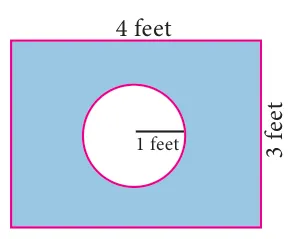
Total region = rectangle of area sq.feet
Winning region = circle of radius ft, area sq.feet
Two customers Priya and Amuthan are visiting a particular shop in the same week (Monday to Saturday). Each is equally likely to visit the shop on any one day as on another day. What is the probability that both will visit the shop on
(i)
the same day?
Each can visit on any of 6 days (Mon–Sat).
Same day: ;
(ii)
different days?
Different days is the complement of same day.
(iii)
consecutive days?
Consecutive day pairs: (Mon,Tue), (Tue,Wed), (Wed,Thu), (Thu,Fri), (Fri,Sat) — 5 pairs.
Each pair can occur in 2 orders, so
In a game, the entry fee is ₹. The game consists of tossing a coin times. Dhana bought a ticket for entry. If one or two heads show, she gets her entry fee back. If she throws 3 heads, she receives double the entry fees. Otherwise she will lose. Find the probability that she
(i)
gets double entry fee.
;
She gets double the entry fee only for 3 heads.
;
(ii)
just gets her entry fee.
She just gets back the entry fee when one or two heads show.
;
(iii)
loses the entry fee.
She loses when no head shows.
;
Quick check
The probability of getting a job for a person is . If the probability of not getting the job is then the value of is
Question 1 of 5Show answer
Answer: (2)
The mean of observations is and their standard deviation is . The sum of squares of all observations is
Question 2 of 5Show answer
Answer: (2)
Which of the following is incorrect?
Question 3 of 5Show answer
Answer: (1)
Probability of any event always lies between and .
So is impossible.
The probability a red marble selected at random from a jar containing red, blue and r green marbles is
Question 4 of 5Show answer
Answer: (2)
Total marbles ; red marbles .
The range of the data is
Question 5 of 5Show answer
Answer: (1)
Largest value , smallest value .
Range .
Chapter 8 formulas
- Range
- Coefficient of range
- Variance
- Standard deviation
- Standard deviation (ungrouped data) - Direct method
- Standard deviation (ungrouped data) - Mean method
- Standard deviation (ungrouped data) - Assumed mean method
- Standard deviation (ungrouped data) - Step deviation method
- Standard deviation of first n natural numbers
- Standard deviation (grouped data) - Mean method
- Standard deviation (grouped data) - Assumed mean method
- Standard deviation (grouped data) - Step deviation method
- Coefficient of variation
- Consistency using C.V.
- Mutually exclusive events
- Probability of an event
- Sure and impossible events
- Range of probability
- Complement of an event
- Addition theorem (mutually exclusive events)
- Probability of only A
- Probability of only B
- Addition theorem for any two events
- Addition theorem for any three events