
10th Science Unit 17 Reproduction in Plants and Animals Book Back Answers
10th Science Unit 17 Reproduction in Plants and Animals book back answers for all 58 questions in the 2026-27 Samacheer Kalvi (Tamil Nadu) textbook.
This unit looks at how plants and animals make new life. You will study vegetative, asexual and sexual reproduction, the parts of a flower, pollination, double fertilisation and seed formation, along with human reproductive organs, gametes, the menstrual cycle and reproductive health. The book-back questions mix multiple choice, fill in the blanks, matching, short answers and diagram-based questions from these topics.
Answers at a glance
I. Choose the correct answer
II. Fill in the blanks
III. (a) Match the following
- Q1Fission - Amoeba, Budding - Yeast, Fragmentation - Spirogyra
III. (b) Match the following terms with their respective meanings
- Q1a - 3, b - 1, c - 4, d - 2
IV. State whether the following statements are True or False. Correct the false statement
- Q1False – Stalk of the ovule is called funiculus.
- Q2False – Seeds are the product of sexual reproduction.
- Q3False – Yeast reproduces asexually by means of budding.
- Q4False – The part of the pistil which serves as a receptive structure for the pollen is called stigma.
- Q5False – Insect pollinated flowers are characterized by large, sticky pollen with pitted or spiny exine.
- Q6False – Sex organs produce gametes which are haploid.
- Q7False – LH is secreted by the anterior pituitary.
- Q8True
- Q9False – Surgical methods of contraception prevent the transport of gametes, not their formation.
- Q10False – The decreased level of estrogen and progesterone is responsible for menstruation.
I. Choose the correct answer
The plant which propagates with the help of its leaves is ___________ .
In Bryophyllum, small plantlets grow at the leaf notches and develop into new plants when they fall on the soil.
Onion (bulb), ginger (rhizome) propagate by stems; neem is grown from seeds.
d) Bryophyllum
In budding, a daughter individual is formed from a small projection (bud) on the parent body, as in yeast.
Amoeba reproduces by fission and bacteria by fission/spore formation.
b) Yeast
Syngamy is the fusion of one male gamete with the egg cell.
This fusion forms a diploid zygote, which later develops into the embryo.
c) Zygote
Androecium (stamens) produces pollen grains and gynoecium (carpels) bears ovules, so both take part directly in reproduction.
Calyx and corolla are non-essential or accessory whorls.
d) Androecium and Gynoecium
Anemophilous (wind-pollinated) flowers have stigmas that are comparatively large, protruding and sometimes hairy or feathery.
This helps them trap the small, light, dry pollen grains carried by wind.
d) Large feathery stigma
A mature pollen grain has a vegetative cell and a generative cell.
The generative cell divides mitotically to form the two male gametes.
a) Generative cell
Gametes (sperm and ovum) are haploid cells produced by gametogenesis in the gonads — testes and ovaries.
They are not diploid, do not form gonads and do not secrete hormones.
d) They are formed from gonads
A single highly coiled tube where sperms are stored, get concentrated and mature is known as
The epididymis is a single, highly coiled tube attached to the testis.
Sperms are stored here, become concentrated and mature before passing into the vas deferens.
a) Epididymis
Sertoli cells lie in the seminiferous tubules and are the supporting cells.
They provide nutrients to the developing sperms; Leydig cells only secrete testosterone.
b) Sertoli cells
As the egg grows, the primary follicle enlarges, fills with fluid and becomes the Graafian follicle.
The Graafian follicle secretes estrogen, whose level rises during the follicular phase.
c) Graffian follicle
IUCDs (intra-uterine devices) are contraceptive devices inserted into the uterus, such as Lippe's Loop and Copper-T.
Oral pills are hormonal, diaphragm is a barrier and tubectomy is a surgical method.
a) Copper – T
II. Fill in the blanks
The embryo sac in a typical dicot at the time of fertilization is ___________ .
The embryo sac is the female gametophyte inside the ovule.
At the time of fertilization it contains seven cells and eight nuclei — egg apparatus (egg + 2 synergids), 3 antipodal cells and 2 polar nuclei (secondary nucleus).
7-celled and 8-nucleate
Post-fertilization changes: the ovule becomes the seed and its integuments become the seed coat.
The ovary enlarges and develops into the fruit.
fruit
Planaria has a specialized mass of cells that can rebuild lost body parts.
The ability of lost body parts to give rise to a whole new organism is called regeneration.
regeneration
In humans the sperm is deposited inside the female genital tract.
Fusion of sperm and ovum occurs in the ampulla of the fallopian tube, i.e. inside the body.
internal (takes place in the oviduct / ampulla of fallopian tube)
After cleavage the blastocyst travels to the uterus.
It attaches to the uterine endometrium about 6 to 7 days after fertilization; this is implantation.
6 to 7 days
The milk released from the mammary gland in the first 2–3 days after child birth is colostrum.
It contains immune substances and gives immunity to the new born.
Colostrum
Milk production from the alveoli of the mammary glands is stimulated by prolactin.
Prolactin is secreted by the anterior pituitary (oxytocin from the posterior pituitary ejects the milk).
the anterior pituitary gland
III. (a) Match the following
| Column 1 | Column 2 |
|---|---|
| Fission | Spirogyra |
| Budding | Amoeba |
| Fragmentation | Yeast |
Fission – the parent cell divides into two daughter cells, each growing into a new adult, e.g. Amoeba.
Budding – a daughter individual arises from a small projection (bud) on the parent body, e.g. Yeast.
Fragmentation – the filament breaks into many fragments, each growing into a new filament, e.g. Spirogyra.
Fission - Amoeba, Budding - Yeast, Fragmentation - Spirogyra
III. (b) Match the following terms with their respective meanings
| Term | Meaning |
|---|---|
| a) Parturition | 1) Duration between pregnancy and birth |
| b) Gestation | 2) Attachment of zygote to endometrium |
| c) Ovulation | 3) Delivery of baby from uterus |
| d) Implantation | 4) Release of egg from Graafian follicle |
a) Parturition – the expulsion of the young one from the mother's uterus at the end of gestation, i.e. delivery of baby from uterus → 3
b) Gestation – the period during which the embryo develops in the uterus (about 280 days), i.e. duration between pregnancy and birth → 1
c) Ovulation – on the 14th day the Graafian follicle ruptures and releases the ovum, i.e. release of egg from Graafian follicle → 4
d) Implantation – the attachment of the blastocyst (fertilised egg/zygote) to the uterine wall or endometrium → 2
a - 3, b - 1, c - 4, d - 2
IV. State whether the following statements are True or False. Correct the false statement
The ovule is attached to the ovary wall by a stalk known as the funiculus.
Pedicel is the stalk of a flower, not of an ovule.
False – Stalk of the ovule is called funiculus.
Seeds are formed after pollination and fertilization, which involve fusion of male and female gametes.
Hence seeds are the product of sexual reproduction.
False – Seeds are the product of sexual reproduction.
In yeast a small projection called bud arises on the parent body and grows into a daughter individual.
This method is budding, not multiple fission.
False – Yeast reproduces asexually by means of budding.
The part of the pistil which serves as a receptive structure for the pollen is called as style.
The pistil (gynoecium) has three parts – ovary, style and stigma.
The stigma is the receptive structure that receives the pollen grains; style is only the connecting stalk.
False – The part of the pistil which serves as a receptive structure for the pollen is called stigma.
In entomophily (insect pollination) the pollen grains are larger in size with pitted or spiny exine so that they stick firmly to the sticky stigma.
Small, smooth, dry and light pollen grains are the feature of wind pollinated (anemophilous) flowers.
False – Insect pollinated flowers are characterized by large, sticky pollen with pitted or spiny exine.
Gametogenesis produces gametes through meiosis.
Sperms and ova are therefore haploid; only their fusion forms the diploid zygote.
False – Sex organs produce gametes which are haploid.
LH and FSH are pituitary gonadotropins secreted by the anterior pituitary.
Oxytocin is the hormone released from the posterior pituitary.
False – LH is secreted by the anterior pituitary.
If fertilization takes place, the corpus luteum persists and secretes progesterone.
This maintains the thickened uterine wall and prevents maturation of another follicle till the end of pregnancy, so menstruation stops.
Lack of menstruation generally indicates pregnancy.
True
Surgical methods are vasectomy (ligation of vas deferens) in males and tubectomy (ligation of fallopian tube) in females.
They only block the transport of gametes; the testes and ovaries still form gametes.
False – Surgical methods of contraception prevent the transport of gametes, not their formation.
Menstrual flow begins when the uterine endometrial lining breaks down.
This breakdown is caused by a decrease in progesterone and oestrogen levels, not an increase.
False – The decreased level of estrogen and progesterone is responsible for menstruation.
V. Answer in a word or sentence
If one pollen grain produces two male gametes, how many pollen grains are needed to fertilize 10 ovules?
In double fertilization each ovule needs two male gametes – one fuses with the egg (syngamy) and the other with the secondary nucleus (triple fusion).
One pollen grain supplies exactly two male gametes, so one pollen grain is enough for one ovule.
For 10 ovules, pollen grains are needed.
10 pollen grains (one pollen grain, giving two male gametes, per ovule).
After pollination the pollen grain lands on the stigma of the gynoecium.
There it germinates and puts out the pollen tube, which grows through the style to reach the ovule.
On the stigma of the flower.
Budding is the formation of a daughter individual from a small projection (bud) on the parent body.
Yeast reproduces by budding; Hydra also gives out buds that mature into new individuals.
Yeast and Hydra.
The endosperm is formed from the primary endosperm nucleus after triple fusion.
It is triploid and stores food material.
It supplies nourishment to the developing embryo.
The endosperm provides food to the developing embryo.
At the end of gestation the young one has to be expelled from the uterus (parturition).
Oxytocin from the posterior pituitary stimulates vigorous uterine contractions and provides the force to expel the baby.
Oxytocin.
The acrosome is the cap-like structure at the anterior part of the sperm head.
It contains the enzyme hyaluronidase, which helps the sperm to enter the ovum during fertilization.
Hyaluronidase.
Menstrual Hygiene Day is observed every year on May 28.
It creates awareness among girls and women about maintaining menstrual hygiene for good health.
May 28 every year.
Contraception is one of the best birth control measures and prevents unwanted pregnancy.
It checks population explosion and supports family planning – 'Small Family, Happy Family'.
IUDs and similar devices give an adequate time interval (spacing) between pregnancies.
Barrier methods like condoms also protect against sexually transmitted diseases such as syphilis and AIDS, thus improving reproductive health.
Contraception prevents unwanted pregnancy, helps control population, spaces births and protects against STDs.
Name the part of the human female reproductive system where the following occurs. a. Fertilization b. Implantation
a. Fertilization: the sperm fuses with the ovum in the oviduct, usually in the ampulla of the fallopian tube.
b. Implantation: the blastocyst attaches to the uterine wall (endometrium) of the uterus about 6–7 days after fertilization.
a. Fallopian tube (ampulla) b. Uterus (endometrium).
VI. Short answer question
Planaria reproduces by regeneration — the ability of lost body parts of an organism to give rise to a whole new organism.
It has a specialised mass of cells that can grow into all the missing parts.
So each small fragment will grow into a complete new planaria.
Thus many new individuals, genetically identical to the parent, are produced from one animal.
Each cut fragment regenerates into a complete new Planaria (regeneration).
The new plants are produced from vegetative parts (root, stem, leaf or bud) by mitosis only, so they are genetically similar to the parent — good qualities of the parent are retained.
Plants that do not produce viable seeds (e.g. banana, sugarcane, rose) can be multiplied only this way.
It is a quicker and cheaper method; the plants grow and bear flowers and fruits earlier than seed-grown plants.
Many identical plants can be raised from a single parent in a short time.
Because it is quick, cheap and keeps the parent's characters unchanged, and it is the only way to multiply seedless plants.
Binary fission: the parent cell divides into two equal daughter cells, and each develops into a new adult organism, e.g. Amoeba.
Multiple fission: the nucleus of the parent cell divides repeatedly to form many nuclei, and the cell then splits into many daughter cells at a time, e.g. Plasmodium.
Binary fission usually occurs in favourable conditions; multiple fission helps the organism survive unfavourable conditions and produces many offspring at once.
Binary fission gives two daughter cells from one parent, while multiple fission gives many daughter cells at a time.
During double fertilization two male gametes are released into the embryo sac.
One male gamete fuses with the egg (syngamy); the second male gamete fuses with the two polar nuclei (secondary nucleus).
Since three nuclei are involved, this fusion is called triple fusion.
It forms the triploid primary endosperm nucleus, which develops into the endosperm that feeds the embryo.
Triple fusion is the fusion of one male gamete with the secondary nucleus (two polar nuclei) forming the triploid primary endosperm nucleus.
Pollination by insects is called entomophily (honey bees carry about 80% of insect pollination).
The flowers are large and brightly coloured to attract insects.
They have a sweet smell (fragrance) and secrete nectar as a reward for the visiting insects.
Pollen grains are larger in size and the exine is pitted or spiny, so they stick firmly to the insect body and to the sticky stigma.
Entomophilous flowers are brightly coloured, scented and nectar-bearing with large, sticky, spiny pollen grains and sticky stigmas.
The primary sex organs in the male are the testes; the other structures are secondary (accessory) sex organs.
Male accessory sex organs are: vas deferens, epididymis, seminal vesicle, prostate gland and penis.
They help in the transport, nourishment and delivery of the sperms.
Vas deferens, epididymis, seminal vesicle, prostate gland and penis.
Colostrum is the first fluid (milk) released from the mammary glands during the first 2–3 days after child birth.
It contains immune substances and provides immunity to the new born, so it is essential for the baby.
Milk production from the alveoli of the mammary glands is stimulated by the hormone prolactin secreted by the anterior pituitary.
The ejection (release) of milk is stimulated by oxytocin secreted by the posterior pituitary.
Colostrum is the first immunity-rich milk after birth; prolactin controls milk production and oxytocin controls milk ejection.
Sanitary pads should be changed regularly to avoid infection from microbes of the vagina and sweat of the genitals.
The genitals should be cleaned with warm water; this also helps to relieve menstrual cramps.
Loose clothing instead of tight fitting clothes should be worn to allow airflow around the genitals and prevent sweating.
Used pads or tampons must be wrapped properly and discarded (never flushed in the toilet); napkin incinerators should be used for disposal.
By changing pads often, washing the genitals with warm water, wearing loose clothes and disposing of used napkins safely.
After implantation, a disc shaped structure called the placenta is formed, attached to the uterine wall.
It is a temporary association between the developing embryo and the maternal tissues.
Through the placenta the embryo receives food materials and oxygen from the mother's blood, and gives out carbon dioxide and nitrogenous wastes.
The placenta is connected to the foetus by the umbilical cord, which contains the blood vessels carrying these substances.
The embryo gets food and oxygen from the mother through the placenta and umbilical cord.
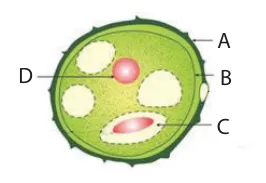
The figure shows a mature pollen grain in section (textbook p. 258).
A – Exine (thick outer wall with spiny projections).
B – Intine (the inner wall layer beneath the exine).
C – Generative cell (small cell that divides to form the two male gametes).
D – Vegetative nucleus (the larger nucleus of the vegetative cell).
A – Exine, B – Intine, C – Generative cell, D – Vegetative nucleus.
Write the events involved in the sexual reproduction of a flowering plant. a. Discuss the first event and write the types. b. Mention the advantages and the disadvantages of that event.
Show steps (7)
Sexual reproduction in a flowering plant involves two events: 1. Pollination and 2. Fertilization.
a. First event – Pollination: the transfer of pollen grains from the anther to the stigma of a flower.
Types of pollination: (i) Self-pollination (autogamy) – transfer of pollen from the anther to the stigma of the same flower or another flower on the same plant, e.g. Hibiscus; (ii) Cross pollination – transfer of pollen from the anther of a flower to the stigma of a flower on another plant of the same species, e.g. apple, grapes, plum.
b. Advantages of self-pollination: it is possible in bisexual flowers; flowers do not depend on external agents; there is no wastage of pollen grains.
Disadvantages of self-pollination: seeds are less in number; the endosperm is minute, so seeds produce weak plants; new varieties cannot be produced.
Advantages of cross pollination: seeds develop and germinate properly and grow into better plants, leading to new varieties; more viable seeds are produced.
Disadvantages of cross pollination: pollination may fail due to distance barrier; more wastage of pollen grains; unwanted characters may be introduced; flowers depend on external agencies.
Pollination (self and cross) followed by fertilization; self-pollination is sure but gives weak seeds, cross pollination gives better new varieties but depends on agents.
Why are the human testes located outside the abdominal cavity? Name the pouch in which they are present .
The testes lie outside the abdominal cavity in a sac like structure called the scrotum.
The scrotum keeps the testes at a temperature about 2–3 °C lower than the body temperature.
This lower temperature is necessary for the normal formation of sperms (spermatogenesis) in the seminiferous tubules.
Inside the warm abdominal cavity, sperm production would be affected.
To keep the testes at a lower temperature needed for sperm formation; they lie in a pouch called the scrotum.
Luteal phase of the menstrual cycle is also called the secretory phase. Give reason.
The luteal phase extends from the 15th to the 28th day of the menstrual cycle.
The emptied Graafian follicle changes into the corpus luteum, which secretes the hormone progesterone.
Progesterone makes the endometrial glands of the uterus secretory, so the uterine lining becomes thick and spongy and is prepared for implantation.
Because of this active glandular secretion in the ovary and uterus, the phase is called the secretory phase.
Because the corpus luteum secretes progesterone which makes the uterine glands secrete and prepares the endometrium for implantation.
Why are family planning methods not adopted by all the people of our country?
Illiteracy and ignorance — many people do not know about family planning methods or their benefits.
Superstitions, religious beliefs and social customs make some people oppose contraception.
Preference for a male child makes couples go on having more children.
Early marriage, poverty and the belief that more children mean more earning hands add to the problem.
Lack of proper counselling and fear of side effects of contraceptives also keep people away, so population explosion continues.
Because of illiteracy, superstitions and religious beliefs, preference for a male child, early marriage, poverty and fear of side effects.
VII. Long answer questions
With a neat labelled diagram describe the parts of a typical angiospermic ovule.
Show steps (10)
Diagram (label these parts): Funicle, Chalaza, Nucellus, Integuments, Micropyle, Embryo sac with egg, synergids, secondary nucleus (polar nuclei) and antipodal cells.
Funiculus (funicle): The stalk by which the ovule is attached to the ovary wall.
Chalaza: The basal part of the ovule, where the funicle, nucellus and integuments meet.
Nucellus: The main body of the ovule; it is a mass of nutritive tissue that encloses and nourishes the embryo sac.
Integuments: Two protective coverings that surround the nucellus. After fertilization they develop into the seed coat.
Micropyle: The small opening left by the integuments at the tip of the ovule. The pollen tube enters the embryo sac through the micropyle.
Embryo sac: The female gametophyte lying within the nucellus. It contains seven cells and eight nuclei.
Egg apparatus: The three cells at the micropylar end — one egg cell (female gamete) and two synergids.
Antipodal cells: The three cells present at the chalazal end.
Polar nuclei / secondary nucleus: The remaining two nuclei lie in the centre; they fuse with a male gamete during triple fusion to form the triploid primary endosperm nucleus.
An angiospermic ovule consists of funicle, chalaza, nucellus, two integuments with a micropyle, and an embryo sac containing the egg apparatus (egg + 2 synergids), two polar nuclei and three antipodal cells.
What are the phases of menstrual cycle? Indicate the changes in the ovary and uterus.
Show steps (8)
The cyclic events taking place in a rhythmic fashion during the reproductive period of a woman's life is the menstrual cycle; it normally lasts about 28 days and has four phases.
1. Menstrual (destructive) phase – 4 to 5 days: In the ovary, primary follicles begin to develop. In the uterus, the endometrial lining breaks down and bleeding occurs. Progesterone and oestrogen levels decrease.
2. Follicular (proliferative) phase – 6th to 13th day: In the ovary, the primary follicle grows into a fully mature Graafian follicle. In the uterus, the endometrium regenerates by proliferation. FSH and oestrogen increase.
3. Ovulatory phase – 14th day: The Graafian follicle ruptures and releases the ovum (ovulation). The endometrium increases in thickness. There is a peak of LH.
4. Luteal (secretory) phase – 15th to 28th day: The emptied Graafian follicle develops into the corpus luteum. The endometrium is prepared for implantation. LH and FSH decrease while progesterone from the corpus luteum increases.
If fertilization occurs, the corpus luteum persists and secretes progesterone, maintaining the thickened uterine wall throughout pregnancy.
If fertilization does not occur, the corpus luteum degenerates, progesterone falls, the uterine wall ruptures, bleeding starts and the unfertilized egg is expelled — a new cycle begins.
These changes in the ovary and uterus are controlled by the pituitary hormones (LH and FSH) and the ovarian hormones (oestrogen and progesterone).
The menstrual cycle has four phases — menstrual, follicular, ovulatory and luteal — with follicle development, ovulation and corpus luteum formation in the ovary, and breakdown, regeneration, thickening and preparation of the endometrium in the uterus, all under the control of FSH, LH, oestrogen and progesterone.
VIII. Higher Order Thinking Skills (HOTS)
In angiosperms the pollen germinates to produce pollen tube that carries two gametes. What is the purpose of carrying two gametes when single gamete can fertilize the egg?
In angiosperms two types of fusion take place inside the embryo sac, so two male gametes are needed. This is called double fertilization.
One male gamete fuses with the egg cell (syngamy) and forms the diploid zygote, which develops into the embryo.
The second male gamete fuses with the secondary nucleus (triple fusion) and forms the triploid primary endosperm nucleus.
The primary endosperm nucleus develops into the endosperm, which supplies food to the developing embryo. Without the second gamete there would be no endosperm and the embryo would starve.
One gamete fertilizes the egg to form the zygote and the other fuses with the secondary nucleus to form the endosperm that nourishes the embryo — hence two gametes are carried.
Why menstrual cycle does not take place before puberty and during pregnancy ?
The menstrual cycle is controlled by the pituitary gonadotropins (FSH and LH) and the ovarian hormones estrogen and progesterone.
Before puberty these hormones are not secreted in sufficient amounts, so the ovary and uterus are not functional; the first menstruation (menarche) begins only at puberty, at about 11–13 years.
During pregnancy the fertilized egg is implanted in the uterus, so the uterine lining must be maintained and not shed.
The corpus luteum persists and keeps secreting progesterone, which maintains the thickened uterine wall and prevents maturation of another follicle till the end of pregnancy. Hence there is no ovulation and no menstrual flow.
Before puberty the reproductive hormones are not yet secreted, and during pregnancy progesterone from the persisting corpus luteum maintains the endometrium and stops ovulation — so no menstrual cycle occurs.
Read the following passage and answer the questions that follow
Rahini and her parents were watching a television programme. An advertisement flashed on the screen which was promoting use of sanitary napkins. Rahini's parents suddenly changed the channel, but she objected to her parents and explained the need and importance of such advertisement. a) What is first menstruation called? When does it occur ? b) List out the napkin hygiene measures taken during menstruation ? c) Do you think that Rahini's objection towards her parents was correct? If so, Why?
Show steps (10)
a) First menstruation: The first menstruation in a girl is called menarche.
a) Time of occurrence: It occurs at the onset of puberty, at about 11–13 years of age, and the cycles continue till menopause at about 48–50 years.
b) Napkin hygiene – change regularly: Sanitary pads should be changed regularly to avoid infection from microbes of the vagina and sweat from the genitals.
b) Proper wrapping and disposal: Used sanitary pads and tampons should be wrapped properly and discarded, because they can spread infections.
b) Do not flush: A sanitary pad or tampon should never be flushed down the toilet.
b) Use incinerators: Napkin incinerators should be used properly for the disposal of used napkins.
b) Other care: Genitals should be cleaned with warm water (it also relieves menstrual cramps) and loose clothing should be worn to allow airflow and prevent sweating.
c) Rahini's objection was correct: Menstruation is a normal, natural biological process and should not be treated as something shameful to be hidden.
c) Reason – awareness: Such advertisements create awareness among girls and women about the use of sanitary napkins and their proper disposal, which prevents skin and genitourinary tract (UTI) infections.
c) Reason – health and social attitude: Maintaining menstrual hygiene is important for the overall health of women; even Menstrual Hygiene Day (May 28) is observed for this purpose. Open discussion with parents and teachers removes the taboo and helps girls stay healthy.
The first menstruation is menarche, occurring at puberty (11–13 years); napkin hygiene means changing pads regularly, wrapping and disposing them properly, never flushing them and using incinerators; Rahini was right, because such advertisements spread the awareness of menstrual hygiene that protects women's health.
Quick check
The plant which propagates with the help of its leaves is ___________ .
Question 1 of 5Show answer
Answer: (4) Bryophyllum
In Bryophyllum, small plantlets grow at the leaf notches and develop into new plants when they fall on the soil.
Onion (bulb), ginger (rhizome) propagate by stems; neem is grown from seeds.
Male gametes in angiosperms are formed by the division of ___________ .
Question 2 of 5Show answer
Answer: (1) Generative cell
A mature pollen grain has a vegetative cell and a generative cell.
The generative cell divides mitotically to form the two male gametes.
Which one of the following is an IUCD?
Question 3 of 5Show answer
Answer: (1) Copper – T
IUCDs (intra-uterine devices) are contraceptive devices inserted into the uterus, such as Lippe's Loop and Copper-T.
Oral pills are hormonal, diaphragm is a barrier and tubectomy is a surgical method.
Syngamy results in the formation of _________ .
Question 4 of 5Show answer
Answer: (3) Zygote
Syngamy is the fusion of one male gamete with the egg cell.
This fusion forms a diploid zygote, which later develops into the embryo.
A single highly coiled tube where sperms are stored, get concentrated and mature is known as
Question 5 of 5Show answer
Answer: (1) Epididymis
The epididymis is a single, highly coiled tube attached to the testis.
Sperms are stored here, become concentrated and mature before passing into the vas deferens.