
10th Science Unit 18 Genetics Book Back Answers
10th Science Unit 18 Genetics book back answers for all 43 questions in the 2026-27 Samacheer Kalvi (Tamil Nadu) textbook.
Unit 18 explains how parents pass traits to their children. You will learn about Mendel's work with pea plants, monohybrid and dihybrid crosses, dominant and recessive traits, phenotype and genotype, chromosome types, DNA structure and copying, mutations and Down's syndrome. The book-back questions include multiple choice, fill in the blanks, true or false, short answers, ratio problems and cross diagrams.
Answers at a glance
I. Choose the correct answer
III. Identify whether the statement are True or False. Correct the false statement
- Q1False – A typical Mendelian dihybrid ratio of generation is 9:3:3:1.
- Q2False – A recessive factor is not altered but only masked (hidden) by the presence of a dominant factor.
- Q3True
- Q4True
- Q5False – Some chromosomes have an elongated knob-like appendage known as satellite.
- Q6True
- Q7False – Down's syndrome is the genetic condition with 47 chromosomes (an extra copy of chromosome 21).
IV. Match the following
- Q11 - c, 2 - d, 3 - e, 4 - a, 5 - b
I. Choose the correct answer
The textbook (18.2, Mendel's Interpretation on Monohybrid cross) states: 'Two factors making up a pair of contrasting characters are called alleles.'
These two factors are nothing but a pair of genes (e.g. T and t) occupying the same locus, one contributed by each parent.
Hence, according to Mendel, alleles are a pair of genes; 'responsible for character' is a property of genes in general, not the defining character of alleles.
a) Pair of genes
9:3:3:1 is the dihybrid ratio of the F2 generation.
It arises because the factors of one pair assort out independently of the other pair — the law of independent assortment.
c) Independent assortment
The region of the chromosome where the spindle fibres get attached during cell division
The two arms of a chromosome meet at the primary constriction called the centromere.
The centromere is the region where spindle fibres attach during cell division.
c) Centromere
In a metacentric chromosome the centromere occurs in the centre and forms two equal arms.
Such chromosomes are V shaped.
b) Metacentric
In the Watson and Crick model, the nitrogenous bases lie in the centre.
They are linked to sugar–phosphate units, which form the backbone of the DNA.
d) Sugar phosphate
Okazaki fragments are the short DNA segments made on the lagging strand.
These fragments are joined together by the enzyme DNA ligase.
d) DNA ligase
Each human cell normally contains 23 pairs of chromosomes.
Of these, 22 pairs are autosomes and the 23rd pair is the allosome (sex chromosome).
a) 22 pairs of autosomes and 1 pair of allosomes.
The loss of one or more chromosome in a ploidy is called ___________.
Aneuploidy is the loss or gain of one or more chromosomes in a set.
Its types are monosomy (2n−1), trisomy (2n+1) and nullisomy (2n−2).
b) Aneuploidy
II. Fill in the blanks
Two factors making up a pair of contrasting characters are called alleles.
Their phenotypic expressions are called allelomorphs.
alleles (allelomorphs)
External expression of a particular trait is known as phenotype.
The genetic constitution is genotype, but the physical expression is phenotype.
phenotype
The thin thread like structures found in the nucleus of each cell are called _________.
The nucleus of each cell contains thin thread like structures called chromosomes.
They carry the genetic material with hereditary information.
chromosomes
In the Watson and Crick model, DNA molecule consists of two polynucleotide chains.
These chains run anti-parallel and form a double helix.
polynucleotide
An inheritable change in the amount or the structure of a gene or a chromosome is called _______________.
Mutation is an inheritable sudden change in the genetic material (DNA) of an organism.
Change in the chromosome is chromosomal mutation and change in the gene is gene mutation.
mutation
III. Identify whether the statement are True or False. Correct the false statement
A dihybrid cross involves two pairs of contrasting characters, and Mendel obtained four types of seeds in F2.
The phenotypic ratio of these four types is 9:3:3:1; the 3:1 ratio belongs to a monohybrid cross.
False – A typical Mendelian dihybrid ratio of generation is 9:3:3:1.
In a hybrid the two factors of an allelic pair remain together without mixing.
The recessive factor is only masked by the dominant factor in F1; it stays pure and reappears in F2.
False – A recessive factor is not altered but only masked (hidden) by the presence of a dominant factor.
By Mendel's law of segregation (law of purity of gametes), the two factors of an allelic pair separate during gamete formation.
So a gamete carries either T or t, that is only one allele of a gene.
True
A cross between two genetically different (pure breeding tall × pure breeding dwarf) parents gives F1 offspring.
These F1 offspring, such as Tt monohybrids, are called hybrids.
True
The elongated knob-like appendage at one end of some chromosomes is called the satellite, and such chromosomes are sat-chromosomes.
Telomere is the end of the chromosome which gives stability and prevents joining with adjacent chromosomes.
False – Some chromosomes have an elongated knob-like appendage known as satellite.
New nucleotides are added and new complementary strand of DNA is formed with the help of enzyme DNA polymerase.
After the RNA primer is formed, nucleotides are added to the template strand.
This addition and the formation of the new complementary strand is carried out by the enzyme DNA polymerase.
True
Down's syndrome is caused by an extra copy of chromosome 21 (Trisomy 21).
So the cell has one chromosome more than normal, that is 47 chromosomes, not 45.
False – Down's syndrome is the genetic condition with 47 chromosomes (an extra copy of chromosome 21).
IV. Match the following
| Column I | Column II |
|---|---|
| 1. Autosomes | Trisomy 21 |
| 2. Diploid condition | 9:3:3:1 |
| 3. Allosome | 22 pair of chromosome |
| 4. Down's syndrome | 2n |
| 5. Dihybrid ratio | 23rd pair of chromosome |
Autosomes – 22 pairs of chromosomes: in human beings, out of the 23 pairs, 22 pairs are autosomes which carry genes for somatic (body) characters.
Diploid condition – 2n: in body cells chromosomes occur in pairs, and this condition is called diploid (2n).
Allosome – 23rd pair of chromosome: the 23rd pair is the sex chromosome (allosome) that decides the sex of an individual.
Down's syndrome – Trisomy 21: it is an aneuploid condition with an extra copy of chromosome 21.
Dihybrid ratio – 9:3:3:1: the phenotypic ratio obtained in the F2 generation of Mendel's dihybrid cross.
1 - c, 2 - d, 3 - e, 4 - a, 5 - b
V. Answer in a sentence
What is a cross in which inheritance of two pairs of contrasting characters are studied?
A cross that involves the inheritance of two pairs of contrasting characteristics at the same time is a dihybrid cross.
Mendel's example: round-yellow seeds crossed with wrinkled-green seeds.
Its F2 phenotypic ratio is 9:3:3:1, called the dihybrid ratio.
Dihybrid cross.
Factors (alleles) occur in pairs; they may be alike or unlike.
When both alleles of a pair are alike, as in pure breeding tall (TT) or dwarf (tt) plants, the condition is homozygous.
If the two alleles are unlike (Tt), the condition is heterozygous.
Homozygous condition.
A garden pea plant produces axial white flowers. Another of the same species produced terminal violet flowers. Identify the dominant trait?
The two characters compared are flower position (axial/axillary and terminal) and flower colour (white and violet).
In Mendel's contrasting characters, axillary flower position is dominant and terminal is recessive.
For flower colour, the coloured (violet/blue) flower is dominant and white is recessive.
Axillary (axial) flower position and violet flower colour are the dominant traits.
What is the name given to the segments of DNA, which are responsible for the inheritance of a particular character?
Chromosomes are made of DNA, which forms the genetic material.
Genes are segments of DNA responsible for the inheritance of a particular phenotypic character.
Each gene occupies a specific position on a chromosome called its locus.
Genes.
DNA is a polynucleotide made of millions of nucleotides.
The nucleotides in a helix are joined together by phosphodiester bonds.
The two strands are held together by hydrogen bonds between the complementary nitrogenous bases.
Phosphodiester bond joins the nucleotides in a DNA strand.
VI. Short answers questions
The pea plant is naturally self-pollinating, so pure breeding individuals can be raised very easily.
It is an annual with a short life span, so several generations could be followed in a short time.
It can be easily cross-pollinated by the experimenter.
It has deeply defined contrasting characters (like tall/dwarf, round/wrinkled seeds) and the flowers are bisexual.
Mendel chose the pea plant because it is self-pollinating, short-lived, easy to cross-pollinate, bisexual-flowered and has clearly defined contrasting characters.
Phenotype: the external expression of a particular trait of an organism, e.g. tall plant or dwarf plant.
Genotype: the genetic constitution of an organism, e.g. TT, Tt or tt.
In a monohybrid cross the F2 phenotypic ratio is 3:1 (tall : dwarf) while the genotypic ratio is 1:2:1 (TT : Tt : tt).
Phenotype is the external appearance of a trait; genotype is the genetic constitution of the organism.
Allosomes are the chromosomes which are responsible for determining the sex of an individual.
They are also called sex chromosomes or hetero-chromosomes.
There are two types — X chromosome and Y chromosome.
Human males have one X and one Y chromosome (XY); human females have two X chromosomes (XX). In man the 23rd pair is the allosome.
Allosomes are the sex chromosomes (X and Y) that determine the sex of an individual.
During DNA replication one new strand (the leading strand) is made continuously, while the other is made in short pieces.
These short segments of DNA synthesised on the lagging strand are called Okazaki fragments.
They are formed because the synthesis of DNA by DNA polymerase is unidirectional.
The fragments are later joined together by the enzyme DNA ligase.
Okazaki fragments are the short DNA segments formed on the lagging strand during replication, later joined by DNA ligase.
Euploidy is the condition in which an individual bears more than the usual number of diploid (2n) sets of chromosomes, e.g. triploidy (3n) and tetraploidy (4n).
Tetraploid plants (4n) are advantageous because they often result in increased fruit and flower size, giving better yield and quality.
Triploid (3n) plants and animals are typically sterile; this sterility is useful commercially — e.g. triploid oysters, which are larger than diploid oysters (Figure 18.10).
Thus the extra sets of chromosomes give improved size and quality in both plants and animals.
Euploidy is advantageous because the extra sets of chromosomes give increased fruit and flower size in plants (tetraploids) and larger, sterile forms such as triploid oysters in animals.
A pure tall plant (TT) is crossed with pure dwarf plant (tt), what would be the and generations? Explain.
Parents: pure breeding tall plant (TT) × pure breeding dwarf plant (tt). The gametes are T and t.
F1 generation: all plants are Tt (heterozygous) and all are tall, because tallness (T) is dominant over dwarfness (t).
F2 generation: on selfing the F1 hybrids (Tt × Tt), the offspring are TT, Tt, Tt and tt.
Phenotype in F2 is tall and dwarf in the ratio 3:1; genotype is TT : Tt : tt = 1:2:1.
This shows the law of dominance and the law of segregation — the factors do not mix and separate during gamete formation.
F1 = all tall heterozygous (Tt); F2 = tall : dwarf in 3:1 phenotypic ratio and TT : Tt : tt in 1:2:1 genotypic ratio.
Show steps (7)
Chromosomes are thin, long, thread-like structures in the nucleus, consisting of two identical strands called sister chromatids held together by the centromere.
Each chromatid is made of a spirally coiled thin thread called chromonema, which bears bead-like structures called chromomeres along its length.
Primary constriction (centromere): the point where the two arms meet; spindle fibres attach here during cell division.
Secondary constriction: present in some chromosomes; known as the nucleolar organiser, as the nucleolus is formed here.
Telomere: the end of the chromosome; it has polarity, prevents joining with adjacent chromosomes and gives stability.
Satellite: an elongated knob-like appendage at one end; such chromosomes are called sat-chromosomes.
Chemically a chromosome is made up of DNA, RNA, chromosomal proteins (histones and non-histones) and certain metallic ions.
A chromosome has two chromatids joined at the centromere, with chromonema, chromomeres, primary and secondary constrictions, telomeres and sometimes a satellite, and is made of DNA, RNA and proteins.
Label the parts of the DNA in the diagram given below. Explain the structure briefly.
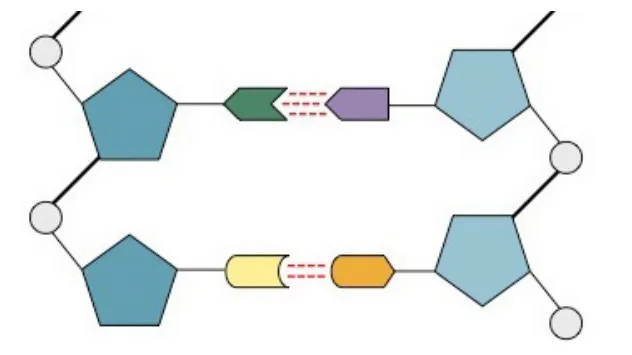
Show steps (6)
Labels of the diagram: (a) phosphate group (small circles of the backbone), (b) deoxyribose sugar (pentagons), (c) nitrogenous bases projecting inwards, (d) hydrogen bonds (dotted lines) between the paired bases, and the two sugar–phosphate backbones of the two polynucleotide chains.
DNA is a polynucleotide; each nucleotide has a deoxyribose sugar, a nitrogenous base and a phosphate group (Nucleoside = base + sugar; Nucleotide = nucleoside + phosphate).
According to the Watson and Crick model, DNA consists of two polynucleotide chains forming a double helix, the two strands running anti-parallel to each other.
The sugar–phosphate units form the backbone of the DNA and the nitrogenous bases lie in the centre; nucleotides in a chain are joined by phosphodiester bonds.
Base pairing is specific, always between a purine and a pyrimidine: Adenine pairs with Thymine by two hydrogen bonds () and Cytosine pairs with Guanine by three hydrogen bonds (). This is complementary base pairing.
These hydrogen bonds make the DNA molecule stable. Each turn of the helix is (3.4 nm) and contains ten base pairs.
DNA is a double helix of two anti-parallel polynucleotide chains with a sugar–phosphate backbone and central bases paired as A=T and C≡G by hydrogen bonds.
VII. Long answer questions
Explain with an example the inheritance of dihybrid cross. How is it different from monohybrid cross?
Show steps (10)
Meaning: A dihybrid cross involves the inheritance of two pairs of contrasting characters at the same time.
Characters chosen by Mendel: Shape and colour of seeds — round-yellow seeds and wrinkled-green seeds.
Parental cross: Pure breeding round-yellow seeded plants () were crossed with pure breeding wrinkled-green seeded plants ().
F1 generation: All the seeds produced were round and yellow (). No wrinkled-green seeds appeared. Hence round shape and yellow colour are dominant over wrinkled shape and green colour.
F2 generation: When F1 plants were self-pollinated, four types of seeds appeared — round-yellow, round-green, wrinkled-yellow and wrinkled-green in the ratio . This is the dihybrid ratio.
Results: 9 plants with two dominant traits, 3 with one dominant and one recessive trait, 3 with the other dominant and other recessive trait, and 1 with two recessive traits.
New combinations: Two new combinations — round-green and wrinkled-yellow — appeared in F2, showing that the factors of one pair assort independently of the other pair (Law of Independent Assortment).
Difference 1 (number of traits): A monohybrid cross involves only one pair of contrasting characters (e.g. tall × dwarf), while a dihybrid cross involves two pairs at the same time.
Difference 2 (ratios): Monohybrid F2 gives a phenotypic ratio of and a genotypic ratio of , whereas dihybrid F2 gives a phenotypic ratio of .
Difference 3 (law demonstrated): Monohybrid cross demonstrates the Law of Dominance and the Law of Segregation; the dihybrid cross demonstrates the Law of Independent Assortment and produces new combinations of traits.
A dihybrid cross (round-yellow × wrinkled-green) gives an F2 ratio of 9:3:3:1 for two pairs of traits, whereas a monohybrid cross deals with one pair of traits and gives 3:1 in F2.
How is the structure of DNA organised? What is the biological significance of DNA?
Show steps (10)
Nature of DNA: DNA is the hereditary material and the most important constituent of a chromosome. It is a large molecule made of millions of nucleotides, so it is also called a polynucleotide.
Nucleotide: Each nucleotide has three components — a deoxyribose sugar, a nitrogenous base and a phosphate group. (Nucleoside = nitrogen base + sugar; Nucleotide = nucleoside + phosphate.)
Bases: The nitrogenous bases are of two kinds — purines (Adenine and Guanine) and pyrimidines (Cytosine and Thymine).
Watson–Crick model: DNA consists of two polynucleotide chains forming a double helix, with the two strands running anti-parallel to one another.
Backbone: The nitrogenous bases lie in the centre and are linked to sugar-phosphate units, which form the backbone of the DNA.
Base pairing: Pairing is specific, always between a purine and a pyrimidine linked by hydrogen bonds — Adenine links Thymine by two hydrogen bonds () and Cytosine links Guanine by three hydrogen bonds (). This is complementary base pairing, and these hydrogen bonds make the molecule stable.
Dimensions: Each turn of the double helix is ( nm) and contains ten base pairs. The nucleotides in a helix are joined by phosphodiester bonds.
Significance 1: DNA is responsible for the transmission of hereditary information from one generation to the next generation.
Significance 2: It contains the information required for the formation of proteins.
Significance 3: It controls the developmental process and life activities of an organism.
DNA is a double helix of two anti-parallel polynucleotide chains with a sugar-phosphate backbone and complementary A=T, C≡G base pairs; it transmits hereditary information, codes for proteins and controls the life activities of the organism.
The sex of the new born child is a matter of chance and neither of the parents may be considered responsible for it. What would be the possible fusion of gametes to determine the sex of the child?
Show steps (7)
Chromosome number: Human beings have 23 pairs of chromosomes — 22 pairs of autosomes and one pair of sex chromosomes (allosomes).
Female gametes: All eggs formed by the mother are alike in chromosome type, . Therefore human females are homogametic.
Male gametes: The father produces two types of sperms in equal proportion — and . Therefore human males are heterogametic.
Fusion 1: Egg + sperm → zygote , which develops into a female child.
Fusion 2: Egg + sperm → zygote , which develops into a male child.
Matter of chance: It is purely a matter of probability which category of sperm fuses with the egg, so the sex of the child cannot be predicted or controlled.
Who decides: Since the mother can give only an X chromosome, it is the sperm produced by the father that determines the sex of the child; the mother is not responsible for determining the sex of the child.
Egg (22+X) fused with an X-bearing sperm gives a female (44+XX) and with a Y-bearing sperm gives a male (44+XY); the sperm of the father decides the sex, purely by chance.
VIII. Higher Order Thinking Skills (HOTS)
Flowers of the garden pea are bisexual and self-pollinated. Therefore, it is difficult to perform hybridization experiment by crossing a particular pistil with the specific pollen grains. How Mendel made it possible in his monohybrid and dihybrid crosses?
Show steps (7)
Choice of plant: Mendel chose the garden pea (Pisum sativum) because, though its flowers are bisexual and self-pollinating, they can easily be cross-pollinated by hand.
Emasculation: To stop self-pollination, he removed the immature anthers (male part) from the flower of the plant chosen as the female parent, before the pollen matured.
Bagging: The emasculated flower was then covered with a bag so that no unwanted pollen from other plants could fall on its stigma.
Artificial (hand) pollination: He collected mature pollen grains from the desired male parent plant and dusted them on the stigma of the emasculated flower, and re-bagged it.
Raising F1 plants: The seeds so formed were collected and sown; the plants grown from them formed the first filial (F1) generation of the monohybrid cross (tall × dwarf) and dihybrid cross (round-yellow × wrinkled-green).
Raising F2 plants: The F1 hybrids were allowed to self-pollinate naturally, and the seeds obtained gave the F2 generation, in which he got the 3:1 (monohybrid) and 9:3:3:1 (dihybrid) ratios.
Other helpful features: The pea plant is an annual with a short life span, has clearly defined pairs of contrasting characters and is naturally self-pollinating, so pure-breeding lines were easy to maintain — these made his experiments successful.
Mendel emasculated and bagged the flowers of one parent and dusted them with pollen of the chosen parent (artificial cross-pollination), raising F1 plants; selfing these F1 plants gave the F2 generation.
(a)
Pure-bred tall pea plants are first crossed with pure-bred dwarf pea plants. The pea plants obtained in generation are then selfed to produce generation of pea plants. a. What do the plants of generation look like?
The cross is a monohybrid cross between pure-breeding tall (TT) and pure-breeding dwarf (tt) plants.
All F1 plants receive one T and one t, so their genotype is Tt (heterozygous).
Tallness is dominant over dwarfness, so the recessive dwarf character is masked.
All F1 plants are tall (genotype Tt, heterozygous monohybrids).
(b)
b. What is the ratio of tall plants to dwarf plants in generation?
Selfing the F1 hybrids (Tt × Tt) gives TT, Tt, Tt and tt.
TT and Tt plants are tall (3 plants) and tt is dwarf (1 plant).
Mendel actually obtained 787 tall and 277 dwarf plants, which is nearly 3:1.
Tall : Dwarf = 3 : 1 (phenotypic ratio); genotypic ratio 1 : 2 : 1.
(c)
c. Which type of plants were missing in generation but reappeared in generation?
Dwarf plants were absent in the F1 generation because the factor for dwarfness (t) is recessive and was masked by the dominant factor for tallness (T).
The factors remain pure and do not mix; during gamete formation T and t segregate.
On selfing F1 (Tt × Tt), two t factors come together (tt) and dwarf plants reappear in F2.
Dwarf plants — they were missing in F1 (recessive, masked) and reappeared in F2 in the ratio 1 out of 4.
Kavitha gave birth to a female baby. Her family members say that she can give birth to only female babies because of her family history. Is the statement given by her family members true. Justify your answer.
Show steps (7)
The statement made by the family members is not true.
In humans, of the 23 pairs of chromosomes, the 23rd pair is the sex chromosome pair. The mother has XX and the father has XY.
The mother produces only one type of egg (22+X), so human females are homogametic; she can never give a Y chromosome.
The father produces two types of sperms in equal proportion — (22+X) and (22+Y); so human males are heterogametic.
If the egg (22+X) is fertilised by an X-bearing sperm, the child is a female (44+XX); if it is fertilised by a Y-bearing sperm, the child is a male (44+XY).
Thus the sex of the child depends purely on chance — on which type of sperm from the father fuses with the egg. The mother is in no way responsible.
So Kavitha cannot be blamed, and there is an equal (50%) chance of her having a male child in future.
False — the sperm of the father decides the sex of the child; the mother, being homogametic (XX), cannot determine it.
IX. Value based question
Under which conditions does the law of independent assortment hold good and why?
Show steps (8)
The law (textbook statement): "In case of inheritance of two or more pairs of characters simultaneously, the factors or genes of one pair assort out independently of the other pair." Mendel framed it from his dihybrid cross between round-yellow and wrinkled-green seeded pea plants.
Condition 1 – Two or more pairs of contrasting characters must be studied at the same time. The law applies only to a dihybrid (or polyhybrid) cross, e.g. seed shape (round/wrinkled) together with seed colour (yellow/green), because independence can be observed only when two pairs are followed simultaneously.
Condition 2 – The parents must be pure breeding (homozygous). Mendel crossed pure round-yellow (RRYY) plants with pure wrinkled-green (rryy) plants, so that the F1 was a uniform dihybrid (RrYy) receiving one factor of each pair from each parent.
Condition 3 – The two pairs of genes must lie on different (non-homologous) chromosomes, i.e. they must not be linked. Only then can the factors of one pair enter the gametes without being tied to the factors of the other pair; linked genes would travel together and the law would not hold.
Condition 4 – The factors must remain pure and segregate independently during gamete formation. As the law of segregation states, the two factors of an allelic pair remain together without mixing and separate at gamete formation, so each gamete receives either R or r and, independently, either Y or y. This produces four kinds of gametes — RY, Ry, rY and ry — in equal numbers.
Condition 5 – Fertilization must be random and the offspring number large. All four types of male gametes must have an equal chance of fusing with all four types of female gametes, and a large F2 population is needed for the expected proportions to appear.
Why these conditions give the result: When the four gamete types combine at random, 16 combinations are formed in the Punnett square and four phenotypes appear — round-yellow 9, round-green 3, wrinkled-yellow 3 and wrinkled-green 1, i.e. the dihybrid ratio 9:3:3:1.
Proof of independence: Two entirely new combinations, round-green and wrinkled-yellow, appear in the F2 generation. Such new combinations can arise only if the factor for seed shape passed into the gamete independently of the factor for seed colour, showing that each character maintains its own identity.
The law of independent assortment holds good when two or more pairs of contrasting characters are followed together, the parents are pure breeding, the genes of the two pairs lie on different (unlinked) chromosomes, the factors remain pure and segregate independently into the gametes (RY, Ry, rY, ry in equal numbers), and fertilization is random in a large population. Under these conditions the F2 shows the dihybrid ratio 9:3:3:1 with new combinations (round-green and wrinkled-yellow), proving that the factors of one pair assort independently of the other pair.
Quick check
According to Mendel alleles have the following character
Question 1 of 5Show answer
Answer: (1) Pair of genes
The textbook (18.2, Mendel's Interpretation on Monohybrid cross) states: 'Two factors making up a pair of contrasting characters are called alleles.'
These two factors are nothing but a pair of genes (e.g. T and t) occupying the same locus, one contributed by each parent.
Hence, according to Mendel, alleles are a pair of genes; 'responsible for character' is a property of genes in general, not the defining character of alleles.
Okasaki fragments are joined together by ___________________.
Question 2 of 5Show answer
Answer: (4) DNA ligase
Okazaki fragments are the short DNA segments made on the lagging strand.
These fragments are joined together by the enzyme DNA ligase.
The region of the chromosome where the spindle fibres get attached during cell division
Question 3 of 5Show answer
Answer: (3) Centromere
The two arms of a chromosome meet at the primary constriction called the centromere.
The centromere is the region where spindle fibres attach during cell division.
The loss of one or more chromosome in a ploidy is called ___________.
Question 4 of 5Show answer
Answer: (2) Aneuploidy
Aneuploidy is the loss or gain of one or more chromosomes in a set.
Its types are monosomy (2n−1), trisomy (2n+1) and nullisomy (2n−2).
The _____________ units form the backbone of the DNA.
Question 5 of 5Show answer
Answer: (4) Sugar phosphate
In the Watson and Crick model, the nitrogenous bases lie in the centre.
They are linked to sugar–phosphate units, which form the backbone of the DNA.