Samacheer Kalvi 10th Maths Exercise 5.1 Solutions

10th Maths Exercise 5.1 solutions (Chapter 5 Coordinate Geometry) with step-by-step answers for all 18 questions, as per the 2026-27 Samacheer Kalvi textbook.

Answers at a glance17 answers · full steps below
  1. Q1 (i)2424 sq.units
  2. Q1 (ii)11.511.5 sq.units
  3. Q2 (i)The points are collinear
  4. Q2 (ii)The points are collinear
  5. Q3 (i)p=44p = 44
  6. Q3 (ii)p=13p = 13
  7. Q4 (i)a=0a = 0
  8. Q4 (ii)a=12a = \dfrac12 or a=−1a = -1
  9. Q5 (i)3535 sq.units
  10. Q5 (ii)3434 sq.units
  11. Q6k=−5k = -5
  12. Q7a=2a = 2, b=−1b = -1
  13. Q9122122 sq.units
  14. Q101010 buckets
  15. Q11 (i)3.753.75 sq.units
  16. Q11 (ii)33 sq.units
  17. Q11 (iii)13.87513.875 sq.units

Q1. Find the area of the triangle formed by the points

(i)

(1,−1)(1, -1), (−4,6)(-4, 6) and (−3,−5)(-3, -5)

  1. Take the vertices in order A(1,−1)A(1,-1), B(−4,6)B(-4,6), C(−3,−5)C(-3,-5).

  2. Area =12{(x1y2+x2y3+x3y1)−(x2y1+x3y2+x1y3)}=\dfrac12\{(x_1y_2+x_2y_3+x_3y_1)-(x_2y_1+x_3y_2+x_1y_3)\}

  3. x1y2+x2y3+x3y1=6+20+3=29x_1y_2+x_2y_3+x_3y_1 = 6+20+3 = 29

  4. x2y1+x3y2+x1y3=4−18−5=−19x_2y_1+x_3y_2+x_1y_3 = 4-18-5 = -19

  5. Area =12{29−(−19)}=12(48)=\dfrac12\{29-(-19)\}=\dfrac12(48)

Answer

2424 sq.units

(ii)

(−10,−4)(-10, -4), (−8,−1)(-8, -1) and (−3,−5)(-3, -5)

  1. Vertices A(−10,−4)A(-10,-4), B(−8,−1)B(-8,-1), C(−3,−5)C(-3,-5).

  2. x1y2+x2y3+x3y1=10+40+12=62x_1y_2+x_2y_3+x_3y_1 = 10+40+12 = 62

  3. x2y1+x3y2+x1y3=32+3+50=85x_2y_1+x_3y_2+x_1y_3 = 32+3+50 = 85

  4. Area =12 ∣62−85∣=12(23)=\dfrac12\,|62-85| = \dfrac12(23)

Answer

11.511.5 sq.units

Q2. Determine whether the sets of points are collinear?

(i)

(−12,3)\left(-\dfrac{1}{2}, 3\right), (−5,6)(-5, 6) and (−8,8)(-8, 8)

  1. Let the points be (−12,3)\left(-\dfrac12,3\right), (−5,6)(-5,6), (−8,8)(-8,8).

  2. x1y2+x2y3+x3y1=−3−40−24=−67x_1y_2+x_2y_3+x_3y_1 = -3-40-24 = -67

  3. x2y1+x3y2+x1y3=−15−48−4=−67x_2y_1+x_3y_2+x_1y_3 = -15-48-4 = -67

  4. Area =12{−67−(−67)}=0=\dfrac12\{-67-(-67)\}=0

  5. Area of the triangle is zero, so the points lie on one line.

Answer

The points are collinear

(ii)

(a,b+c)(a, b+c), (b,c+a)(b, c+a) and (c,a+b)(c, a+b)

Show steps (6)
  1. Points: (a,b+c)(a,b+c), (b,c+a)(b,c+a), (c,a+b)(c,a+b).

  2. x1y2+x2y3+x3y1=a(c+a)+b(a+b)+c(b+c)x_1y_2+x_2y_3+x_3y_1 = a(c+a)+b(a+b)+c(b+c)

  3. =a2+b2+c2+ab+bc+ca\qquad = a^2+b^2+c^2+ab+bc+ca

  4. x2y1+x3y2+x1y3=b(b+c)+c(c+a)+a(a+b)x_2y_1+x_3y_2+x_1y_3 = b(b+c)+c(c+a)+a(a+b)

  5. =a2+b2+c2+ab+bc+ca\qquad = a^2+b^2+c^2+ab+bc+ca

  6. Both sums are equal, so area =12{0}=0=\dfrac12\{0\}=0.

Answer

The points are collinear

Q3. Vertices of given triangles are taken in order and their areas are …

Vertices of given triangles are taken in order and their areas are provided aside. In each case, find the value of 'pp'.

(i)

Vertices (0,0)(0, 0), (p,8)(p, 8), (6,2)(6, 2); Area =20= 20 sq.units

S.No. Vertices Area (sq.units)
(i) (0,0)(0, 0), (p,8)(p, 8), (6,2)(6, 2) 20
(ii) (p,p)(p, p), (5,6)(5, 6), (5,−2)(5, -2) 32
Show steps (6)
  1. Vertices in order: (x1,y1)=(0,0)(x_1,y_1)=(0,0), (x2,y2)=(p,8)(x_2,y_2)=(p,8), (x3,y3)=(6,2)(x_3,y_3)=(6,2), area =20=20 sq.units.

  2. Textbook area formula (vertices taken in order, anticlockwise): Area =12{(x1y2+x2y3+x3y1)−(x2y1+x3y2+x1y3)}=\dfrac12\{(x_1y_2+x_2y_3+x_3y_1)-(x_2y_1+x_3y_2+x_1y_3)\}.

  3. x1y2+x2y3+x3y1=(0)(8)+(p)(2)+(6)(0)=2px_1y_2+x_2y_3+x_3y_1 = (0)(8)+(p)(2)+(6)(0) = 2p.

  4. x2y1+x3y2+x1y3=(p)(0)+(6)(8)+(0)(2)=48x_2y_1+x_3y_2+x_1y_3 = (p)(0)+(6)(8)+(0)(2) = 48.

  5. So 12(2p−48)=20\dfrac12(2p-48) = 20.

  6. 2p−48=40⇒2p=88⇒p=442p-48 = 40 \Rightarrow 2p = 88 \Rightarrow p = 44.

Answer

p=44p = 44

(ii)

Vertices (p,p)(p, p), (5,6)(5, 6), (5,−2)(5, -2); Area =32= 32 sq.units

S.No. Vertices Area (sq.units)
(i) (0,0)(0, 0), (p,8)(p, 8), (6,2)(6, 2) 20
(ii) (p,p)(p, p), (5,6)(5, 6), (5,−2)(5, -2) 32
Show steps (7)
  1. Vertices in order: (x1,y1)=(p,p)(x_1,y_1)=(p,p), (x2,y2)=(5,6)(x_2,y_2)=(5,6), (x3,y3)=(5,−2)(x_3,y_3)=(5,-2), area =32=32 sq.units.

  2. x1y2+x2y3+x3y1=6p−10+5p=11p−10x_1y_2+x_2y_3+x_3y_1 = 6p-10+5p = 11p-10

  3. x2y1+x3y2+x1y3=5p+30−2p=3p+30x_2y_1+x_3y_2+x_1y_3 = 5p+30-2p = 3p+30

  4. Area =12{(11p−10)−(3p+30)}=12(8p−40)=4p−20=\dfrac12\{(11p-10)-(3p+30)\} = \dfrac12(8p-40) = 4p-20

  5. Since the vertices are taken in order (anticlockwise), the area is positive: 4p−20=324p-20 = 32

  6. 4p=524p = 52, so p=13p = 13.

  7. (If the order were reversed we would get 4p−20=−324p-20=-32, i.e. p=−3p=-3; this makes the given order clockwise, so it is rejected — the required value is p=13p=13.)

Answer

p=13p = 13

Q4. In each of the following, find the value of 'aa' for which …

In each of the following, find the value of 'aa' for which the given points are collinear.

(i)

(2,3)(2, 3), (4,a)(4, a) and (6,−3)(6, -3)

Show steps (6)
  1. For collinear points the area of the triangle is 00.

  2. Points (2,3)(2,3), (4,a)(4,a), (6,−3)(6,-3).

  3. x1y2+x2y3+x3y1=2a−12+18=2a+6x_1y_2+x_2y_3+x_3y_1 = 2a-12+18 = 2a+6

  4. x2y1+x3y2+x1y3=12+6a−6=6a+6x_2y_1+x_3y_2+x_1y_3 = 12+6a-6 = 6a+6

  5. 12{(2a+6)−(6a+6)}=0\dfrac12\{(2a+6)-(6a+6)\} = 0

  6. −4a=0-4a = 0

Answer

a=0a = 0

(ii)

(a,2−2a)(a, 2-2a), (−a+1,2a)(-a+1, 2a) and (−4−a,6−2a)(-4-a, 6-2a)

Show steps (8)
  1. Points (a,2−2a)(a,2-2a), (1−a,2a)(1-a,2a), (−4−a,6−2a)(-4-a,6-2a); area =0=0.

  2. x1y2+x2y3+x3y1x_1y_2+x_2y_3+x_3y_1

  3. =2a2+(2a2−8a+6)+(2a2+6a−8)=6a2−2a−2= 2a^2+(2a^2-8a+6)+(2a^2+6a-8) = 6a^2-2a-2

  4. x2y1+x3y2+x1y3x_2y_1+x_3y_2+x_1y_3

  5. =(2a2−4a+2)+(−2a2−8a)+(−2a2+6a)=−2a2−6a+2= (2a^2-4a+2)+(-2a^2-8a)+(-2a^2+6a) = -2a^2-6a+2

  6. 12{(6a2−2a−2)−(−2a2−6a+2)}=0\dfrac12\{(6a^2-2a-2)-(-2a^2-6a+2)\} = 0

  7. 8a2+4a−4=0⇒2a2+a−1=08a^2+4a-4 = 0 \Rightarrow 2a^2+a-1 = 0

  8. (2a−1)(a+1)=0(2a-1)(a+1) = 0

Answer

a=12a = \dfrac12 or a=−1a = -1

Q5. Find the area of the quadrilateral whose vertices are at

(i)

(−9,−2)(-9, -2), (−8,−4)(-8, -4), (2,2)(2, 2) and (1,−3)(1, -3)

Show steps (7)
  1. Plot the four points. The order in which they are listed is not the cyclic (boundary) order; taken anticlockwise the vertices are A(−9,−2)A(-9,-2), B(−8,−4)B(-8,-4), C(1,−3)C(1,-3), D(2,2)D(2,2).

  2. Write the coordinates in a cycle: (−9−812−9−2−4−32−2)\begin{pmatrix}-9 & -8 & 1 & 2 & -9\\ -2 & -4 & -3 & 2 & -2\end{pmatrix}

  3. Area =12{(x1y2+x2y3+x3y4+x4y1)−(x2y1+x3y2+x4y3+x1y4)}=\dfrac12\{(x_1y_2+x_2y_3+x_3y_4+x_4y_1)-(x_2y_1+x_3y_2+x_4y_3+x_1y_4)\}

  4. First sum =(−9)(−4)+(−8)(−3)+(1)(2)+(2)(−2)=36+24+2−4=58=(-9)(-4)+(-8)(-3)+(1)(2)+(2)(-2)=36+24+2-4=58

  5. Second sum =(−8)(−2)+(1)(−4)+(2)(−3)+(−9)(2)=16−4−6−18=−12=(-8)(-2)+(1)(-4)+(2)(-3)+(-9)(2)=16-4-6-18=-12

  6. Area =12 ∣58−(−12)∣=12(70)=35=\dfrac12\,|58-(-12)|=\dfrac12(70)=35 sq.units

  7. Check by splitting: △ABC=192=9.5\triangle ABC=\dfrac{19}{2}=9.5 and △ACD=512=25.5\triangle ACD=\dfrac{51}{2}=25.5, total =35=35 sq.units.

Answer

3535 sq.units

(ii)

(−9,0)(-9, 0), (−8,6)(-8, 6), (−1,−2)(-1, -2) and (−6,−3)(-6, -3)

  1. Vertices in order A(−9,0)A(-9,0), B(−8,6)B(-8,6), C(−1,−2)C(-1,-2), D(−6,−3)D(-6,-3).

  2. First sum =−54+16+3+0=−35= -54+16+3+0 = -35

  3. Second sum =0−6+12+27=33= 0-6+12+27 = 33

  4. Area =12 ∣−35−33∣=12(68)=\dfrac12\,|-35-33| = \dfrac12(68)

Answer

3434 sq.units

Q6. Find the value of kk , if the area of a quadrilateral …

Find the value of kk, if the area of a quadrilateral is 2828 sq.units, whose vertices are taken in the order (−4,−2)(-4, -2), (−3,k)(-3, k), (3,−2)(3, -2) and (2,3)(2, 3)

Show steps (6)
  1. Vertices in order (−4,−2)(-4,-2), (−3,k)(-3,k), (3,−2)(3,-2), (2,3)(2,3).

  2. First sum =−4k+6+9−4=−4k+11= -4k+6+9-4 = -4k+11

  3. Second sum =6+3k−4−12=3k−10= 6+3k-4-12 = 3k-10

  4. Area =12{(−4k+11)−(3k−10)}=12(21−7k)=\dfrac12\{(-4k+11)-(3k-10)\} = \dfrac12(21-7k)

  5. 12(21−7k)=28\dfrac12(21-7k) = 28

  6. 21−7k=56⇒−7k=3521-7k = 56 \Rightarrow -7k = 35

Answer

k=−5k = -5

Q7. If the points A(−3,9)A(-3, 9) , B(a,b)B(a, b) and C(4,−5)C(4, -5) are collinear and if …

If the points A(−3,9)A(-3, 9), B(a,b)B(a, b) and C(4,−5)C(4, -5) are collinear and if a+b=1a + b = 1, then find aa and bb.

Show steps (7)
  1. A(−3,9)A(-3,9), B(a,b)B(a,b), C(4,−5)C(4,-5) are collinear, so area =0=0.

  2. x1y2+x2y3+x3y1=−3b−5a+36x_1y_2+x_2y_3+x_3y_1 = -3b-5a+36

  3. x2y1+x3y2+x1y3=9a+4b+15x_2y_1+x_3y_2+x_1y_3 = 9a+4b+15

  4. 12{(−3b−5a+36)−(9a+4b+15)}=0\dfrac12\{(-3b-5a+36)-(9a+4b+15)\} = 0

  5. −14a−7b+21=0⇒2a+b=3-14a-7b+21 = 0 \Rightarrow 2a+b = 3 …(1)

  6. Given a+b=1a+b = 1 …(2)

  7. (1) −- (2): a=2a = 2, then b=1−2=−1b = 1-2 = -1.

Answer

a=2a = 2, b=−1b = -1

Q8. Let P(11,7)P(11, 7) , Q(13.5,4)Q(13.5, 4) and R(9.5,4)R(9.5, 4) be the mid-points of the sides …

Let P(11,7)P(11, 7), Q(13.5,4)Q(13.5, 4) and R(9.5,4)R(9.5, 4) be the mid-points of the sides ABAB, BCBC and ACAC respectively of ΔABC\Delta ABC. Find the coordinates of the vertices AA, BB and CC. Hence find the area of ΔABC\Delta ABC and compare this with area of ΔPQR\Delta PQR.

Show steps (10)
  1. PP is the midpoint of ABAB, QQ of BCBC, RR of ACAC.

  2. Then A=P+R−QA = P+R-Q, B=P+Q−RB = P+Q-R, C=Q+R−PC = Q+R-P.

  3. A=(11+9.5−13.5,  7+4−4)=(7,7)A = (11+9.5-13.5,\;7+4-4) = (7,7)

  4. B=(11+13.5−9.5,  7+4−4)=(15,7)B = (11+13.5-9.5,\;7+4-4) = (15,7)

  5. C=(13.5+9.5−11,  4+4−7)=(12,1)C = (13.5+9.5-11,\;4+4-7) = (12,1)

  6. Area of ΔABC=12{(49+15+84)−(105+84+7)}\Delta ABC = \dfrac12\{(49+15+84)-(105+84+7)\}

  7. =12 ∣148−196∣=12(48)=24=\dfrac12\,|148-196| = \dfrac12(48) = 24 sq.units

  8. Area of ΔPQR=12{(44+54+66.5)−(94.5+38+44)}\Delta PQR = \dfrac12\{(44+54+66.5)-(94.5+38+44)\}

  9. =12 ∣164.5−176.5∣=12(12)=6=\dfrac12\,|164.5-176.5| = \dfrac12(12) = 6 sq.units

  10. area of ΔABCarea of ΔPQR=246=4\dfrac{\text{area of }\Delta ABC}{\text{area of }\Delta PQR} = \dfrac{24}{6} = 4

Answer

A(7,7)A(7,7), B(15,7)B(15,7), C(12,1)C(12,1); area of ΔABC=24\Delta ABC = 24 sq.units, area of ΔPQR=6\Delta PQR = 6 sq.units, i.e. area of ΔABC=4×\Delta ABC = 4 \times area of ΔPQR\Delta PQR

Q9. In the figure, the quadrilateral swimming pool shown is surrounded by concrete …

In the figure, the quadrilateral swimming pool shown is surrounded by concrete patio. Find the area of the patio.
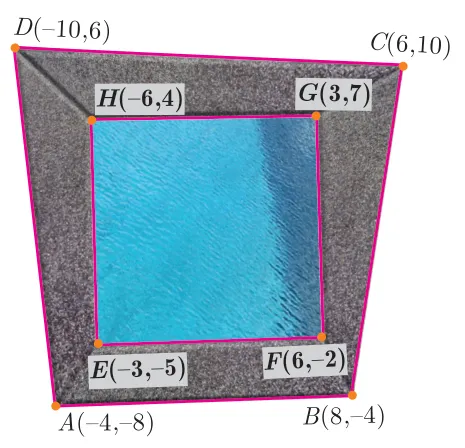
Photograph-style diagram of a quadrilateral swimming pool E(-3,-5), F(6,-2), G(3,7), H(-6,4) shaded blue, surrounded by a concrete patio bounded by the outer quadrilateral A(-4,-8), B(8,-4), C(6,10), D(-10,6).
Show steps (10)
  1. Area of patio == area of ABCDABCD −- area of pool EFGHEFGH.

  2. For A(−4,−8)A(-4,-8), B(8,−4)B(8,-4), C(6,10)C(6,10), D(−10,6)D(-10,6):

  3. First sum =16+80+36+80=212= 16+80+36+80 = 212

  4. Second sum =−64−24−100−24=−212= -64-24-100-24 = -212

  5. Area ABCD=12 ∣212+212∣=212ABCD = \dfrac12\,|212+212| = 212 sq.units

  6. For E(−3,−5)E(-3,-5), F(6,−2)F(6,-2), G(3,7)G(3,7), H(−6,4)H(-6,4):

  7. First sum =6+42+12+30=90= 6+42+12+30 = 90

  8. Second sum =−30−6−42−12=−90= -30-6-42-12 = -90

  9. Area EFGH=12 ∣90+90∣=90EFGH = \dfrac12\,|90+90| = 90 sq.units

  10. Area of patio =212−90= 212-90

Answer

122122 sq.units

Q10. A triangular shaped glass with vertices at A(−5,−4)A(-5, -4) , B(1,6)B(1, 6) and C(7,−4)C(7, -4) …

A triangular shaped glass with vertices at A(−5,−4)A(-5, -4), B(1,6)B(1, 6) and C(7,−4)C(7, -4) has to be painted. If one bucket of paint covers 6 square feet, how many buckets of paint will be required to paint the whole glass, if only one coat of paint is applied.

Show steps (6)
  1. Vertices A(−5,−4)A(-5,-4), B(1,6)B(1,6), C(7,−4)C(7,-4).

  2. x1y2+x2y3+x3y1=−30−4−28=−62x_1y_2+x_2y_3+x_3y_1 = -30-4-28 = -62

  3. x2y1+x3y2+x1y3=−4+42+20=58x_2y_1+x_3y_2+x_1y_3 = -4+42+20 = 58

  4. Area =12 ∣−62−58∣=12(120)=60=\dfrac12\,|-62-58| = \dfrac12(120) = 60 sq.feet

  5. One bucket covers 66 sq.feet.

  6. Number of buckets =606= \dfrac{60}{6}

Answer

1010 buckets

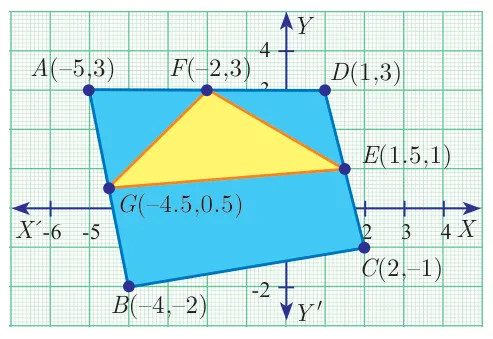
Q11. In the figure, find the area of

(i)

triangle AGFAGF.

Graph on coordinate axes showing quadrilateral ABCD with A(-5,3), B(-4,-2), C(2,-1), D(1,3) shaded blue, with inner points F(-2,3), E(1.5,1) and G(-4.5,0.5) forming a yellow shaded triangular region.
  1. A(−5,3)A(-5,3), G(−4.5,0.5)G(-4.5,0.5), F(−2,3)F(-2,3).

  2. x1y2+x2y3+x3y1=−2.5−13.5−6=−22x_1y_2+x_2y_3+x_3y_1 = -2.5-13.5-6 = -22

  3. x2y1+x3y2+x1y3=−13.5−1−15=−29.5x_2y_1+x_3y_2+x_1y_3 = -13.5-1-15 = -29.5

  4. Area =12 ∣−22+29.5∣=12(7.5)=\dfrac12\,|-22+29.5| = \dfrac12(7.5)

Answer

3.753.75 sq.units

(ii)

triangle FEDFED.

  1. F(−2,3)F(-2,3), E(1.5,1)E(1.5,1), D(1,3)D(1,3).

  2. x1y2+x2y3+x3y1=−2+4.5+3=5.5x_1y_2+x_2y_3+x_3y_1 = -2+4.5+3 = 5.5

  3. x2y1+x3y2+x1y3=4.5+1−6=−0.5x_2y_1+x_3y_2+x_1y_3 = 4.5+1-6 = -0.5

  4. Area =12 ∣5.5+0.5∣=12(6)=\dfrac12\,|5.5+0.5| = \dfrac12(6)

Answer

33 sq.units

(iii)

quadrilateral BCEGBCEG.

  1. B(−4,−2)B(-4,-2), C(2,−1)C(2,-1), E(1.5,1)E(1.5,1), G(−4.5,0.5)G(-4.5,0.5).

  2. First sum =4+2+0.75+9=15.75= 4+2+0.75+9 = 15.75

  3. Second sum =−4−1.5−4.5−2=−12= -4-1.5-4.5-2 = -12

  4. Area =12 ∣15.75+12∣=12(27.75)=\dfrac12\,|15.75+12| = \dfrac12(27.75)

Answer

13.87513.875 sq.units

Quick check

  1. A straight line has equation 8y=4x+218y = 4x + 21. Which of the following is true

    1. (1) The slope is 0.5 and the yy intercept is 2.6
    2. (2) The slope is 5 and the yy intercept is 1.6
    3. (3) The slope is 0.5 and the yy intercept is 1.6
    4. (4) The slope is 5 and the yy intercept is 2.6
    Show answer

    Answer: (1) The slope is 0.5 and the yy intercept is 2.6

    1. 8y=4x+21⇒y=48x+2188y=4x+21\Rightarrow y=\dfrac{4}{8}x+\dfrac{21}{8}.

    2. y=0.5x+2.625y=0.5x+2.625.

    3. Slope =0.5=0.5, yy intercept =2.625≈2.6=2.625\approx 2.6.

    Question 1 of 5
  2. If (5,7)(5,7), (3,p)(3,p) and (6,6)(6,6) are collinear, then the value of pp is

    1. (1) 33
    2. (2) 66
    3. (3) 99
    4. (4) 1212
    Show answer

    Answer: (3) 99

    1. Slope of the line joining (5,7)(5,7) and (6,6)(6,6) is 6−76−5=−1\dfrac{6-7}{6-5}=-1.

    2. For collinearity, slope of (5,7)(5,7) and (3,p)(3,p) is also −1-1.

    3. p−73−5=−1⇒p−7=2\dfrac{p-7}{3-5}=-1\Rightarrow p-7=2

    4. p=9p=9

    Question 2 of 5
  3. If AA is a point on the YY axis whose ordinate is 8 and BB is a point on the XX axis whose abscissae is 5 then the equation of the line ABAB is

    1. (1) 8x+5y=408x + 5y = 40
    2. (2) 8x−5y=408x - 5y = 40
    3. (3) x=8x = 8
    4. (4) y=5y = 5
    Show answer

    Answer: (1) 8x+5y=408x + 5y = 40

    1. AA is on the Y axis with ordinate 88, so A(0,8)A(0,8); BB is on the X axis with abscissa 55, so B(5,0)B(5,0).

    2. Intercept form: x5+y8=1\dfrac{x}{5}+\dfrac{y}{8}=1.

    3. Multiplying by 4040: 8x+5y=408x+5y=40.

    Question 3 of 5
  4. The equation of a line passing through the origin and perpendicular to the line 7x−3y+4=07x - 3y + 4 = 0 is

    1. (1) 7x−3y+4=07x - 3y + 4 = 0
    2. (2) 3x−7y+4=03x - 7y + 4 = 0
    3. (3) 3x+7y=03x + 7y = 0
    4. (4) 7x−3y=07x - 3y = 0
    Show answer

    Answer: (3) 3x+7y=03x + 7y = 0

    1. Slope of 7x−3y+4=07x-3y+4=0 is −7−3=73\dfrac{-7}{-3}=\dfrac{7}{3}.

    2. Slope of the perpendicular line =−37=-\dfrac{3}{7}.

    3. Through the origin: y=−37x⇒3x+7y=0y=-\dfrac{3}{7}x\Rightarrow 3x+7y=0.

    Question 4 of 5
  5. A man walks near a wall, such that the distance between him and the wall is 10 units. Consider the wall to be the YY axis. The path travelled by the man is

    1. (1) x=10x = 10
    2. (2) y=10y = 10
    3. (3) x=0x = 0
    4. (4) y=0y = 0
    Show answer

    Answer: (1) x=10x = 10

    1. The wall is the Y axis, and his distance from it is always 1010 units.

    2. So his xx coordinate is always 1010.

    3. Path is the line x=10x=10.

    Question 5 of 5
Chapter 5 formulas
  • Area of a triangle with vertices (x₁,y₁), (x₂,y₂), (x₃,y₃)

    Area=12{(x1y2+x2y3+x3y1)−(x2y1+x3y2+x1y3)} sq.units\text{Area}=\frac{1}{2}\left\{(x_1y_2+x_2y_3+x_3y_1)-(x_2y_1+x_3y_2+x_1y_3)\right\}\ \text{sq.units}

  • Collinearity condition (area)

    Area of △ABC=0orx1y2+x2y3+x3y1=x2y1+x3y2+x1y3\text{Area of }\triangle ABC=0\quad\text{or}\quad x_1y_2+x_2y_3+x_3y_1=x_2y_1+x_3y_2+x_1y_3

  • Collinearity condition (slope)

    slope of AB=slope of BC=slope of AC\text{slope of }AB=\text{slope of }BC=\text{slope of }AC

  • Area of a quadrilateral with vertices (x₁,y₁), (x₂,y₂), (x₃,y₃), (x₄,y₄)

    Area=12{(x1y2+x2y3+x3y4+x4y1)−(x2y1+x3y2+x4y3+x1y4)} sq.units\text{Area}=\frac{1}{2}\left\{(x_1y_2+x_2y_3+x_3y_4+x_4y_1)-(x_2y_1+x_3y_2+x_4y_3+x_1y_4)\right\}\ \text{sq.units}

  • Slope of a line making angle θ with the positive direction of the X axis

    m=tan⁡θm=\tan\theta

  • Slope of a line joining two distinct points A(x₁,y₁) and B(x₂,y₂)

    m=y2−y1x2−x1m=\frac{y_2-y_1}{x_2-x_1}

  • Slope of the line ax + by + c = 0

    m=−abm=\frac{-a}{b}

  • General form of a straight line

    ax+by+c=0ax+by+c=0

  • Point-slope form

    y−y1=m(x−x1)y-y_1=m(x-x_1)

  • Slope-intercept form

    y=mx+cy=mx+c

  • Two point form

    y−y1y2−y1=x−x1x2−x1\frac{y-y_1}{y_2-y_1}=\frac{x-x_1}{x_2-x_1}

  • Intercept form

    xa+yb=1\frac{x}{a}+\frac{y}{b}=1

  • Line parallel to the Y axis

    x=cx=c

  • Line parallel to the X axis

    y=by=b

  • Condition for two straight lines to be parallel

    m1=m2m_1=m_2

  • Condition for two straight lines to be perpendicular

    m1×m2=−1m_1\times m_2=-1

Answers checked against the Samacheer Kalvi textbook · Updated

Spotted a mistake? Email us at [email protected] and we will fix it.