Samacheer Kalvi 10th Maths Unit Exercise 4 Solutions

10th Maths Unit Exercise 4 solutions (Chapter 4 Geometry) with step-by-step answers for all 13 questions, as per the 2026-27 Samacheer Kalvi textbook.

Answers at a glance4 answers · full steps below
  1. Q2x=125=2.4x = \dfrac{12}{5} = 2.4 cm, y=103=3.33y = \dfrac{10}{3} = 3.33 cm
  2. Q52013≈72.1120\sqrt{13} \approx 72.11 km
  3. Q7The height of the tree is 1010 m.
  4. Q10CF=6CF = 6 units

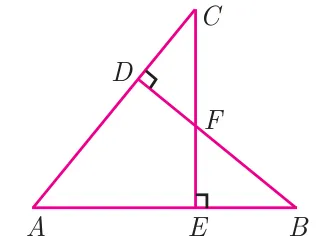
Q1. In the figure, if BD⊥ACBD \perp AC and CE⊥ABCE \perp AB , prove that

In the figure, if BD⊥ACBD \perp AC and CE⊥ABCE \perp AB, prove that

(i)

ΔAEC∼ΔADB\Delta AEC \sim \Delta ADB

Triangle ABC with altitude BD perpendicular to AC and altitude CE perpendicular to AB, meeting at point F inside the triangle.
  1. In ΔAEC\Delta AEC and ΔADB\Delta ADB:

  2. ∠AEC=90∘\angle AEC = 90^\circ (since CE⊥ABCE \perp AB) and ∠ADB=90∘\angle ADB = 90^\circ (since BD⊥ACBD \perp AC).

  3. So ∠AEC=∠ADB\angle AEC = \angle ADB.

  4. ∠EAC=∠DAB\angle EAC = \angle DAB (∠A\angle A is common to both triangles).

  5. By AA similarity, ΔAEC∼ΔADB\Delta AEC \sim \Delta ADB.

Answer

ΔAEC∼ΔADB\Delta AEC \sim \Delta ADB (by AA similarity)

(ii)

CAAB=CEDB\dfrac{CA}{AB} = \dfrac{CE}{DB}

  1. From (i), ΔAEC∼ΔADB\Delta AEC \sim \Delta ADB.

  2. Corresponding sides are proportional:

  3. AEAD=ECDB=ACAB\dfrac{AE}{AD} = \dfrac{EC}{DB} = \dfrac{AC}{AB}.

  4. Taking the last two ratios, ACAB=ECDB\dfrac{AC}{AB} = \dfrac{EC}{DB}.

  5. Hence CAAB=CEDB\dfrac{CA}{AB} = \dfrac{CE}{DB}.

Answer

CAAB=CEDB\dfrac{CA}{AB} = \dfrac{CE}{DB}

Q2. In the given figure AB∥CD∥EFAB \parallel CD \parallel EF . If AB=6AB = 6 cm, CD=xCD = x cm, EF=4EF = 4 …

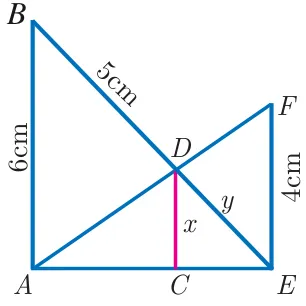
In the given figure AB∥CD∥EFAB \parallel CD \parallel EF. If AB=6AB = 6 cm, CD=xCD = x cm, EF=4EF = 4 cm, BD=5BD = 5 cm and DE=yDE = y cm. Find xx and yy.

Two vertical segments AB of 6 cm and EF of 4 cm on a horizontal base line A–C–E, with lines BE (BD = 5 cm) and AF crossing at D; CD is labelled x and DE is labelled y.
Show steps (8)
  1. In ΔBEF\Delta BEF, CD∥EFCD \parallel EF, so ΔBDC∼ΔBEF\Delta BDC \sim \Delta BEF:

  2. x4=BDBE=55+y\dfrac{x}{4} = \dfrac{BD}{BE} = \dfrac{5}{5+y} ... (1)

  3. In ΔEAB\Delta EAB, CD∥ABCD \parallel AB, so ΔEDC∼ΔEBA\Delta EDC \sim \Delta EBA:

  4. x6=EDEB=y5+y\dfrac{x}{6} = \dfrac{ED}{EB} = \dfrac{y}{5+y} ... (2)

  5. Adding (1) and (2): x4+x6=5+y5+y=1\dfrac{x}{4} + \dfrac{x}{6} = \dfrac{5+y}{5+y} = 1

  6. 5x12=1⇒x=125=2.4\dfrac{5x}{12} = 1 \Rightarrow x = \dfrac{12}{5} = 2.4 cm

  7. Put x=2.4x = 2.4 in (2): 2.46=y5+y\dfrac{2.4}{6} = \dfrac{y}{5+y}

  8. 0.4(5+y)=y⇒2=0.6y⇒y=1030.4(5+y) = y \Rightarrow 2 = 0.6y \Rightarrow y = \dfrac{10}{3} cm

Answer

x=125=2.4x = \dfrac{12}{5} = 2.4 cm, y=103=3.33y = \dfrac{10}{3} = 3.33 cm

Q3. O is any point inside a triangle ABCABC . The bisector of …

O is any point inside a triangle ABCABC. The bisector of ∠AOB\angle AOB, ∠BOC\angle BOC and ∠COA\angle COA meet the sides ABAB, BCBC and CACA in point DD, EE and FF respectively. Show that AD×BE×CF=DB×EC×FAAD \times BE \times CF = DB \times EC \times FA

Show steps (9)
  1. In ΔAOB\Delta AOB, ODOD is the bisector of ∠AOB\angle AOB and DD lies on ABAB.

  2. By the angle bisector theorem, ADDB=OAOB\dfrac{AD}{DB} = \dfrac{OA}{OB} ... (1)

  3. In ΔBOC\Delta BOC, OEOE bisects ∠BOC\angle BOC and EE lies on BCBC:

  4. BEEC=OBOC\dfrac{BE}{EC} = \dfrac{OB}{OC} ... (2)

  5. In ΔCOA\Delta COA, OFOF bisects ∠COA\angle COA and FF lies on CACA:

  6. CFFA=OCOA\dfrac{CF}{FA} = \dfrac{OC}{OA} ... (3)

  7. Multiplying (1), (2) and (3):

  8. ADDB×BEEC×CFFA=OAOB×OBOC×OCOA=1\dfrac{AD}{DB} \times \dfrac{BE}{EC} \times \dfrac{CF}{FA} = \dfrac{OA}{OB} \times \dfrac{OB}{OC} \times \dfrac{OC}{OA} = 1

  9. Therefore AD×BE×CF=DB×EC×FAAD \times BE \times CF = DB \times EC \times FA.

Answer

AD×BE×CF=DB×EC×FAAD \times BE \times CF = DB \times EC \times FA

Q4. In the figure, ABCABC is a triangle in which AB=ACAB = AC . Points …

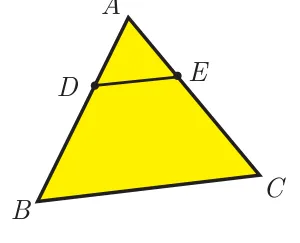
In the figure, ABCABC is a triangle in which AB=ACAB = AC. Points DD and EE are points on the side ABAB and ACAC respectively such that AD=AEAD = AE. Show that the points BB, CC, EE and DD lie on a same circle.

Shaded triangle ABC with apex A at top, points D on AB and E on AC joined by segment DE.
Show steps (9)
  1. AB=ACAB = AC and AD=AEAD = AE.

  2. So DB=AB−AD=AC−AE=ECDB = AB - AD = AC - AE = EC.

  3. Then ADDB=AEEC\dfrac{AD}{DB} = \dfrac{AE}{EC}, so by the converse of the Basic Proportionality Theorem, DE∥BCDE \parallel BC.

  4. Since DE∥BCDE \parallel BC, ∠ADE=∠ABC\angle ADE = \angle ABC (corresponding angles).

  5. So ∠BDE=180∘−∠ADE=180∘−∠ABC\angle BDE = 180^\circ - \angle ADE = 180^\circ - \angle ABC ... (1)

  6. Since AB=ACAB = AC, ∠ABC=∠ACB\angle ABC = \angle ACB, i.e. ∠ABC=∠ECB\angle ABC = \angle ECB ... (2)

  7. From (1) and (2): ∠BDE+∠ECB=180∘\angle BDE + \angle ECB = 180^\circ.

  8. In quadrilateral BDECBDEC the opposite angles ∠BDE\angle BDE and ∠ECB\angle ECB are supplementary.

  9. Hence BDECBDEC is a cyclic quadrilateral, so BB, CC, EE, DD lie on the same circle.

Answer

∠BDE+∠BCE=180∘\angle BDE + \angle BCE = 180^\circ, so BDECBDEC is cyclic — the points BB, CC, EE, DD lie on one circle.

Q5. Two trains leave a railway station at the same time. The first …

Two trains leave a railway station at the same time. The first train travels due west and the second train due north. The first train travels at a speed of 2020 km/hr and the second train travels at 3030 km/hr. After 22 hours, what is the distance between them?

Show steps (6)
  1. Distance of first train in 2 hours (west) =20×2=40= 20 \times 2 = 40 km.

  2. Distance of second train in 2 hours (north) =30×2=60= 30 \times 2 = 60 km.

  3. West and north directions are perpendicular, so the paths form a right angle at the station.

  4. By Pythagoras theorem, distance =402+602= \sqrt{40^2 + 60^2}

  5. =1600+3600=5200= \sqrt{1600 + 3600} = \sqrt{5200}

  6. =2013≈72.11= 20\sqrt{13} \approx 72.11 km

Answer

2013≈72.1120\sqrt{13} \approx 72.11 km

Q6. DD is the mid point of side BCBC and AE⊥BCAE \perp BC . If …

DD is the mid point of side BCBC and AE⊥BCAE \perp BC. If BC=aBC = a, AC=bAC = b, AB=cAB = c, ED=xED = x, AD=pAD = p and AE=hAE = h, prove that

(i)

b2=p2+ax+a24b^2 = p^2 + ax + \dfrac{a^2}{4}

Show steps (6)
  1. DD is the midpoint of BCBC, so BD=DC=a2BD = DC = \dfrac{a}{2}, and EC=ED+DC=x+a2EC = ED + DC = x + \dfrac{a}{2}.

  2. In right triangle AEDAED: p2=h2+x2p^2 = h^2 + x^2, so h2=p2−x2h^2 = p^2 - x^2 ... (1)

  3. In right triangle AECAEC: b2=h2+EC2b^2 = h^2 + EC^2

  4. b2=h2+(x+a2)2b^2 = h^2 + \left(x + \dfrac{a}{2}\right)^2

  5. Using (1): b2=p2−x2+x2+ax+a24b^2 = p^2 - x^2 + x^2 + ax + \dfrac{a^2}{4}

  6. b2=p2+ax+a24b^2 = p^2 + ax + \dfrac{a^2}{4}

Answer

b2=p2+ax+a24b^2 = p^2 + ax + \dfrac{a^2}{4}

(ii)

c2=p2−ax+a24c^2 = p^2 - ax + \dfrac{a^2}{4}

  1. BE=BD−ED=a2−xBE = BD - ED = \dfrac{a}{2} - x.

  2. In right triangle AEBAEB: c2=h2+BE2=h2+(a2−x)2c^2 = h^2 + BE^2 = h^2 + \left(\dfrac{a}{2} - x\right)^2

  3. From ΔAED\Delta AED: h2=p2−x2h^2 = p^2 - x^2

  4. c2=p2−x2+a24−ax+x2c^2 = p^2 - x^2 + \dfrac{a^2}{4} - ax + x^2

  5. c2=p2−ax+a24c^2 = p^2 - ax + \dfrac{a^2}{4}

Answer

c2=p2−ax+a24c^2 = p^2 - ax + \dfrac{a^2}{4}

(iii)

b2+c2=2p2+a22b^2 + c^2 = 2p^2 + \dfrac{a^2}{2}

  1. From (i): b2=p2+ax+a24b^2 = p^2 + ax + \dfrac{a^2}{4}

  2. From (ii): c2=p2−ax+a24c^2 = p^2 - ax + \dfrac{a^2}{4}

  3. Adding, the terms +ax+ax and −ax-ax cancel:

  4. b2+c2=2p2+a24+a24b^2 + c^2 = 2p^2 + \dfrac{a^2}{4} + \dfrac{a^2}{4}

  5. b2+c2=2p2+a22b^2 + c^2 = 2p^2 + \dfrac{a^2}{2}

Answer

b2+c2=2p2+a22b^2 + c^2 = 2p^2 + \dfrac{a^2}{2}

Q7. A man whose eye-level is 22 m above the ground wishes to …

A man whose eye-level is 22 m above the ground wishes to find the height of a tree. He places a mirror horizontally on the ground 2020 m from the tree and finds that if he stands at a point CC which is 44 m from the mirror BB, he can see the reflection of the top of the tree. How height is the tree?

  1. Let the tree be ABAB (height hh), the mirror at BB on the ground and the man CDCD with eye level 22 m.

  2. By the law of reflection, the angle of incidence equals the angle of reflection, so ΔABE∼ΔCBD\Delta ABE \sim \Delta CBD (AA).

  3. height of treedistance of tree from mirror=eye leveldistance of man from mirror\dfrac{\text{height of tree}}{\text{distance of tree from mirror}} = \dfrac{\text{eye level}}{\text{distance of man from mirror}}

  4. h20=24\dfrac{h}{20} = \dfrac{2}{4}

  5. h=20×24=10h = \dfrac{20 \times 2}{4} = 10 m

Answer

The height of the tree is 1010 m.

Q8. An Emu which is 88 feet tall is standing at the foot …

An Emu which is 88 feet tall is standing at the foot of a pillar which is 3030 feet high. It walks away from the pillar. The shadow of the Emu falls beyond Emu. What is the relation between the length of the shadow and the distance from the Emu to the pillar?

Show steps (6)
  1. Let the Emu be at a distance xx ft from the pillar and let its shadow be ss ft long.

  2. The tip of the pillar, the top of the Emu and the tip of the shadow lie on one line, so the two right triangles formed are similar.

  3. height of pillardistance from pillar to shadow tip=height of Emushadow\dfrac{\text{height of pillar}}{\text{distance from pillar to shadow tip}} = \dfrac{\text{height of Emu}}{\text{shadow}}

  4. 30x+s=8s\dfrac{30}{x+s} = \dfrac{8}{s}

  5. 30s=8x+8s⇒22s=8x30s = 8x + 8s \Rightarrow 22s = 8x

  6. s=4x11s = \dfrac{4x}{11}

Answer

Length of shadow =411×= \dfrac{4}{11} \times (distance of the Emu from the pillar); that is, the distance from the pillar is 114\dfrac{11}{4} times the shadow.

Q9. Two circles intersect at AA and BB . From a point PP …

Two circles intersect at AA and BB. From a point PP on one of the circles lines PACPAC and PBDPBD are drawn intersecting the second circle at CC and DD. Prove that CDCD is parallel to the tangent at PP.

Show steps (10)
  1. Let TPT′TPT' be the tangent at PP to the first circle; AA, BB lie on both circles.

  2. In the first circle, by the tangent–chord angle (alternate segment) theorem with chord PAPA:

  3. ∠TPA=∠ABP\angle TPA = \angle ABP ... (1)

  4. AA, BB, DD, CC lie on the second circle, so ABDCABDC is a cyclic quadrilateral:

  5. ∠ABD+∠ACD=180∘\angle ABD + \angle ACD = 180^\circ ... (2)

  6. PP, BB, DD are collinear, so ∠ABP+∠ABD=180∘\angle ABP + \angle ABD = 180^\circ ... (3)

  7. From (2) and (3): ∠ABP=∠ACD\angle ABP = \angle ACD.

  8. Using (1): ∠TPA=∠ACD=∠PCD\angle TPA = \angle ACD = \angle PCD.

  9. These are alternate angles for the lines TPT′TPT' and CDCD with transversal PCPC.

  10. Hence CD∥CD \parallel tangent at PP.

Answer

∠TPA=∠PCD\angle TPA = \angle PCD (alternate angles), hence CDCD is parallel to the tangent at PP.

Q10. Let ABCABC be a triangle and D,E,F are points on the respective …

Let ABCABC be a triangle and D,E,F are points on the respective sides ABAB, BCBC, ACAC (or their extensions). Let AD:DB=5:3AD : DB = 5 : 3, BE:EC=3:2BE : EC = 3 : 2 and AC=21AC = 21. Find the length of the line segment CFCF.

Show steps (7)
  1. The points DD, EE, FF on the sides (or extensions) of ΔABC\Delta ABC are collinear, so Menelaus' theorem applies.

  2. Menelaus' theorem: ADDB×BEEC×CFFA=1\dfrac{AD}{DB}\times\dfrac{BE}{EC}\times\dfrac{CF}{FA}=1.

  3. Substitute the given ratios: 53×32×CFFA=1\dfrac{5}{3}\times\dfrac{3}{2}\times\dfrac{CF}{FA}=1.

  4. 52×CFFA=1⇒CFFA=25\dfrac{5}{2}\times\dfrac{CF}{FA}=1 \Rightarrow \dfrac{CF}{FA}=\dfrac{2}{5}.

  5. Here FF is a point on the side ACAC, so AF+FC=ACAF+FC=AC.

  6. Let CF=2kCF=2k and FA=5kFA=5k; then 2k+5k=212k+5k=21, i.e. 7k=217k=21, so k=3k=3.

  7. Therefore CF=2k=2×3=6CF=2k=2\times 3=6 units.

Answer

CF=6CF = 6 units

Quick check

  1. The perimeters of two similar triangles ΔABC\Delta ABC and ΔPQR\Delta PQR are 3636 cm and 2424 cm respectively. If PQ=10PQ = 10 cm, then the length of ABAB is

    1. (1) 6236\dfrac{2}{3} cm
    2. (2) 1063\dfrac{10\sqrt{6}}{3} cm
    3. (3) 662366\dfrac{2}{3} cm
    4. (4) 1515 cm
    Show answer

    Answer: (4) 1515 cm

    1. In similar triangles, ratio of perimeters = ratio of corresponding sides.

    2. ABPQ=3624\dfrac{AB}{PQ}=\dfrac{36}{24}

    3. AB=10×3624=15AB=10\times\dfrac{36}{24}=15 cm.

    Question 1 of 5
  2. The two tangents from an external points PP to a circle with centre at OO are PAPA and PBPB. If ∠APB=70∘\angle APB = 70^\circ then the value of ∠AOB\angle AOB is

    1. (1) 100∘100^\circ
    2. (2) 110∘110^\circ
    3. (3) 120∘120^\circ
    4. (4) 130∘130^\circ
    Show answer

    Answer: (2) 110∘110^\circ

    1. OA⊥PAOA\perp PA and OB⊥PBOB\perp PB, so ∠OAP=∠OBP=90∘\angle OAP=\angle OBP=90^\circ.

    2. In quadrilateral OAPBOAPB, ∠AOB+∠APB+90∘+90∘=360∘\angle AOB+\angle APB+90^\circ+90^\circ=360^\circ.

    3. ∠AOB=360∘−180∘−70∘=110∘\angle AOB=360^\circ-180^\circ-70^\circ=110^\circ.

    Question 2 of 5
  3. In the adjacent figure ∠BAC=90∘\angle BAC = 90^\circ and AD⊥BCAD \perp BC then

    1. (1) BD⋅CD=BC2BD \cdot CD = BC^2
    2. (2) AB.AC=BC2AB.AC = BC^2
    3. (3) BD⋅CD=AD2BD \cdot CD = AD^2
    4. (4) AB⋅AC=AD2AB \cdot AC = AD^2
    Show answer

    Answer: (3) BD⋅CD=AD2BD \cdot CD = AD^2

    1. ∠BAC=90∘\angle BAC=90^\circ and AD⊥BCAD\perp BC, so ADAD is the altitude to the hypotenuse.

    2. Then ΔABD∼ΔCAD\Delta ABD \sim \Delta CAD.

    3. BDAD=ADCD\dfrac{BD}{AD}=\dfrac{AD}{CD}

    4. BD⋅CD=AD2BD\cdot CD = AD^2.

    Question 3 of 5
  4. If ΔABC\Delta ABC is an isosceles triangle with ∠C=90∘\angle C = 90^\circ and AC=5AC = 5 cm, then ABAB is

    1. (1) 2.52.5 cm
    2. (2) 55 cm
    3. (3) 1010 cm
    4. (4) 525\sqrt{2} cm
    Show answer

    Answer: (4) 525\sqrt{2} cm

    1. ∠C=90∘\angle C=90^\circ, so ABAB is the hypotenuse and the equal sides are AC=BC=5AC=BC=5 cm.

    2. AB2=AC2+BC2=52+52=50AB^2=AC^2+BC^2=5^2+5^2=50

    3. AB=50=52AB=\sqrt{50}=5\sqrt{2} cm.

    Question 4 of 5
  5. A tangent is perpendicular to the radius at the

    1. (1) centre
    2. (2) point of contact
    3. (3) infinity
    4. (4) chord
    Show answer

    Answer: (2) point of contact

    1. The radius drawn to the point where the tangent touches the circle is perpendicular to the tangent.

    2. So it is perpendicular at the point of contact.

    Question 5 of 5
Chapter 4 formulas
  • Similar triangles — equal corresponding angles

    △ABC∼△PQR⇒∠A=∠P, ∠B=∠Q, ∠C=∠R\triangle ABC \sim \triangle PQR \Rightarrow \angle A = \angle P,\ \angle B = \angle Q,\ \angle C = \angle R

  • Similar triangles — proportional corresponding sides

    △ABC∼△PQR⇒ABPQ=BCQR=CARP\triangle ABC \sim \triangle PQR \Rightarrow \dfrac{AB}{PQ} = \dfrac{BC}{QR} = \dfrac{CA}{RP}

  • AA (same as AAA) similarity criterion

    ∠A=∠P, ∠B=∠Q⇒△ABC∼△PQR\angle A = \angle P,\ \angle B = \angle Q \Rightarrow \triangle ABC \sim \triangle PQR

  • SAS similarity criterion

    ∠A=∠P and ABPQ=ACPR⇒△ABC∼△PQR\angle A = \angle P \text{ and } \dfrac{AB}{PQ} = \dfrac{AC}{PR} \Rightarrow \triangle ABC \sim \triangle PQR

  • SSS similarity criterion

    ABPQ=BCQR=CARP⇒△ABC∼△PQR\dfrac{AB}{PQ} = \dfrac{BC}{QR} = \dfrac{CA}{RP} \Rightarrow \triangle ABC \sim \triangle PQR

  • Ratio of perimeters of similar triangles

    Perimeter of △ABCPerimeter of △PQR=ABPQ=BCQR=CARP\dfrac{\text{Perimeter of } \triangle ABC}{\text{Perimeter of } \triangle PQR} = \dfrac{AB}{PQ} = \dfrac{BC}{QR} = \dfrac{CA}{RP}

  • Ratio of areas of similar triangles

    Area of △ABCArea of △PQR=AB2PQ2=BC2QR2=CA2RP2\dfrac{\text{Area of } \triangle ABC}{\text{Area of } \triangle PQR} = \dfrac{AB^2}{PQ^2} = \dfrac{BC^2}{QR^2} = \dfrac{CA^2}{RP^2}

  • Tangent perpendicular to radius at the point of contact

    OP⊥PT, i.e. ∠OPT=90∘OP \perp PT,\ \text{i.e. } \angle OPT = 90^\circ

  • Number of tangents from an exterior point

    From an exterior point P, exactly 2 tangents can be drawn to a circle\text{From an exterior point } P,\ \text{exactly } 2 \text{ tangents can be drawn to a circle}

  • Lengths of tangents from an exterior point are equal

    PA=PBPA = PB

  • Direct common tangents to two circles

    AB=CD(the two direct common tangents are equal in length)AB = CD \quad (\text{the two direct common tangents are equal in length})

  • Median relation (Apollonius type) — part (i)

    b2=p2+ax+a24b^{2} = p^{2} + ax + \dfrac{a^{2}}{4}

  • Median relation (Apollonius type) — part (ii)

    c2=p2−ax+a24c^{2} = p^{2} - ax + \dfrac{a^{2}}{4}

  • Median relation (Apollonius type) — part (iii)

    b2+c2=2p2+a22b^{2} + c^{2} = 2p^{2} + \dfrac{a^{2}}{2}

Answers checked against the Samacheer Kalvi textbook · Updated

Spotted a mistake? Email us at [email protected] and we will fix it.