Samacheer Kalvi 10th Maths Exercise 6.2 Solutions

10th Maths Exercise 6.2 solutions (Chapter 6 Trigonometry) with step-by-step answers for all 7 questions, as per the 2026-27 Samacheer Kalvi textbook.

Answers at a glance7 answers · full steps below
  1. Q1The angle of elevation is 30∘30^\circ
  2. Q2Width of the road =24=24 m
  3. Q3Height of the window =3.66=3.66 m
  4. Q4Height of the pedestal =1.5=1.5 m
  5. Q5 (i)Height of the pole =7=7 m
  6. Q5 (ii)Radius of the dome =16.39=16.39 m
  7. Q6Height of the electric pole =10=10 m

Q1. Find the angle of elevation of the top of a tower from …

Find the angle of elevation of the top of a tower from a point on the ground, which is 30 m away from the foot of a tower of height 10310\sqrt{3} m.

  1. Let θ\theta be the angle of elevation, tower PQ=103PQ=10\sqrt3 m, QR=30QR=30 m.

  2. In the right angled ΔPQR\Delta PQR, tan⁡θ=PQQR\tan\theta=\dfrac{PQ}{QR}

  3. tan⁡θ=10330=13\tan\theta=\dfrac{10\sqrt3}{30}=\dfrac{1}{\sqrt3}

  4. tan⁡θ=tan⁡30∘\tan\theta=\tan 30^\circ, so θ=30∘\theta=30^\circ.

Answer

The angle of elevation is 30∘30^\circ

Q2. A road is flanked on either side by continuous rows of houses …

A road is flanked on either side by continuous rows of houses of height 434\sqrt{3} m with no space in between them. A pedestrian is standing on the median of the road facing a row house. The angle of elevation from the pedestrian to the top of the house is 30°30°. Find the width of the road.

Show steps (7)
  1. Let AB=43AB=4\sqrt3 m be the height of the house and BB the foot of the house.

  2. Let CC be the position of the pedestrian on the median, ∠ACB=30∘\angle ACB=30^\circ.

  3. In the right angled ΔABC\Delta ABC, tan⁡30∘=ABBC\tan 30^\circ=\dfrac{AB}{BC}

  4. 13=43BC\dfrac{1}{\sqrt3}=\dfrac{4\sqrt3}{BC}

  5. BC=43×3=12BC=4\sqrt3\times\sqrt3=12 m

  6. BCBC is half the width of the road (pedestrian stands on the median).

  7. Width of the road =2×12=24=2\times12=24 m.

Answer

Width of the road =24=24 m

Q3. To a man standing outside his house, the angles of elevation of …

To a man standing outside his house, the angles of elevation of the top and bottom of a window are 60°60° and 45°45° respectively. If the height of the man is 180 cm and if he is 5 m away from the wall, what is the height of the window? (3=1.732)(\sqrt{3} = 1.732)

Show steps (7)
  1. Height of the man =180=180 cm =1.8=1.8 m, so his eye level is 1.81.8 m above the ground.

  2. Horizontal distance from the wall =5=5 m.

  3. Let the bottom of the window be h1h_1 m above eye level and the top be h2h_2 m above eye level.

  4. For the bottom: tan⁡45∘=h15⇒h1=5\tan 45^\circ=\dfrac{h_1}{5}\Rightarrow h_1=5 m

  5. For the top: tan⁡60∘=h25⇒h2=53\tan 60^\circ=\dfrac{h_2}{5}\Rightarrow h_2=5\sqrt3 m

  6. Height of the window =h2−h1=53−5=5(1.732)−5=h_2-h_1=5\sqrt3-5=5(1.732)-5

  7. =8.66−5=3.66=8.66-5=3.66 m

Answer

Height of the window =3.66=3.66 m

Q4. A statue 1.6 m tall stands on the top of a pedestal. …

A statue 1.6 m tall stands on the top of a pedestal. From a point on the ground, the angle of elevation of the top of the statue is 60°60° and from the same point the angle of elevation of the top of the pedestal is 40°40°. Find the height of the pedestal. (tan⁡40°=0.8391, 3=1.732)(\tan 40° = 0.8391,\ \sqrt{3} = 1.732)

Show steps (8)
  1. Let AB=hAB=h m be the height of the pedestal and BC=1.6BC=1.6 m the statue on it.

  2. Let PP be the point on the ground, BPBP (wait) let the distance from PP to the foot AA be dd m.

  3. In the right angled triangle with ∠APB=40∘\angle APB=40^\circ: tan⁡40∘=hd⇒d=h0.8391\tan 40^\circ=\dfrac{h}{d}\Rightarrow d=\dfrac{h}{0.8391} …(1)

  4. With ∠APC=60∘\angle APC=60^\circ: tan⁡60∘=h+1.6d⇒3=h+1.6d\tan 60^\circ=\dfrac{h+1.6}{d}\Rightarrow \sqrt3=\dfrac{h+1.6}{d} …(2)

  5. Substituting (1) in (2): 1.732=(h+1.6)(0.8391)h1.732=\dfrac{(h+1.6)(0.8391)}{h}

  6. 1.732h=0.8391h+1.342561.732h=0.8391h+1.34256

  7. 0.8929h=1.342560.8929h=1.34256

  8. h=1.342560.8929=1.5h=\dfrac{1.34256}{0.8929}=1.5 (approximately)

Answer

Height of the pedestal =1.5=1.5 m

Q5. A flag pole of height 'hh' metres is on the top of …

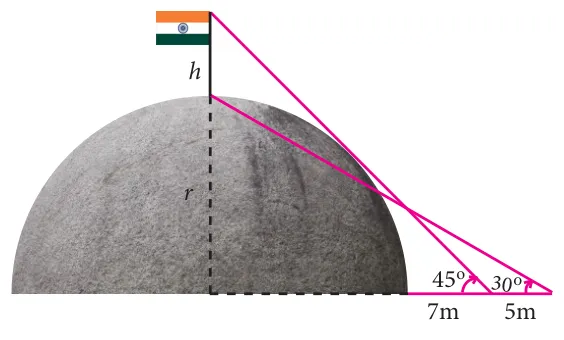
A flag pole of height 'hh' metres is on the top of the hemispherical dome of radius 'rr' metres. A man is standing 7 m away from the dome. Seeing the top of the pole at an angle 45°45° and moving 5 m away from the dome and seeing the bottom of the pole at an angle 30°30°. Find

(i)

the height of the pole. (3=1.732)(\sqrt{3} = 1.732)

Diagram of a hemispherical dome of radius r on the ground with a flag pole of height h on top; from points 7 m and a further 5 m away on the ground, angles of 45° to the pole's top and 30° to its bottom are marked.
Show steps (6)
  1. Let OO be the centre of the dome, radius =r=r m, pole height =h=h m.

  2. The top of the pole is at height r+hr+h above the ground.

  3. The first point is 77 m from the dome, so its distance from OO is r+7r+7.

  4. In that right angled triangle, tan⁡45∘=r+hr+7\tan 45^\circ=\dfrac{r+h}{r+7}

  5. 1=r+hr+7⇒r+h=r+71=\dfrac{r+h}{r+7}\Rightarrow r+h=r+7

  6. h=7h=7

Answer

Height of the pole =7=7 m

(ii)

radius of the dome. (3=1.732)(\sqrt{3} = 1.732)

Show steps (6)
  1. The bottom of the pole is at height rr (top of the dome).

  2. The second point is 7+5=127+5=12 m from the dome, so its distance from OO is r+12r+12.

  3. tan⁡30∘=rr+12\tan 30^\circ=\dfrac{r}{r+12}

  4. 13=rr+12⇒r+12=3 r\dfrac{1}{\sqrt3}=\dfrac{r}{r+12}\Rightarrow r+12=\sqrt3\,r

  5. r(3−1)=12r(\sqrt3-1)=12

  6. r=121.732−1=120.732=16.39r=\dfrac{12}{1.732-1}=\dfrac{12}{0.732}=16.39

Answer

Radius of the dome =16.39=16.39 m

Q6. The top of a 1515 m high tower makes an angle of …

The top of a 1515 m high tower makes an angle of elevation of 60°60° with the bottom of an electronic pole and angle of elevation of 30°30° with the top of the pole. What is the height of the electric pole?

Show steps (7)
  1. Let AB=15AB=15 m be the tower and CD=hCD=h m the electric pole, with BDBD the distance between them.

  2. From the bottom DD of the pole, ∠ADB=60∘\angle ADB=60^\circ: tan⁡60∘=15BD\tan 60^\circ=\dfrac{15}{BD}

  3. BD=153=53BD=\dfrac{15}{\sqrt3}=5\sqrt3 m

  4. From the top CC of the pole, the horizontal line meets the tower at EE, so AE=15−hAE=15-h and CE=BD=53CE=BD=5\sqrt3.

  5. tan⁡30∘=15−h53\tan 30^\circ=\dfrac{15-h}{5\sqrt3}

  6. 13=15−h53⇒15−h=5\dfrac{1}{\sqrt3}=\dfrac{15-h}{5\sqrt3}\Rightarrow 15-h=5

  7. h=10h=10

Answer

Height of the electric pole =10=10 m

Quick check

  1. A tower is 60 m heigh. Its shadow reduces by xx metres when the angle of elevation of the sun increases from 30∘30^\circ to 45∘45^\circ then xx is equal to

    1. (1) 41.92 m
    2. (2) 43.92 m
    3. (3) 43 m
    4. (4) 45.6 m
    Show answer

    Answer: (2) 43.92 m

    1. Shadow at 30∘30^\circ: 60tan⁡30∘=603\dfrac{60}{\tan 30^\circ}=60\sqrt3 m.

    2. Shadow at 45∘45^\circ: 60tan⁡45∘=60\dfrac{60}{\tan 45^\circ}=60 m.

    3. x=603−60=60(1.732−1)=43.92x=60\sqrt3-60=60(1.732-1)=43.92 m.

    Question 1 of 5
  2. If sin⁡θ+cos⁡θ=a\sin\theta + \cos\theta = a and sec⁡θ+cosec θ=b\sec\theta + \mathrm{cosec}\,\theta = b, then the value of b(a2−1)b(a^2-1) is equal to

    1. (1) 2a2a
    2. (2) 3a3a
    3. (3) 00
    4. (4) 2ab2ab
    Show answer

    Answer: (1) 2a2a

    1. a2−1=(sin⁡θ+cos⁡θ)2−1=2sin⁡θcos⁡θa^2-1=(\sin\theta+\cos\theta)^2-1=2\sin\theta\cos\theta.

    2. b=sec⁡θ+cosec θ=sin⁡θ+cos⁡θsin⁡θcos⁡θ=asin⁡θcos⁡θb=\sec\theta+\mathrm{cosec}\,\theta=\dfrac{\sin\theta+\cos\theta}{\sin\theta\cos\theta}=\dfrac{a}{\sin\theta\cos\theta}.

    3. b(a2−1)=asin⁡θcos⁡θ×2sin⁡θcos⁡θ=2ab(a^2-1)=\dfrac{a}{\sin\theta\cos\theta}\times 2\sin\theta\cos\theta=2a.

    Question 2 of 5
  3. acot⁡θ+b cosec θ=pa\cot\theta + b\,\mathrm{cosec}\,\theta = p and bcot⁡θ+a cosec θ=qb\cot\theta + a\,\mathrm{cosec}\,\theta = q then p2−q2p^2 - q^2 is equal to

    1. (1) a2−b2a^2 - b^2
    2. (2) b2−a2b^2 - a^2
    3. (3) a2+b2a^2 + b^2
    4. (4) b−ab - a
    Show answer

    Answer: (2) b2−a2b^2 - a^2

    1. p2−q2=(acot⁡θ+b cosec θ)2−(bcot⁡θ+a cosec θ)2p^2-q^2=(a\cot\theta+b\,\mathrm{cosec}\,\theta)^2-(b\cot\theta+a\,\mathrm{cosec}\,\theta)^2.

    2. =(a2−b2)cot⁡2θ−(a2−b2)cosec2θ=(a^2-b^2)\cot^2\theta-(a^2-b^2)\mathrm{cosec}^2\theta (the 2ab2ab terms cancel).

    3. =(a2−b2)(cot⁡2θ−cosec2θ)=(a2−b2)(−1)=b2−a2=(a^2-b^2)(\cot^2\theta-\mathrm{cosec}^2\theta)=(a^2-b^2)(-1)=b^2-a^2.

    Question 3 of 5
  4. If the ratio of the height of a tower and the length of its shadow is 3:1\sqrt{3}:1, then the angle of elevation of the sun has measure

    1. (1) 45∘45^\circ
    2. (2) 30∘30^\circ
    3. (3) 90∘90^\circ
    4. (4) 60∘60^\circ
    Show answer

    Answer: (4) 60∘60^\circ

    1. tan⁡θ=heightshadow=31=3\tan\theta=\dfrac{\text{height}}{\text{shadow}}=\dfrac{\sqrt3}{1}=\sqrt3.

    2. θ=60∘\theta=60^\circ.

    Question 4 of 5
  5. tan⁡θ cosec2θ−tan⁡θ\tan\theta\,\mathrm{cosec}^2\theta - \tan\theta is equal to

    1. (1) sec⁡θ\sec\theta
    2. (2) cot⁡2θ\cot^2\theta
    3. (3) sin⁡θ\sin\theta
    4. (4) cot⁡θ\cot\theta
    Show answer

    Answer: (4) cot⁡θ\cot\theta

    1. tan⁡θ cosec2θ−tan⁡θ=tan⁡θ(cosec2θ−1)\tan\theta\,\mathrm{cosec}^2\theta-\tan\theta=\tan\theta(\mathrm{cosec}^2\theta-1).

    2. cosec2θ−1=cot⁡2θ\mathrm{cosec}^2\theta-1=\cot^2\theta.

    3. =tan⁡θ⋅cot⁡2θ=cot⁡θ=\tan\theta\cdot\cot^2\theta=\cot\theta.

    Question 5 of 5
Chapter 6 formulas
  • Pythagorean identity

    sin⁡2θ+cos⁡2θ=1\sin^2\theta + \cos^2\theta = 1

  • Identity with tangent and secant

    1+tan⁡2θ=sec⁡2θ1 + \tan^2\theta = \sec^2\theta

  • Identity with cotangent and cosecant

    1+cot⁡2θ=cosec⁡2θ1 + \cot^2\theta = \operatorname{cosec}^2\theta

  • Trigonometric identity (definition)

    An equation in trigonometric ratios that is true for all values of the angle\text{An equation in trigonometric ratios that is true for all values of the angle}

  • Line of sight

    The line drawn from the eye of an observer to the point on the object being viewed\text{The line drawn from the eye of an observer to the point on the object being viewed}

  • Angle of elevation

    Angle between the line of sight and the horizontal, when the object is above the horizontal level\text{Angle between the line of sight and the horizontal, when the object is above the horizontal level}

  • Angle of depression

    Angle between the line of sight and the horizontal, when the object is below the horizontal level\text{Angle between the line of sight and the horizontal, when the object is below the horizontal level}

  • Use of trigonometric ratios

    Height or length of an object, or distance between two far objects, can be found using trigonometric ratios\text{Height or length of an object, or distance between two far objects, can be found using trigonometric ratios}

Answers checked against the Samacheer Kalvi textbook · Updated

Spotted a mistake? Email us at [email protected] and we will fix it.