Samacheer Kalvi 10th Maths Exercise 6.4 Solutions

10th Maths Exercise 6.4 solutions (Chapter 6 Trigonometry) with step-by-step answers for all 9 questions, as per the 2026-27 Samacheer Kalvi textbook.

Answers at a glance8 answers · full steps below
  1. Q1Height of the second tree =35.516= 35.516 m
  2. Q2Distance of the hill from the ship =69.28= 69.28 m; height of the hill =160= 160 m
  3. Q4Height of the cell phone tower =150= 150 m; since 150150 m >120> 120 m, it meets the radiation norms.
  4. Q5 (i)Height of the lamp post =264= 264 m
  5. Q5 (ii)Difference in heights =198= 198 m
  6. Q5 (iii)Distance between the lamp post and the apartment =114.312= 114.312 m
  7. Q6 (i)Vertical height between AA and B=2.912B = 2.912 km
  8. Q6 (ii)Vertical height between BB and C=6.928C = 6.928 km

Q1. From the top of a tree of height 1313 m the angle …

From the top of a tree of height 1313 m the angle of elevation and depression of the top and bottom of another tree are 45∘45^\circ and 30∘30^\circ respectively. Find the height of the second tree. (3=1.732)(\sqrt{3} = 1.732)

Show steps (9)
  1. Let ABAB be the first tree of height 1313 m and CDCD the second tree.

  2. From the top AA, the angle of depression of the foot DD is 30∘30^\circ and the angle of elevation of the top CC is 45∘45^\circ.

  3. Let the distance between the trees be dd and let CE=xCE = x, where EE is the point on CDCD at the level of AA.

  4. In the right triangle with the 30∘30^\circ angle, tan⁡30∘=13d\tan 30^\circ = \dfrac{13}{d}

  5. 13=13d⇒d=133\dfrac{1}{\sqrt{3}} = \dfrac{13}{d} \Rightarrow d = 13\sqrt{3} m

  6. In the right triangle with the 45∘45^\circ angle, tan⁡45∘=xd\tan 45^\circ = \dfrac{x}{d}

  7. 1=x133⇒x=1331 = \dfrac{x}{13\sqrt{3}} \Rightarrow x = 13\sqrt{3} m

  8. Height of second tree =13+133=13(1+3)= 13 + 13\sqrt{3} = 13(1+\sqrt{3})

  9. =13(1+1.732)=13×2.732=35.516= 13(1+1.732) = 13 \times 2.732 = 35.516 m

Answer

Height of the second tree =35.516= 35.516 m

Q2. A man is standing on the deck of a ship, which is …

A man is standing on the deck of a ship, which is 40 m above water level. He observes the angle of elevation of the top of a hill as 60∘60^\circ and the angle of depression of the base of the hill as 30∘30^\circ. Calculate the distance of the hill from the ship and the height of the hill. (3=1.732)(\sqrt{3} = 1.732)

Show steps (8)
  1. Let AA be the man's position on the deck, 4040 m above the water level BB.

  2. Let CDCD be the hill, DD its base, and let BD=dBD = d be the horizontal distance.

  3. Angle of depression of the base DD is 30∘30^\circ, so tan⁡30∘=40d\tan 30^\circ = \dfrac{40}{d}

  4. 13=40d⇒d=403=40×1.732=69.28\dfrac{1}{\sqrt{3}} = \dfrac{40}{d} \Rightarrow d = 40\sqrt{3} = 40 \times 1.732 = 69.28 m

  5. Let xx be the height of the hill above the level of the deck.

  6. tan⁡60∘=xd⇒3=x403\tan 60^\circ = \dfrac{x}{d} \Rightarrow \sqrt{3} = \dfrac{x}{40\sqrt{3}}

  7. x=403×3=120x = 40\sqrt{3} \times \sqrt{3} = 120 m

  8. Height of the hill =120+40=160= 120 + 40 = 160 m

Answer

Distance of the hill from the ship =69.28= 69.28 m; height of the hill =160= 160 m

Q3. If the angle of elevation of a cloud from a point 'hh' …

If the angle of elevation of a cloud from a point 'hh' metres above a lake is θ1\theta_1 and the angle of depression of its reflection in the lake is θ2\theta_2. Prove that the height that the cloud is located from the ground is h(tan⁡θ1+tan⁡θ2)tan⁡θ2−tan⁡θ1\dfrac{h(\tan\theta_1 + \tan\theta_2)}{\tan\theta_2 - \tan\theta_1}.

Show steps (10)
  1. Let PP be the point hh m above the lake and let the cloud CC be at height HH m above the lake.

  2. The reflection C′C' of the cloud lies HH m below the lake surface.

  3. Let the horizontal distance from PP to the vertical line through the cloud be xx.

  4. Height of the cloud above the level of PP is H−hH - h, so tan⁡θ1=H−hx\tan\theta_1 = \dfrac{H-h}{x} ...(1)

  5. Depth of the reflection below the level of PP is H+hH + h, so tan⁡θ2=H+hx\tan\theta_2 = \dfrac{H+h}{x} ...(2)

  6. From (1), x=H−htan⁡θ1x = \dfrac{H-h}{\tan\theta_1} and from (2), x=H+htan⁡θ2x = \dfrac{H+h}{\tan\theta_2}

  7. Hence (H−h)tan⁡θ2=(H+h)tan⁡θ1(H-h)\tan\theta_2 = (H+h)\tan\theta_1

  8. Htan⁡θ2−htan⁡θ2=Htan⁡θ1+htan⁡θ1H\tan\theta_2 - h\tan\theta_2 = H\tan\theta_1 + h\tan\theta_1

  9. H(tan⁡θ2−tan⁡θ1)=h(tan⁡θ1+tan⁡θ2)H(\tan\theta_2 - \tan\theta_1) = h(\tan\theta_1 + \tan\theta_2)

  10. H=h(tan⁡θ1+tan⁡θ2)tan⁡θ2−tan⁡θ1H = \dfrac{h(\tan\theta_1 + \tan\theta_2)}{\tan\theta_2 - \tan\theta_1}

Answer

The cloud is at a height h(tan⁡θ1+tan⁡θ2)tan⁡θ2−tan⁡θ1\dfrac{h(\tan\theta_1 + \tan\theta_2)}{\tan\theta_2 - \tan\theta_1} metres above the ground. Hence proved.

Q4. The angle of elevation of the top of a cell phone tower …

The angle of elevation of the top of a cell phone tower from the foot of a high apartment is 60∘60^\circ and the angle of depression of the foot of the tower from the top of the apartment is 30∘30^\circ. If the height of the apartment is 5050 m, find the height of the cell phone tower. According to radiations control norms, the minimum height of a cell phone tower should be 120120 m. State if the height of the above mentioned cell phone tower meets the radiation norms.

Show steps (8)
  1. Let ABAB be the apartment of height 5050 m and CDCD the cell phone tower, with BD=dBD = d the distance between them.

  2. From the top AA of the apartment, the angle of depression of the foot DD of the tower is 30∘30^\circ.

  3. tan⁡30∘=50d⇒13=50d\tan 30^\circ = \dfrac{50}{d} \Rightarrow \dfrac{1}{\sqrt{3}} = \dfrac{50}{d}

  4. d=503d = 50\sqrt{3} m

  5. From the foot BB of the apartment, the angle of elevation of the top CC of the tower is 60∘60^\circ.

  6. tan⁡60∘=CDd⇒3=CD503\tan 60^\circ = \dfrac{CD}{d} \Rightarrow \sqrt{3} = \dfrac{CD}{50\sqrt{3}}

  7. CD=503×3=150CD = 50\sqrt{3} \times \sqrt{3} = 150 m

  8. Since 150>120150 > 120, the tower satisfies the radiation norms.

Answer

Height of the cell phone tower =150= 150 m; since 150150 m >120> 120 m, it meets the radiation norms.

Q5. The angles of elevation and depression of the top and bottom of …

The angles of elevation and depression of the top and bottom of a lamp post from the top of a 66 m high apartment are 60∘60^\circ and 30∘30^\circ respectively. Find

(i)

The height of the lamp post. (3=1.732)(\sqrt{3} = 1.732)

Show steps (7)
  1. Let ABAB be the apartment of height 6666 m and CDCD the lamp post, with distance BD=dBD = d.

  2. From the top AA, the angle of depression of the foot DD is 30∘30^\circ.

  3. tan⁡30∘=66d⇒d=663\tan 30^\circ = \dfrac{66}{d} \Rightarrow d = 66\sqrt{3} m

  4. Let xx be the part of the lamp post above the level of AA.

  5. tan⁡60∘=xd⇒3=x663\tan 60^\circ = \dfrac{x}{d} \Rightarrow \sqrt{3} = \dfrac{x}{66\sqrt{3}}

  6. x=663×3=198x = 66\sqrt{3} \times \sqrt{3} = 198 m

  7. Height of the lamp post =198+66=264= 198 + 66 = 264 m

Answer

Height of the lamp post =264= 264 m

(ii)

The difference between height of the lamp post and the apartment. (3=1.732)(\sqrt{3} = 1.732)

  1. Height of the lamp post =264= 264 m and height of the apartment =66= 66 m.

  2. Difference =264−66=198= 264 - 66 = 198 m

Answer

Difference in heights =198= 198 m

(iii)

The distance between the lamp post and the apartment. (3=1.732)(\sqrt{3} = 1.732)

  1. The distance between them is d=663d = 66\sqrt{3} m.

  2. d=66×1.732=114.312d = 66 \times 1.732 = 114.312 m

Answer

Distance between the lamp post and the apartment =114.312= 114.312 m

Q6. Three villagers AA , BB and CC can see each other using …

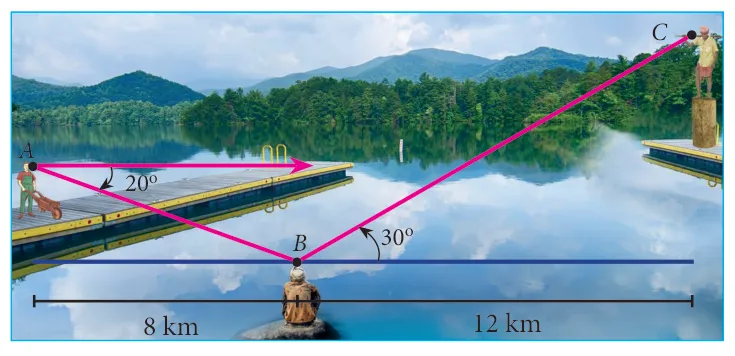
Three villagers AA, BB and CC can see each other using telescope across a valley. The horizontal distance between AA and BB is 8 km and the horizontal distance between BB and CC is 12 km. The angle of depression of B from AA is 20∘20^\circ and the angle of elevation of CC from BB is 30∘30^\circ. Calculate :

(i)

the vertical height between AA and BB. (tan⁡20∘=0.3640, 3=1.732)(\tan 20^\circ = 0.3640,\ \sqrt{3} = 1.732)

A photograph of a valley with a lake and hills marking villager A on the left, B at the bottom middle and C on the upper right, with a 20° angle of depression from A to B, a 30° angle of elevation from B to C, and horizontal distances of 8 km and 12 km marked along the base line.
  1. Let h1h_1 be the vertical height between AA and BB, with horizontal distance 88 km.

  2. The angle of depression of BB from AA is 20∘20^\circ.

  3. tan⁡20∘=h18\tan 20^\circ = \dfrac{h_1}{8}

  4. h1=8×0.3640=2.912h_1 = 8 \times 0.3640 = 2.912 km

Answer

Vertical height between AA and B=2.912B = 2.912 km

(ii)

the vertical height between BB and CC. (tan⁡20∘=0.3640, 3=1.732)(\tan 20^\circ = 0.3640,\ \sqrt{3} = 1.732)

  1. Let h2h_2 be the vertical height between BB and CC, with horizontal distance 1212 km.

  2. The angle of elevation of CC from BB is 30∘30^\circ.

  3. tan⁡30∘=h212⇒13=h212\tan 30^\circ = \dfrac{h_2}{12} \Rightarrow \dfrac{1}{\sqrt{3}} = \dfrac{h_2}{12}

  4. h2=123=43=4×1.732=6.928h_2 = \dfrac{12}{\sqrt{3}} = 4\sqrt{3} = 4 \times 1.732 = 6.928 km

Answer

Vertical height between BB and C=6.928C = 6.928 km

Quick check

  1. A tower is 60 m heigh. Its shadow reduces by xx metres when the angle of elevation of the sun increases from 30∘30^\circ to 45∘45^\circ then xx is equal to

    1. (1) 41.92 m
    2. (2) 43.92 m
    3. (3) 43 m
    4. (4) 45.6 m
    Show answer

    Answer: (2) 43.92 m

    1. Shadow at 30∘30^\circ: 60tan⁡30∘=603\dfrac{60}{\tan 30^\circ}=60\sqrt3 m.

    2. Shadow at 45∘45^\circ: 60tan⁡45∘=60\dfrac{60}{\tan 45^\circ}=60 m.

    3. x=603−60=60(1.732−1)=43.92x=60\sqrt3-60=60(1.732-1)=43.92 m.

    Question 1 of 5
  2. If sin⁡θ+cos⁡θ=a\sin\theta + \cos\theta = a and sec⁡θ+cosec θ=b\sec\theta + \mathrm{cosec}\,\theta = b, then the value of b(a2−1)b(a^2-1) is equal to

    1. (1) 2a2a
    2. (2) 3a3a
    3. (3) 00
    4. (4) 2ab2ab
    Show answer

    Answer: (1) 2a2a

    1. a2−1=(sin⁡θ+cos⁡θ)2−1=2sin⁡θcos⁡θa^2-1=(\sin\theta+\cos\theta)^2-1=2\sin\theta\cos\theta.

    2. b=sec⁡θ+cosec θ=sin⁡θ+cos⁡θsin⁡θcos⁡θ=asin⁡θcos⁡θb=\sec\theta+\mathrm{cosec}\,\theta=\dfrac{\sin\theta+\cos\theta}{\sin\theta\cos\theta}=\dfrac{a}{\sin\theta\cos\theta}.

    3. b(a2−1)=asin⁡θcos⁡θ×2sin⁡θcos⁡θ=2ab(a^2-1)=\dfrac{a}{\sin\theta\cos\theta}\times 2\sin\theta\cos\theta=2a.

    Question 2 of 5
  3. acot⁡θ+b cosec θ=pa\cot\theta + b\,\mathrm{cosec}\,\theta = p and bcot⁡θ+a cosec θ=qb\cot\theta + a\,\mathrm{cosec}\,\theta = q then p2−q2p^2 - q^2 is equal to

    1. (1) a2−b2a^2 - b^2
    2. (2) b2−a2b^2 - a^2
    3. (3) a2+b2a^2 + b^2
    4. (4) b−ab - a
    Show answer

    Answer: (2) b2−a2b^2 - a^2

    1. p2−q2=(acot⁡θ+b cosec θ)2−(bcot⁡θ+a cosec θ)2p^2-q^2=(a\cot\theta+b\,\mathrm{cosec}\,\theta)^2-(b\cot\theta+a\,\mathrm{cosec}\,\theta)^2.

    2. =(a2−b2)cot⁡2θ−(a2−b2)cosec2θ=(a^2-b^2)\cot^2\theta-(a^2-b^2)\mathrm{cosec}^2\theta (the 2ab2ab terms cancel).

    3. =(a2−b2)(cot⁡2θ−cosec2θ)=(a2−b2)(−1)=b2−a2=(a^2-b^2)(\cot^2\theta-\mathrm{cosec}^2\theta)=(a^2-b^2)(-1)=b^2-a^2.

    Question 3 of 5
  4. If the ratio of the height of a tower and the length of its shadow is 3:1\sqrt{3}:1, then the angle of elevation of the sun has measure

    1. (1) 45∘45^\circ
    2. (2) 30∘30^\circ
    3. (3) 90∘90^\circ
    4. (4) 60∘60^\circ
    Show answer

    Answer: (4) 60∘60^\circ

    1. tan⁡θ=heightshadow=31=3\tan\theta=\dfrac{\text{height}}{\text{shadow}}=\dfrac{\sqrt3}{1}=\sqrt3.

    2. θ=60∘\theta=60^\circ.

    Question 4 of 5
  5. tan⁡θ cosec2θ−tan⁡θ\tan\theta\,\mathrm{cosec}^2\theta - \tan\theta is equal to

    1. (1) sec⁡θ\sec\theta
    2. (2) cot⁡2θ\cot^2\theta
    3. (3) sin⁡θ\sin\theta
    4. (4) cot⁡θ\cot\theta
    Show answer

    Answer: (4) cot⁡θ\cot\theta

    1. tan⁡θ cosec2θ−tan⁡θ=tan⁡θ(cosec2θ−1)\tan\theta\,\mathrm{cosec}^2\theta-\tan\theta=\tan\theta(\mathrm{cosec}^2\theta-1).

    2. cosec2θ−1=cot⁡2θ\mathrm{cosec}^2\theta-1=\cot^2\theta.

    3. =tan⁡θ⋅cot⁡2θ=cot⁡θ=\tan\theta\cdot\cot^2\theta=\cot\theta.

    Question 5 of 5
Chapter 6 formulas
  • Pythagorean identity

    sin⁡2θ+cos⁡2θ=1\sin^2\theta + \cos^2\theta = 1

  • Identity with tangent and secant

    1+tan⁡2θ=sec⁡2θ1 + \tan^2\theta = \sec^2\theta

  • Identity with cotangent and cosecant

    1+cot⁡2θ=cosec⁡2θ1 + \cot^2\theta = \operatorname{cosec}^2\theta

  • Trigonometric identity (definition)

    An equation in trigonometric ratios that is true for all values of the angle\text{An equation in trigonometric ratios that is true for all values of the angle}

  • Line of sight

    The line drawn from the eye of an observer to the point on the object being viewed\text{The line drawn from the eye of an observer to the point on the object being viewed}

  • Angle of elevation

    Angle between the line of sight and the horizontal, when the object is above the horizontal level\text{Angle between the line of sight and the horizontal, when the object is above the horizontal level}

  • Angle of depression

    Angle between the line of sight and the horizontal, when the object is below the horizontal level\text{Angle between the line of sight and the horizontal, when the object is below the horizontal level}

  • Use of trigonometric ratios

    Height or length of an object, or distance between two far objects, can be found using trigonometric ratios\text{Height or length of an object, or distance between two far objects, can be found using trigonometric ratios}

Answers checked against the Samacheer Kalvi textbook · Updated

Spotted a mistake? Email us at [email protected] and we will fix it.