Samacheer Kalvi 10th Maths Exercise 7.1 Solutions

10th Maths Exercise 7.1 solutions (Chapter 7 Mensuration) with step-by-step answers for all 10 questions, as per the 2026-27 Samacheer Kalvi textbook.

Answers at a glance10 answers · full steps below
  1. Q1Radius =25=25 cm, height =35=35 cm
  2. Q2Radius =7=7 cm, height =35=35 cm
  3. Q3T.S.A. =2992=2992 cm2^2
  4. Q4C.S.A.1_1 : C.S.A.2=3:4_2 = 3:4
  5. Q5Height of the tent =333≈18.25=\sqrt{333}\approx 18.25 m
  6. Q62828 caps
  7. Q7C.S.A.1_1 : C.S.A.2=5:9_2 = \sqrt5 : 9
  8. Q8Surface area increases by 56.25%56.25\%
  9. Q9Cost of painting == ₹ 302.72302.72
  10. Q10Total cost of painting the lamp == ₹ 1357.721357.72 (approximately)

Q1. The radius and height of a cylinder are in the ratio 5:75:7 …

The radius and height of a cylinder are in the ratio 5:75:7 and its curved surface area is 55005500 sq.cm. Find its radius and height.

Show steps (6)
  1. Let radius =5x=5x and height =7x=7x.

  2. C.S.A. of cylinder =2πrh=2\pi rh

  3. 2×227×5x×7x=55002\times\dfrac{22}{7}\times 5x\times 7x=5500

  4. 220x2=5500220x^2=5500

  5. x2=25⇒x=5x^2=25\Rightarrow x=5

  6. Radius =5×5=25=5\times5=25 cm, height =7×5=35=7\times5=35 cm.

Answer

Radius =25=25 cm, height =35=35 cm

Q2. A solid iron cylinder has total surface area of 18481848 sq.cm. Its …

A solid iron cylinder has total surface area of 18481848 sq.cm. Its curved surface area is five – sixth of its total surface area. Find the radius and height of the iron cylinder.

Show steps (8)
  1. T.S.A. =1848=1848 sq.cm

  2. C.S.A. =56×1848=1540=\dfrac{5}{6}\times1848=1540 sq.cm

  3. T.S.A. −- C.S.A. =2πr2=2\pi r^2

  4. 2πr2=1848−1540=3082\pi r^2=1848-1540=308

  5. 2×227×r2=308⇒r2=492\times\dfrac{22}{7}\times r^2=308\Rightarrow r^2=49, so r=7r=7 cm

  6. Now 2πrh=15402\pi rh=1540

  7. 2×227×7×h=1540⇒44h=15402\times\dfrac{22}{7}\times7\times h=1540\Rightarrow 44h=1540

  8. h=35h=35 cm

Answer

Radius =7=7 cm, height =35=35 cm

Q3. The external radius and the length of a hollow wooden log are …

The external radius and the length of a hollow wooden log are 1616 cm and 1313 cm respectively. If its thickness is 44 cm then find its T.S.A.

Show steps (6)
  1. External radius R=16R=16 cm, thickness =4=4 cm

  2. Internal radius r=16−4=12r=16-4=12 cm, height h=13h=13 cm

  3. T.S.A. of hollow cylinder =2π(R+r)h+2π(R2−r2)=2\pi(R+r)h+2\pi(R^2-r^2) sq. units

  4. =2×227[(16+12)×13+(162−122)]=2\times\dfrac{22}{7}\big[(16+12)\times13+(16^2-12^2)\big]

  5. =447[364+112]=447×476=\dfrac{44}{7}\big[364+112\big]=\dfrac{44}{7}\times476

  6. =44×68=2992=44\times68=2992

Answer

T.S.A. =2992=2992 cm2^2

Q4. A right angled triangle PQRPQR where ∠Q=90∘\angle Q = 90^\circ is rotated about QRQR and …

A right angled triangle PQRPQR where ∠Q=90∘\angle Q = 90^\circ is rotated about QRQR and PQPQ as central axes. If QR=16QR=16 cm and PR=20PR=20 cm, compare the curved surface areas of the right circular cones so formed by the triangle.

Show steps (7)
  1. In △PQR\triangle PQR, ∠Q=90∘\angle Q=90^\circ, PR=20PR=20 cm (hypotenuse), QR=16QR=16 cm

  2. PQ=202−162=400−256=12PQ=\sqrt{20^2-16^2}=\sqrt{400-256}=12 cm

  3. Rotating about QRQR: radius =PQ=12=PQ=12, slant l=PR=20l=PR=20

  4. C.S.A.1=πrl=π×12×20=240π_1=\pi rl=\pi\times12\times20=240\pi

  5. Rotating about PQPQ: radius =QR=16=QR=16, slant l=PR=20l=PR=20

  6. C.S.A.2=π×16×20=320π_2=\pi\times16\times20=320\pi

  7. Ratio =240π:320π=3:4=240\pi:320\pi=3:4

Answer

C.S.A.1_1 : C.S.A.2=3:4_2 = 3:4

Q5. 44 persons live in a conical tent whose slant height is 1919 …

44 persons live in a conical tent whose slant height is 1919 m. If each person require 2222 m2^2 of the floor area, then find the height of the tent.

Show steps (6)
  1. Floor area for 4 persons =4×22=88=4\times22=88 m2^2

  2. Base of tent is a circle, so πr2=88\pi r^2=88

  3. 227r2=88⇒r2=28\dfrac{22}{7}r^2=88\Rightarrow r^2=28

  4. Slant height l=19l=19 m and l2=h2+r2l^2=h^2+r^2

  5. h2=192−28=361−28=333h^2=19^2-28=361-28=333

  6. h=333=18.25h=\sqrt{333}=18.25 m (approximately)

Answer

Height of the tent =333≈18.25=\sqrt{333}\approx 18.25 m

Q6. A girl wishes to prepare birthday caps in the form of right …

A girl wishes to prepare birthday caps in the form of right circular cones for her birthday party, using a sheet of paper whose area is 57205720 cm2^2, how many caps can be made with radius 55 cm and height 1212 cm.

  1. For one cap: r=5r=5 cm, h=12h=12 cm

  2. l=r2+h2=25+144=169=13l=\sqrt{r^2+h^2}=\sqrt{25+144}=\sqrt{169}=13 cm

  3. C.S.A. of one cap =πrl=227×5×13=14307=\pi rl=\dfrac{22}{7}\times5\times13=\dfrac{1430}{7} cm2^2

  4. Number of caps =Area of sheetC.S.A. of one cap=\dfrac{\text{Area of sheet}}{\text{C.S.A. of one cap}}

  5. =5720÷14307=5720×71430=28=5720\div\dfrac{1430}{7}=\dfrac{5720\times7}{1430}=28

Answer

2828 caps

Q7. The ratio of the radii of two right circular cones of same …

The ratio of the radii of two right circular cones of same height is 1:31:3. Find the ratio of their curved surface area when the height of each cone is 33 times the radius of the smaller cone.

Show steps (6)
  1. Let the radii be rr and 3r3r; height h=3rh=3r for both

  2. Smaller cone: l1=r2+(3r)2=10 rl_1=\sqrt{r^2+(3r)^2}=\sqrt{10}\,r

  3. Larger cone: l2=(3r)2+(3r)2=32 rl_2=\sqrt{(3r)^2+(3r)^2}=3\sqrt{2}\,r

  4. C.S.A.1=πrl1=10 πr2_1=\pi r l_1=\sqrt{10}\,\pi r^2

  5. C.S.A.2=π(3r)l2=92 πr2_2=\pi(3r)l_2=9\sqrt{2}\,\pi r^2

  6. Ratio =1092=59=\dfrac{\sqrt{10}}{9\sqrt{2}}=\dfrac{\sqrt5}{9}

Answer

C.S.A.1_1 : C.S.A.2=5:9_2 = \sqrt5 : 9

Q8. The radius of a sphere increases by 25%25\% . Find the percentage …

The radius of a sphere increases by 25%25\%. Find the percentage increase in its surface area.

  1. Let original radius =r=r, new radius =r+25%=r+25\% of r=5r4r=\dfrac{5r}{4}

  2. Original S.A. =4πr2=4\pi r^2

  3. New S.A. =4π(5r4)2=2516×4πr2=4\pi\left(\dfrac{5r}{4}\right)^2=\dfrac{25}{16}\times4\pi r^2

  4. Increase =(2516−1)4πr2=916×4πr2=\left(\dfrac{25}{16}-1\right)4\pi r^2=\dfrac{9}{16}\times4\pi r^2

  5. Percentage increase =916×100=56.25%=\dfrac{9}{16}\times100=56.25\%

Answer

Surface area increases by 56.25%56.25\%

Q9. The internal and external diameters of a hollow hemispherical vessel are 2020 …

The internal and external diameters of a hollow hemispherical vessel are 2020 cm and 2828 cm respectively. Find the cost to paint the vessel all over at ₹ 0.140.14 per cm2^2 .

Show steps (6)
  1. Internal radius r=202=10r=\dfrac{20}{2}=10 cm, external radius R=282=14R=\dfrac{28}{2}=14 cm

  2. Painted area == outer C.S.A. ++ inner C.S.A. ++ area of the rim

  3. =2πR2+2πr2+π(R2−r2)=2\pi R^2+2\pi r^2+\pi(R^2-r^2)

  4. =227[2(196)+2(100)+(196−100)]=\dfrac{22}{7}\big[2(196)+2(100)+(196-100)\big]

  5. =227[392+200+96]=227×688=151367=\dfrac{22}{7}\big[392+200+96\big]=\dfrac{22}{7}\times688=\dfrac{15136}{7} cm2^2

  6. Cost =151367×0.14=15136×0.02=302.72=\dfrac{15136}{7}\times0.14=15136\times0.02=302.72

Answer

Cost of painting == ₹ 302.72302.72

Q10. The frustum shaped outer portion of the table lamp has to be …

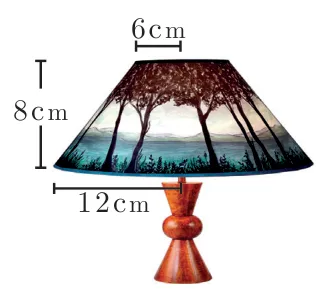
The frustum shaped outer portion of the table lamp has to be painted including the top part. Find the total cost of painting the lamp if the cost of painting 11 sq.cm is ₹ 22.

A table lamp with a frustum-shaped shade on a turned wooden stand, labelled 6 cm across the top, 8 cm slant height on the left, and 12 cm across the bottom.
Show steps (6)
  1. From the figure, the shade is a frustum with radii R=12R = 12 cm (bottom), r=6r = 6 cm (top) and vertical height h=8h = 8 cm.

  2. Slant height l=h2+(R−r)2=82+62=64+36=100=10l = \sqrt{h^2 + (R-r)^2} = \sqrt{8^2 + 6^2} = \sqrt{64+36} = \sqrt{100} = 10 cm.

  3. Area to be painted == C.S.A. of frustum ++ area of the top circle =π(R+r)l+πr2= \pi(R+r)l + \pi r^2.

  4. =227[(12+6)×10+62]=227[180+36]= \dfrac{22}{7}\big[(12+6)\times 10 + 6^2\big] = \dfrac{22}{7}\big[180 + 36\big]

  5. =227×216=47527=678.86= \dfrac{22}{7}\times 216 = \dfrac{4752}{7} = 678.86 sq.cm (approximately).

  6. Cost of painting == Area ×\times ₹2=678.86×2=₹1357.722 = 678.86 \times 2 = ₹1357.72.

Answer

Total cost of painting the lamp == ₹ 1357.721357.72 (approximately)

Quick check

  1. A spherical ball of radius r1r_1 units is melted to make 88 new identical balls each of radius r2r_2 units. Then r1:r2r_1 : r_2 is

    1. (1) 2:12:1
    2. (2) 1:21:2
    3. (3) 4:14:1
    4. (4) 1:41:4
    Show answer

    Answer: (1) 2:12:1

    1. Volume is unchanged: 43πr13=8×43πr23\dfrac{4}{3}\pi r_1^3=8\times\dfrac{4}{3}\pi r_2^3

    2. r13=8r23⇒r1=2r2r_1^3=8r_2^3\Rightarrow r_1=2r_2

    3. r1:r2=2:1r_1:r_2=2:1.

    Question 1 of 5
  2. If the radius of the base of a right circular cylinder is halved keeping the same height, then the ratio of the volume of the cylinder thus obtained to the volume of original cylinder is

    1. (1) 1:21:2
    2. (2) 1:41:4
    3. (3) 1:61:6
    4. (4) 1:81:8
    Show answer

    Answer: (2) 1:41:4

    1. New volume =π(r2)2h=πr2h4=\pi\left(\dfrac{r}{2}\right)^2h=\dfrac{\pi r^2h}{4}.

    2. Ratio =πr2h/4πr2h=14=\dfrac{\pi r^2h/4}{\pi r^2h}=\dfrac{1}{4}.

    Question 2 of 5
  3. A solid sphere of radius xx cm is melted and cast into a shape of a solid cone of same radius. The height of the cone is

    1. (1) 3x3x cm
    2. (2) xx cm
    3. (3) 4x4x cm
    4. (4) 2x2x cm
    Show answer

    Answer: (3) 4x4x cm

    1. Volume of sphere == volume of cone

    2. 43πx3=13πx2h\dfrac{4}{3}\pi x^3=\dfrac{1}{3}\pi x^2h

    3. h=4xh=4x cm.

    Question 3 of 5
  4. A frustum of a right circular cone is of height 1616cm with radii of its ends as 88cm and 2020cm. Then, the volume of the frustum is

    1. (1) 3328π3328\pi cm3^3
    2. (2) 3228π3228\pi cm3^3
    3. (3) 3240π3240\pi cm3^3
    4. (4) 3340π3340\pi cm3^3
    Show answer

    Answer: (1) 3328π3328\pi cm3^3

    1. V=13πh(R2+Rr+r2)V=\dfrac{1}{3}\pi h(R^2+Rr+r^2)

    2. =13π(16)(400+160+64)=\dfrac{1}{3}\pi(16)(400+160+64)

    3. =163π(624)=3328π=\dfrac{16}{3}\pi(624)=3328\pi cm3^3.

    Question 4 of 5
  5. If two solid hemispheres of same base radius rr units are joined together along their bases, then curved surface area of this new solid is

    1. (1) 4πr24\pi r^2 sq. units
    2. (2) 6πr26\pi r^2 sq. units
    3. (3) 3πr23\pi r^2 sq. units
    4. (4) 8πr28\pi r^2 sq. units
    Show answer

    Answer: (1) 4πr24\pi r^2 sq. units

    1. Two hemispheres joined along their bases form a sphere of radius rr.

    2. CSA of sphere =4πr2=4\pi r^2 sq. units.

    Question 5 of 5
Chapter 7 formulas
  • Cuboid — Lateral surface area

    2h(l+b)2h(l+b)

  • Cuboid — Total surface area

    2(lb+bh+lh)2(lb+bh+lh)

  • Cuboid — Volume

    l×b×hl \times b \times h

  • Cube — Lateral surface area

    4a24a^{2}

  • Cube — Total surface area

    6a26a^{2}

  • Cube — Volume

    a3a^{3}

  • Right circular cylinder — Curved surface area

    2πrh2\pi r h

  • Right circular cylinder — Total surface area

    2πr(h+r)2\pi r(h+r)

  • Right circular cylinder — Volume

    πr2h\pi r^{2} h

  • Right circular cone — Curved surface area

    πrl\pi r l

  • Right circular cone — Slant height

    l=r2+h2l=\sqrt{r^{2}+h^{2}}

  • Right circular cone — Total surface area

    πrl+πr2=πr(l+r)\pi r l+\pi r^{2}=\pi r(l+r)

  • Right circular cone — Volume

    13πr2h\dfrac{1}{3}\pi r^{2} h

  • Sphere — Curved surface area

    4πr24\pi r^{2}

  • Sphere — Total surface area

    4πr24\pi r^{2}

  • Sphere — Volume

    43πr3\dfrac{4}{3}\pi r^{3}

  • Hemisphere — Curved surface area

    2πr22\pi r^{2}

  • Hemisphere — Total surface area

    3πr23\pi r^{2}

  • Hemisphere — Volume

    23πr3\dfrac{2}{3}\pi r^{3}

  • Hollow cylinder — Curved surface area

    2π(R+r)h2\pi(R+r)h

  • Hollow cylinder — Total surface area

    2π(R+r)(R−r+h)2\pi(R+r)(R-r+h)

  • Hollow cylinder — Volume

    π(R2−r2)h\pi\left(R^{2}-r^{2}\right)h

  • Hollow sphere — Outer surface area

    4πR24\pi R^{2}

  • Hollow sphere — Total surface area

    4π(R2+r2)4\pi\left(R^{2}+r^{2}\right)

  • Hollow sphere — Volume

    43π(R3−r3)\dfrac{4}{3}\pi\left(R^{3}-r^{3}\right)

  • Hollow hemisphere — Curved surface area

    2π(R2+r2)2\pi\left(R^{2}+r^{2}\right)

  • Hollow hemisphere — Total surface area

    π(3R2+r2)\pi\left(3R^{2}+r^{2}\right)

  • Hollow hemisphere — Volume

    23π(R3−r3)\dfrac{2}{3}\pi\left(R^{3}-r^{3}\right)

  • Frustum of a right circular cone — Curved surface area

    π(R+r)l\pi(R+r)l

  • Frustum of a right circular cone — Slant height

    l=h2+(R−r)2l=\sqrt{h^{2}+(R-r)^{2}}

  • Frustum of a right circular cone — Total surface area

    π(R+r)l+πR2+πr2\pi(R+r)l+\pi R^{2}+\pi r^{2}

  • Frustum of a right circular cone — Volume

    13πh[R2+r2+Rr]\dfrac{1}{3}\pi h\left[R^{2}+r^{2}+Rr\right]

Answers checked against the Samacheer Kalvi textbook · Updated

Spotted a mistake? Email us at [email protected] and we will fix it.