
Samacheer Kalvi 10th Maths Exercise 7.3 Solutions
10th Maths Exercise 7.3 solutions (Chapter 7 Mensuration) with step-by-step answers for all 9 questions, as per the 2026-27 Samacheer Kalvi textbook.
Answers at a glance
A vessel is in the form of a hemispherical bowl mounted by a hollow cylinder. The diameter is cm and the height of the vessel is cm. Find the capacity of the vessel.
Show steps (7)
Diameter cm, so radius cm.
Height of hemisphere radius cm.
Height of cylinder cm.
Capacity Volume of cylinder Volume of hemisphere
Capacity of the vessel cm
Nathan, an engineering student was asked to make a model shaped like a cylinder with two cones attached at its two ends. The diameter of the model is cm and its length is cm. If each cone has a height of cm, find the volume of the model that Nathan made.
Show steps (7)
Diameter cm, so radius cm.
Height of each cone cm.
Height of cylinder cm.
Volume of model Volume of cylinder Volume of cone
Volume of the model cm
From a solid cylinder whose height is cm and the diameter cm, a cone of the same height and same diameter is carved out. Find the volume of the remaining solid to the nearest .
Show steps (6)
Radius cm, height cm (cone and cylinder have the same and ).
Volume of remaining solid Volume of cylinder Volume of cone
cm
Therefore the volume of the remaining solid is cm (approximately cm when rounded to the nearest whole ).
Volume of the remaining solid cm (i.e. about cm)
A solid consisting of a right circular cone of height cm and radius cm standing on a hemisphere of radius cm is placed upright in a right circular cylinder full of water such that it touches the bottom. Find the volume of the water displaced out of the cylinder, if the radius of the cylinder is cm and height is cm.
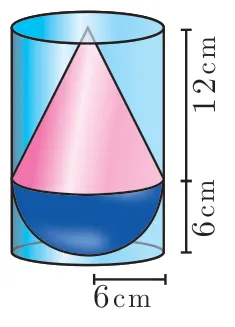
Water displaced Volume of the solid (cone hemisphere).
Cone: cm, cm; Hemisphere: cm.
Volume
Volume of water displaced cm
A capsule is in the shape of a cylinder with two hemisphere stuck to each of its ends. If the length of the entire capsule is mm and the diameter of the capsule is mm, how much medicine it can hold?
Show steps (6)
Diameter mm, so radius mm.
The two hemispheres take up mm of the length.
Height of cylinder mm.
Volume
The capsule can hold mm of medicine
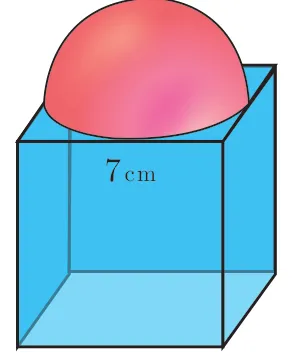
As shown in figure a cubical block of side cm is surmounted by a hemisphere. Find the surface area of the solid.
Show steps (6)
Side of cube cm; diameter of hemisphere cm, so cm.
The circular base of the hemisphere covers part of the top face, so
S.A. T.S.A. of cube C.S.A. of hemisphere base area of hemisphere
Surface area of the solid cm
A right circular cylinder just enclose a sphere of radius units. Calculate
(i)
the surface area of the sphere.
Radius of the sphere units.
Surface area of sphere sq. units.
sq. units
(ii)
the curved surface area of the cylinder.
The cylinder just encloses the sphere, so its radius and its height .
C.S.A. of cylinder sq. units.
sq. units
(iii)
the ratio of the areas obtained in (i) and (ii).
Ratio
Quick check
A spherical ball of radius units is melted to make new identical balls each of radius units. Then is
Question 1 of 5Show answer
Answer: (1)
Volume is unchanged:
.
If the radius of the base of a right circular cylinder is halved keeping the same height, then the ratio of the volume of the cylinder thus obtained to the volume of original cylinder is
Question 2 of 5Show answer
Answer: (2)
New volume .
Ratio .
A solid sphere of radius cm is melted and cast into a shape of a solid cone of same radius. The height of the cone is
Question 3 of 5Show answer
Answer: (3) cm
Volume of sphere volume of cone
cm.
A frustum of a right circular cone is of height cm with radii of its ends as cm and cm. Then, the volume of the frustum is
Question 4 of 5Show answer
Answer: (1) cm
cm.
If two solid hemispheres of same base radius units are joined together along their bases, then curved surface area of this new solid is
Question 5 of 5Show answer
Answer: (1) sq. units
Two hemispheres joined along their bases form a sphere of radius .
CSA of sphere sq. units.
Chapter 7 formulas
- Cuboid — Lateral surface area
- Cuboid — Total surface area
- Cuboid — Volume
- Cube — Lateral surface area
- Cube — Total surface area
- Cube — Volume
- Right circular cylinder — Curved surface area
- Right circular cylinder — Total surface area
- Right circular cylinder — Volume
- Right circular cone — Curved surface area
- Right circular cone — Slant height
- Right circular cone — Total surface area
- Right circular cone — Volume
- Sphere — Curved surface area
- Sphere — Total surface area
- Sphere — Volume
- Hemisphere — Curved surface area
- Hemisphere — Total surface area
- Hemisphere — Volume
- Hollow cylinder — Curved surface area
- Hollow cylinder — Total surface area
- Hollow cylinder — Volume
- Hollow sphere — Outer surface area
- Hollow sphere — Total surface area
- Hollow sphere — Volume
- Hollow hemisphere — Curved surface area
- Hollow hemisphere — Total surface area
- Hollow hemisphere — Volume
- Frustum of a right circular cone — Curved surface area
- Frustum of a right circular cone — Slant height
- Frustum of a right circular cone — Total surface area
- Frustum of a right circular cone — Volume