Samacheer Kalvi 10th Maths Exercise 1.3 Solutions

10th Maths Exercise 1.3 solutions (Chapter 1 Relations and Functions) with step-by-step answers for all 25 questions, as per the 2026-27 Samacheer Kalvi textbook.

Answers at a glance25 answers · full steps below
  1. Q1Domain =N=N, Co-domain =N=N, Range ={2,4,6,…}=\{2,4,6,\ldots\} (even natural numbers); yes, ff is a function.
  2. Q2R={(3,10),(4,17),(6,37),(8,65)}R=\{(3,10),(4,17),(6,37),(8,65)\} is a function from XX to NN.
  3. Q3 (i)f(−1)=12f(-1)=12
  4. Q3 (ii)f(2a)=4a2−10a+6f(2a)=4a^2-10a+6
  5. Q3 (iii)f(2)=0f(2)=0
  6. Q3 (iv)f(x−1)=x2−7x+12f(x-1)=x^2-7x+12
  7. Q4 (i)(a)f(0)=9f(0)=9
  8. Q4 (i)(b)f(7)=6f(7)=6
  9. Q4 (i)(c)f(2)=6f(2)=6
  10. Q4 (i)(d)f(10)=0f(10)=0
  11. Q4 (ii)x=9.5x=9.5
  12. Q4 (iii)Domain ={x∣0≤x≤10}=\{x \mid 0\le x\le 10\}; Range ={y∣0≤y≤9}=\{y \mid 0\le y\le 9\}
  13. Q4 (iv)The image of 66 is 55, that is f(6)=5f(6)=5.
  14. Q522
  15. Q6 (i)−2-2
  16. Q6 (ii)x=32x=\dfrac{3}{2}
  17. Q6 (iii)x=3x=3
  18. Q6 (iv)x=12x=\dfrac{1}{2}
  19. Q7V(x)=x(24−2x)2=4x3−96x2+576xV(x)=x(24-2x)^2=4x^3-96x^2+576x cu.cm
  20. Q8x=1x=1
  21. Q9d(t)=500td(t)=500t km, t≥0t\ge 0
  22. Q10 (i)Yes, the relation y=ax+by=ax+b is a function.
  23. Q10 (ii)a=0.9, b=24.5a=0.9,\ b=24.5 so y=0.9x+24.5y=0.9x+24.5
  24. Q10 (iii)60.560.5 inches
  25. Q10 (iv)3232 cm

Q1. Let f={(x,y)∣x,y∈Nf = \{(x,y) \mid x, y \in N and y=2x}y = 2x\} be a relation on N. Find the domain …

Let f={(x,y)∣x,y∈Nf = \{(x,y) \mid x, y \in N and y=2x}y = 2x\} be a relation on N. Find the domain, co-domain and range. Is this relation a function?

Show steps (6)
  1. y=2xy=2x with x,y∈Nx,y\in N gives the pairs (1,2),(2,4),(3,6),(4,8),…(1,2),(2,4),(3,6),(4,8),\ldots

  2. Every natural number xx has one and only one value y=2xy=2x.

  3. So each element of the domain has a unique image.

  4. Domain =N={1,2,3,…}=N=\{1,2,3,\ldots\}

  5. Co-domain =N=N

  6. Range ={2,4,6,8,…}=\{2,4,6,8,\ldots\}, the set of all even natural numbers.

Answer

Domain =N=N, Co-domain =N=N, Range ={2,4,6,…}=\{2,4,6,\ldots\} (even natural numbers); yes, ff is a function.

Q2. Let X={3,4,6,8}X = \{3, 4, 6, 8\} . Determine whether the relation R={(x,f(x))∣x∈X,f(x)=x2+1}R = \{(x, f(x)) \mid x \in X, f(x) = x^2 + 1\} is a function from …

Let X={3,4,6,8}X = \{3, 4, 6, 8\}. Determine whether the relation R={(x,f(x))∣x∈X,f(x)=x2+1}R = \{(x, f(x)) \mid x \in X, f(x) = x^2 + 1\} is a function from XX to NN?

Show steps (7)
  1. f(x)=x2+1f(x)=x^2+1 for x∈X={3,4,6,8}x\in X=\{3,4,6,8\}

  2. f(3)=32+1=10f(3)=3^2+1=10

  3. f(4)=42+1=17f(4)=4^2+1=17

  4. f(6)=62+1=37f(6)=6^2+1=37

  5. f(8)=82+1=65f(8)=8^2+1=65

  6. R={(3,10),(4,17),(6,37),(8,65)}R=\{(3,10),(4,17),(6,37),(8,65)\}

  7. Each element of XX has exactly one image and all images 10,17,37,6510,17,37,65 belong to NN.

Answer

R={(3,10),(4,17),(6,37),(8,65)}R=\{(3,10),(4,17),(6,37),(8,65)\} is a function from XX to NN.

Q3. Given the function f:x→x2−5x+6f : x \rightarrow x^2 - 5x + 6 , evaluate

Given the function f:x→x2−5x+6f : x \rightarrow x^2 - 5x + 6, evaluate

(i)

f(−1)f(-1)

  1. f(x)=x2−5x+6f(x)=x^2-5x+6

  2. Put x=−1x=-1:

  3. f(−1)=(−1)2−5(−1)+6f(-1)=(-1)^2-5(-1)+6

  4. =1+5+6=12=1+5+6=12

Answer

f(−1)=12f(-1)=12

(ii)

f(2a)f(2a)

  1. Put x=2ax=2a:

  2. f(2a)=(2a)2−5(2a)+6f(2a)=(2a)^2-5(2a)+6

  3. =4a2−10a+6=4a^2-10a+6

Answer

f(2a)=4a2−10a+6f(2a)=4a^2-10a+6

(iii)

f(2)f(2)

  1. Put x=2x=2:

  2. f(2)=22−5(2)+6f(2)=2^2-5(2)+6

  3. =4−10+6=0=4-10+6=0

Answer

f(2)=0f(2)=0

(iv)

f(x−1)f\left(x - 1\right)

  1. Put x=x−1x=x-1:

  2. f(x−1)=(x−1)2−5(x−1)+6f(x-1)=(x-1)^2-5(x-1)+6

  3. =x2−2x+1−5x+5+6=x^2-2x+1-5x+5+6

  4. =x2−7x+12=x^2-7x+12

Answer

f(x−1)=x2−7x+12f(x-1)=x^2-7x+12

Q4. A graph representing the function f(x)f(x) is given in Fig.1.16 it is …

A graph representing the function f(x)f(x) is given in Fig.1.16 it is clear that f(9)=2f(9) = 2.

(i)(a)

Find the following values of the function (a) f(0)f(0)
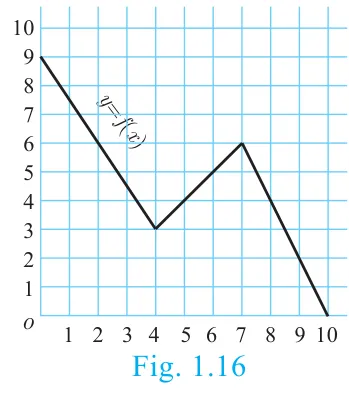
Fig. 1.16: a graph of y = f(x) on axes numbered 1 to 10, a polyline falling from about (0,9) to a minimum near (4,3), rising to a peak near (7,6), then falling through (9,2) to about (10,0).
  1. From the graph, the curve meets the yy-axis at 99.

  2. So when x=0x=0, y=9y=9.

Answer

f(0)=9f(0)=9

(i)(b)

Find the following values of the function (b) f(7)f(7)

  1. Draw a vertical line at x=7x=7 to meet the curve.

  2. The corresponding yy-value is 66.

Answer

f(7)=6f(7)=6

(i)(c)

Find the following values of the function (c) f(2)f(2)

  1. Draw a vertical line at x=2x=2 to meet the curve.

  2. The corresponding yy-value is 66.

Answer

f(2)=6f(2)=6

(i)(d)

Find the following values of the function (d) f(10)f(10)

  1. At x=10x=10 the curve touches the xx-axis.

  2. So the yy-value is 00.

Answer

f(10)=0f(10)=0

(ii)

For what value of xx is f(x)=1f(x) = 1?

  1. Draw the horizontal line y=1y=1.

  2. It cuts the curve at the point whose xx-value is 9.59.5.

Answer

x=9.5x=9.5

(iii)

Describe the following (i) Domain (ii) Range.

  1. The graph is drawn for xx from 00 to 1010.

  2. So domain ={x∣0≤x≤10, x∈R}=\{x \mid 0\le x\le 10,\ x\in R\}.

  3. The yy-values on the curve run from the lowest 00 to the highest 99.

  4. So range ={y∣0≤y≤9, y∈R}=\{y \mid 0\le y\le 9,\ y\in R\}.

Answer

Domain ={x∣0≤x≤10}=\{x \mid 0\le x\le 10\}; Range ={y∣0≤y≤9}=\{y \mid 0\le y\le 9\}

(iv)

What is the image of 6 under ff?

  1. Draw a vertical line at x=6x=6 to meet the curve.

  2. The corresponding yy-value is 55.

Answer

The image of 66 is 55, that is f(6)=5f(6)=5.

Q5. Let f(x)=2x+5f(x) = 2x + 5 . If x≠0x \neq 0 then find f(x+2)−f(2)x\dfrac{f(x+2) - f(2)}{x} .

  1. f(x)=2x+5f(x)=2x+5

  2. f(x+2)=2(x+2)+5=2x+9f(x+2)=2(x+2)+5=2x+9

  3. f(2)=2(2)+5=9f(2)=2(2)+5=9

  4. f(x+2)−f(2)=2x+9−9=2xf(x+2)-f(2)=2x+9-9=2x

  5. f(x+2)−f(2)x=2xx=2\dfrac{f(x+2)-f(2)}{x}=\dfrac{2x}{x}=2 (since x≠0x\neq 0)

Answer

22

Q6. A function ff is defined by f(x)=2x−3f(x) = 2x - 3 .

A function ff is defined by f(x)=2x−3f(x) = 2x - 3.

(i)

find f(0)+f(1)2\dfrac{f(0) + f(1)}{2}.

  1. f(x)=2x−3f(x)=2x-3

  2. f(0)=2(0)−3=−3f(0)=2(0)-3=-3

  3. f(1)=2(1)−3=−1f(1)=2(1)-3=-1

  4. f(0)+f(1)2=−3+(−1)2=−42=−2\dfrac{f(0)+f(1)}{2}=\dfrac{-3+(-1)}{2}=\dfrac{-4}{2}=-2

Answer

−2-2

(ii)

find xx such that f(x)=0f(x) = 0.

  1. f(x)=0f(x)=0

  2. 2x−3=02x-3=0

  3. 2x=32x=3

  4. x=32x=\dfrac{3}{2}

Answer

x=32x=\dfrac{3}{2}

(iii)

find xx such that f(x)=xf(x) = x.

  1. f(x)=xf(x)=x

  2. 2x−3=x2x-3=x

  3. 2x−x=32x-x=3

  4. x=3x=3

Answer

x=3x=3

(iv)

find xx such that f(x)=f(1−x)f(x) = f(1 - x).

  1. f(1−x)=2(1−x)−3=2−2x−3=−2x−1f(1-x)=2(1-x)-3=2-2x-3=-2x-1

  2. f(x)=f(1−x)f(x)=f(1-x) gives 2x−3=−2x−12x-3=-2x-1

  3. 2x+2x=−1+32x+2x=-1+3

  4. 4x=24x=2

  5. x=12x=\dfrac{1}{2}

Answer

x=12x=\dfrac{1}{2}

Q7. An open box is to be made from a square piece of …

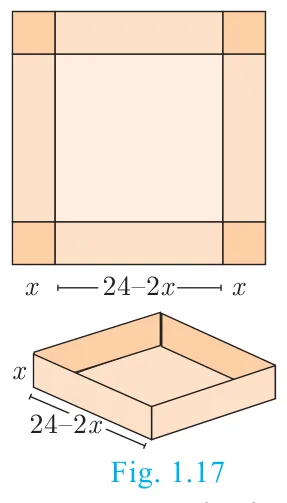
An open box is to be made from a square piece of material, 24 cm on a side, by cutting equal squares from the corners and turning up the sides as shown (Fig.1.17). Express the volume VV of the box as a function of xx.

Fig. 1.17: a square sheet of side 24 cm with squares of side x cut from each corner, with bottom edge marked x, 24−2x, x, and below it the resulting open box with height x and base edge 24−2x.
Show steps (6)
  1. Squares of side xx cm are cut from each corner of a square of side 24 cm.

  2. Length of the base =24−2x=24-2x, breadth of the base =24−2x=24-2x

  3. Height of the box =x=x

  4. V=length×breadth×heightV=\text{length}\times\text{breadth}\times\text{height}

  5. V=(24−2x)(24−2x)×xV=(24-2x)(24-2x)\times x

  6. V(x)=x(24−2x)2V(x)=x(24-2x)^2 cubic cm, where 0<x<120<x<12

Answer

V(x)=x(24−2x)2=4x3−96x2+576xV(x)=x(24-2x)^2=4x^3-96x^2+576x cu.cm

Q8. A function ff is defined by f(x)=3−2xf(x) = 3 - 2x . Find xx such that …

A function ff is defined by f(x)=3−2xf(x) = 3 - 2x. Find xx such that f(x2)=(f(x))2f(x^2) = (f(x))^2.

Show steps (9)
  1. f(x)=3−2xf(x)=3-2x

  2. f(x2)=3−2x2f(x^2)=3-2x^2

  3. (f(x))2=(3−2x)2=9−12x+4x2(f(x))^2=(3-2x)^2=9-12x+4x^2

  4. Given f(x2)=(f(x))2f(x^2)=(f(x))^2

  5. 3−2x2=9−12x+4x23-2x^2=9-12x+4x^2

  6. 0=6−12x+6x20=6-12x+6x^2

  7. 6(x2−2x+1)=06(x^2-2x+1)=0

  8. (x−1)2=0(x-1)^2=0

  9. x=1x=1

Answer

x=1x=1

Q9. A plane is flying at a speed of 500 km per hour. …

A plane is flying at a speed of 500 km per hour. Express the distance 'dd' travelled by the plane as function of time tt in hours.

  1. Distance == speed ×\times time

  2. Speed =500=500 km/hr, time =t=t hours

  3. d(t)=500td(t)=500t

  4. For each value of tt there is only one value of dd, so dd is a function of tt.

Answer

d(t)=500td(t)=500t km, t≥0t\ge 0

Q10. The data in the adjacent table depicts the length of a person …

The data in the adjacent table depicts the length of a person forehand and their corresponding height. Based on this data, a student finds a relationship between the height (yy) and the forehand length(xx) as y=ax+by = ax + b, where aa, bb are constants.

(i)

Check if this relation is a function.

Length 'xx' of forehand (in cm) Height 'yy' (in inches)
35 56
45 65
50 69.5
55 74
  1. Each forehand length xx in the table has exactly one height yy.

  2. The pairs are (35,56),(45,65),(50,69.5),(55,74)(35,56),(45,65),(50,69.5),(55,74).

  3. No xx-value is repeated with two different yy-values.

  4. So the relation is a function.

Answer

Yes, the relation y=ax+by=ax+b is a function.

(ii)

Find aa and bb.

Length 'xx' of forehand (in cm) Height 'yy' (in inches)
35 56
45 65
50 69.5
55 74
Show steps (6)
  1. Using (35,56)(35,56): 35a+b=5635a+b=56 ... (1)

  2. Using (45,65)(45,65): 45a+b=6545a+b=65 ... (2)

  3. (2) −- (1): 10a=910a=9

  4. a=0.9a=0.9

  5. From (1): b=56−35(0.9)=56−31.5=24.5b=56-35(0.9)=56-31.5=24.5

  6. Verify with (50,69.5)(50,69.5): 0.9(50)+24.5=69.50.9(50)+24.5=69.5 ✓

Answer

a=0.9, b=24.5a=0.9,\ b=24.5 so y=0.9x+24.5y=0.9x+24.5

(iii)

Find the height of a person whose forehand length is 40 cm.

Length 'xx' of forehand (in cm) Height 'yy' (in inches)
35 56
45 65
50 69.5
55 74
  1. y=0.9x+24.5y=0.9x+24.5

  2. Put x=40x=40:

  3. y=0.9(40)+24.5y=0.9(40)+24.5

  4. =36+24.5=60.5=36+24.5=60.5

Answer

60.560.5 inches

(iv)

Find the length of forehand of a person if the height is 53.3 inches.

Length 'xx' of forehand (in cm) Height 'yy' (in inches)
35 56
45 65
50 69.5
55 74
  1. y=0.9x+24.5y=0.9x+24.5

  2. Put y=53.3y=53.3:

  3. 53.3=0.9x+24.553.3=0.9x+24.5

  4. 0.9x=53.3−24.5=28.80.9x=53.3-24.5=28.8

  5. x=28.80.9=32x=\dfrac{28.8}{0.9}=32

Answer

3232 cm

Quick check

  1. Let ff and gg be two functions given by f={(0,1),(2,0),(3,−4),(4,2),(5,7)}f = \{(0,1),(2,0),(3,-4),(4,2),(5,7)\}, g={(0,2),(1,0),(2,4),(−4,2),(7,0)}g = \{(0,2),(1,0),(2,4),(-4,2),(7,0)\} then the range of f∘gf \circ g is

    1. (1) {0,2,3,4,5}\{0,2,3,4,5\}
    2. (2) {−4,1,0,2,7}\{-4,1,0,2,7\}
    3. (3) {1,2,3,4,5}\{1,2,3,4,5\}
    4. (4) {0,1,2}\{0,1,2\}
    Show answer

    Answer: (4) {0,1,2}\{0,1,2\}

    1. (f∘g)(0)=f(2)=0(f\circ g)(0)=f(2)=0, (f∘g)(1)=f(0)=1(f\circ g)(1)=f(0)=1.

    2. (f∘g)(2)=f(4)=2(f\circ g)(2)=f(4)=2, (f∘g)(−4)=f(2)=0(f\circ g)(-4)=f(2)=0, (f∘g)(7)=f(0)=1(f\circ g)(7)=f(0)=1.

    3. Range ={0,1,2}=\{0,1,2\}.

    Question 1 of 5
  2. If there are 1024 relations from a set A={1,2,3,4,5}A = \{1, 2, 3, 4, 5\} to a set BB, then the number of elements in BB is

    1. (1) 3
    2. (2) 2
    3. (3) 4
    4. (4) 8
    Show answer

    Answer: (2) 2

    1. Number of relations from AA to BB is 2n(A)⋅n(B)2^{n(A)\cdot n(B)}.

    2. 25 n(B)=1024=2102^{5\,n(B)}=1024=2^{10}.

    3. 5 n(B)=10⇒n(B)=25\,n(B)=10\Rightarrow n(B)=2.

    Question 2 of 5
  3. Let A={1,2,3,4}A = \{1,2,3,4\} and B={4,8,9,10}B = \{4,8,9,10\}. A function f:A→Bf : A \to B given by f={(1,4),(2,8),(3,9),(4,10)}f = \{(1,4),(2,8),(3,9),(4,10)\} is a

    1. (1) Many-one function
    2. (2) Identity function
    3. (3) One-to-one function
    4. (4) Into function
    Show answer

    Answer: (3) One-to-one function

    1. Images are 4,8,9,104,8,9,10 — all different.

    2. Different elements of AA have different images.

    3. So ff is one-to-one.

    Question 3 of 5
  4. If f(x)=2x2f(x) = 2x^2 and g(x)=13xg(x) = \dfrac{1}{3x}, then f∘gf \circ g is

    1. (1) 32x2\dfrac{3}{2x^2}
    2. (2) 23x2\dfrac{2}{3x^2}
    3. (3) 29x2\dfrac{2}{9x^2}
    4. (4) 16x2\dfrac{1}{6x^2}
    Show answer

    Answer: (3) 29x2\dfrac{2}{9x^2}

    1. (f∘g)(x)=f(g(x))=f(13x)(f\circ g)(x)=f\big(g(x)\big)=f\left(\dfrac{1}{3x}\right).

    2. =2(13x)2=2\left(\dfrac{1}{3x}\right)^{2}.

    3. =29x2=\dfrac{2}{9x^{2}}.

    Question 4 of 5
  5. A={a,b,p}A = \{a,b,p\}, B={2,3}B = \{2,3\}, C={p,q,r,s}C = \{p,q,r,s\} then n[(A∪C)×B]n[(A \cup C) \times B] is

    1. (1) 8
    2. (2) 20
    3. (3) 12
    4. (4) 16
    Show answer

    Answer: (3) 12

    1. A∪C={a,b,p,q,r,s}A\cup C=\{a,b,p,q,r,s\}, so n(A∪C)=6n(A\cup C)=6.

    2. n(B)=2n(B)=2.

    3. n[(A∪C)×B]=6×2=12n[(A\cup C)\times B]=6\times 2=12.

    Question 5 of 5
Chapter 1 formulas
  • Cartesian product of A with B

    A×B={(a,b)∣for all a∈A, b∈B}A \times B = \{(a,b) \mid \text{for all } a \in A,\ b \in B\}

  • A relation R from A to B is a subset of A × B

    R⊆A×BR \subseteq A \times B

  • Condition for a relation R from X to Y to be a function

    for every x∈X there exists only one y∈Y\text{for every } x \in X \text{ there exists only one } y \in Y

  • Identity function

    f(x)=xf(x) = x

  • Reciprocal function

    f(x)=1xf(x) = \dfrac{1}{x}

  • Constant function

    f(x)=cf(x) = c

  • Linear function

    f(x)=ax+b, a≠0f(x) = ax + b,\ a \neq 0

  • Quadratic function

    f(x)=ax2+bx+c, a≠0f(x) = ax^{2} + bx + c,\ a \neq 0

  • Cubic function

    f(x)=ax3+bx2+cx+d, a≠0f(x) = ax^{3} + bx^{2} + cx + d,\ a \neq 0

  • Composition of two functions f : A → B and g : B → C

    g∘f:A→C,(g∘f)(x)=g(f(x))  for all x∈Ag \circ f : A \to C,\quad (g \circ f)(x) = g(f(x)) \ \text{ for all } x \in A

  • Composition is not commutative in general

    f∘g≠g∘ff \circ g \neq g \circ f

  • Composition is associative

    f∘(g∘h)=(f∘g)∘hf \circ (g \circ h) = (f \circ g) \circ h

Answers checked against the Samacheer Kalvi textbook · Updated

Spotted a mistake? Email us at [email protected] and we will fix it.