
Samacheer Kalvi 10th Maths Exercise 1.4 Solutions
10th Maths Exercise 1.4 solutions (Chapter 1 Relations and Functions) with step-by-step answers for all 32 questions, as per the 2026-27 Samacheer Kalvi textbook.
Answers at a glance
- Q1 (i)Not a function (fails the vertical line test — a vertical line meets the curve at two points).
- Q1 (ii)It is a function (passes the vertical line test).
- Q1 (iii)Not a function (fails the vertical line test).
- Q1 (iv)It is a function (passes the vertical line test).
- Q2 (i)
- Q2 (ii)
- Q2 (iii)Arrow diagram: (the element has no pre-image).
- Q2 (iv)Plot the points ; they lie on a straight line.
- Q3 (i)Arrow diagram: .
- Q3 (ii)
- Q3 (iii)Plot the points .
- Q6 (i)Range of
- Q6 (ii) is a one-one and into function.
- Q7 (i) is bijective (one-one and onto).
- Q7 (ii) is not bijective (it is neither one-one nor onto).
- Q8 or , and
- Q9 (i)
- Q9 (ii)
- Q9 (iii)
- Q9 (iv)
- Q10 (i)
- Q10 (ii)
- Q10 (iii)
- Q10 (iv)
- Q12 (i)
- Q12 (ii)
- Q12 (iii)
- Q12 (iv)
- Q12 (v) (i.e. )
Determine whether the graph given below represent functions. Give reason for your answers concerning each graph.
(i)
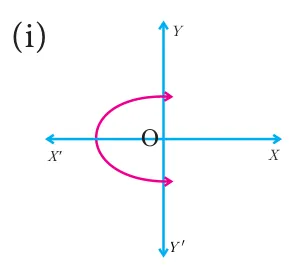
Draw a vertical line on the curve.
The curve opens to the left, so a vertical line cuts it at two points.
A vertical line must meet the graph at only one point for a function.
Not a function (fails the vertical line test — a vertical line meets the curve at two points).
(ii)
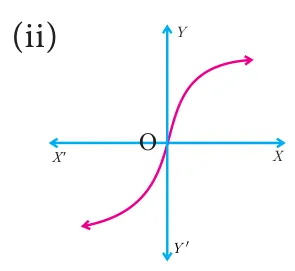
Draw vertical lines anywhere on the curve.
Each vertical line meets the S‑shaped curve at exactly one point.
So every has only one image.
It is a function (passes the vertical line test).
(iii)
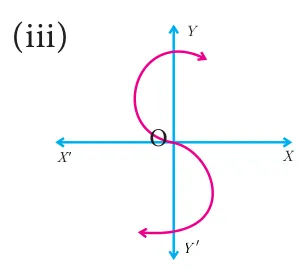
The curve bends back on itself.
A vertical line drawn in that region meets the curve at more than one point.
So one has more than one image.
Not a function (fails the vertical line test).
(iv)
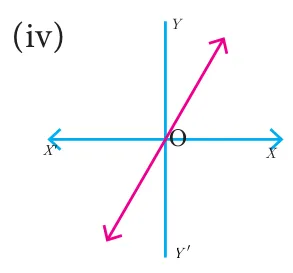
The graph is a straight line through the origin.
Every vertical line meets it at exactly one point.
It is a function (passes the vertical line test).
Let be a function defined by , where , . Represent by
(i)
set of ordered pairs
Show steps (6)
(ii)
a table
Use the images found from .
Write in the first row and in the second row.
(iii)
an arrow diagram
Draw two closed curves: on the left, on the right.
Join by arrows: , , , , .
The element in receives no arrow.
Arrow diagram: (the element has no pre-image).
(iv)
a graph
Take the ordered pairs of as points.
Plot on the graph sheet.
All the points lie on a straight line (the line ).
Plot the points ; they lie on a straight line.
(i)
an arrow diagram
Domain , co-domain .
Draw arrows: , , , , .
Arrow diagram: .
(ii)
a table form
Write the first co-ordinates as and the second as .
(iii)
a graph
Take each ordered pair as a point.
Plot on the graph sheet.
Plot the points .
Show that the function defined by is one-one but not onto.
Show steps (8)
One-one: Let for .
So different elements have different images, hence is one-one.
Onto:
Range of , the set of odd natural numbers.
This is a proper subset of the co-domain (e.g. has no pre-image, since gives ).
Hence is not onto.
is one-one but not onto (it is an into function).
Show steps (7)
Let for .
Since , .
Therefore , that is .
, hence is a one-one function.
Let and . Let be defined by then,
(i)
find the range of
,
Range of
(ii)
identify the type of function
Different elements of have different images, so is one-one.
Co-domain , but range is a proper subset of .
So is not onto; it is into.
is a one-one and into function.
In each of the following cases state whether the function is bijective or not. Justify your answer.
(i)
defined by
One-one: .
Onto: For any , take ; then .
So every element of the co-domain has a pre-image; range .
is bijective (one-one and onto).
(ii)
defined by
and .
Two different elements and have the same image, so is not one-one.
Also , so .
Range , a proper subset of ; so is not onto.
is not bijective (it is neither one-one nor onto).
Let and . If the function defined by is an onto function? Find and .
Show steps (9)
with , .
Since is onto, the images and must together cover all of , so two cases arise.
Case 1: and .
… (1) and … (2).
Adding (1) and (2): ; then from (2), .
Case 2: and .
… (3) and … (4).
Adding (3) and (4): ; then from (4), .
Hence or ; in both cases is onto.
or , and
(i)
, so use .
(ii)
lies in , so .
(iii)
lies in , so .
(iv)
, so .
lies in , so .
A function is defined as follows: Find
(i)
lies in , so .
lies in , so .
(ii)
lies in , so .
lies in , so .
(iii)
lies in , so .
lies in , so .
(iv)
lies in , so .
lies in , so .
lies in , so .
The distance an object travels under the influence of gravity in time seconds is given by where, ( is the acceleration due to gravity), , are constants. Verify wheather the function is one-one or not.
Show steps (6)
Assume .
Time and , so .
Hence , that is .
, so is a one-one function.
The function '' which maps temperature in Celsius () into temperature in Fahrenheit () is defined by where . Find,
(i)
(ii)
(iii)
(iv)
the value of when
(v)
the temperature when the Celsius value is equal to the Farenheit value.
Let .
(i.e. )
Quick check
Let and be two functions given by , then the range of is
Question 1 of 5Show answer
Answer: (4)
, .
, , .
Range .
If there are 1024 relations from a set to a set , then the number of elements in is
Question 2 of 5Show answer
Answer: (2) 2
Number of relations from to is .
.
.
Let and . A function given by is a
Question 3 of 5Show answer
Answer: (3) One-to-one function
Images are — all different.
Different elements of have different images.
So is one-to-one.
If and , then is
Question 4 of 5Show answer
Answer: (3)
.
.
.
, , then is
Question 5 of 5Show answer
Answer: (3) 12
, so .
.
.
Chapter 1 formulas
- Cartesian product of A with B
- A relation R from A to B is a subset of A × B
- Condition for a relation R from X to Y to be a function
- Identity function
- Reciprocal function
- Constant function
- Linear function
- Quadratic function
- Cubic function
- Composition of two functions f : A → B and g : B → C
- Composition is not commutative in general
- Composition is associative