
Samacheer Kalvi 10th Maths Unit Exercise 3 Solutions

10th Maths Unit Exercise 3 solutions (Chapter 3 Algebra) with step-by-step answers for all 23 questions, as per the 2026-27 Samacheer Kalvi textbook.

Answers at a glance21 answers · full steps below
  1. Q1x=6, y=2, z=1x=6,\ y=2,\ z=1
  2. Q2Section A =42=42, Section B =78=78, Section C =30=30 students
  3. Q3The original number is 153153
  4. Q4(x+ky)(k2x2−y2)(x+ky)(k^2x^2-y^2)
  5. Q5GCD =x2+2x+1=x^2+2x+1
  6. Q6 (i)xa−2x^{a}-2
  7. Q6 (ii)5−2x2\dfrac{5-2x}{2}
  8. Q7(p+q+r)22qr\dfrac{(p+q+r)^2}{2qr}
  9. Q8Arul =11=11 hours, Madan =22=22 hours, Ram =33=33 hours
  10. Q9∣17x2−18x+19∣\left|17x^{2}-18x+19\right|
  11. Q10y=3y=3
  12. Q11Speed of the boat in still water =14=14 km/hr
  13. Q12Yes; length =120=120 m, breadth =40=40 m
  14. Q13t=14t=14 minutes
  15. Q14Number of rows at the beginning =25=25
  16. Q15 (i)x2−6x+11x^{2}-6x+11
  17. Q15 (ii)3x2−2x+13x^{2}-2x+1
  18. Q16p=3, q=94p=3,\ q=\dfrac{9}{4}
  19. Q18x=sin⁡θx=\sin\theta
  20. Q19p=8, q=4p=8,\ q=4
  21. Q20D=(12271−58−34)D=\begin{pmatrix} 122 & 71 \\ -58 & -34 \end{pmatrix}

Q1. Solve 13(x+y−5)=y−z=2x−11=9−(x+2z)\dfrac{1}{3}(x + y - 5) = y - z = 2x - 11 = 9 - (x + 2z)

Show steps (11)
  1. Equate the parts two at a time.

  2. 13(x+y−5)=y−z⇒x+y−5=3y−3z\dfrac{1}{3}(x+y-5)=y-z \Rightarrow x+y-5=3y-3z

  3. x−2y+3z=5…(1)x-2y+3z=5 \quad \ldots (1)

  4. y−z=2x−11⇒2x−y+z=11…(2)y-z=2x-11 \Rightarrow 2x-y+z=11 \quad \ldots (2)

  5. 2x−11=9−(x+2z)⇒3x+2z=20…(3)2x-11=9-(x+2z) \Rightarrow 3x+2z=20 \quad \ldots (3)

  6. From (2), y=2x+z−11y=2x+z-11. Put in (1):

  7. x−2(2x+z−11)+3z=5⇒−3x+z=−17x-2(2x+z-11)+3z=5 \Rightarrow -3x+z=-17

  8. So z=3x−17z=3x-17. Put in (3):

  9. 3x+2(3x−17)=20⇒9x=54⇒x=63x+2(3x-17)=20 \Rightarrow 9x=54 \Rightarrow x=6

  10. z=3(6)−17=1z=3(6)-17=1 and y=2(6)+1−11=2y=2(6)+1-11=2

  11. Check: 13(6+2−5)=1, 2−1=1, 12−11=1, 9−(6+2)=1\dfrac{1}{3}(6+2-5)=1,\ 2-1=1,\ 12-11=1,\ 9-(6+2)=1

Answer

x=6, y=2, z=1x=6,\ y=2,\ z=1

Q2. One hundred and fifty students are admitted to a school. They are …

One hundred and fifty students are admitted to a school. They are distrbuted over three sections AA, BB and CC. If 66 students are shifted from section A to section CC, the sections will have equal number of students. If 44 times of students of section CC exceeds the number of students of section AA by the number of students in section BB, find the number of students in the three sections.

Show steps (9)
  1. Let the sections AA, BB, CC have xx, yy, zz students.

  2. x+y+z=150…(1)x+y+z=150 \quad \ldots (1)

  3. Shifting 6 from A to C makes them equal:

  4. x−6=z+6⇒x−z=12…(2)x-6=z+6 \Rightarrow x-z=12 \quad \ldots (2)

  5. 44 times C exceeds A by B:

  6. 4z−x=y⇒x+y−4z=0…(3)4z-x=y \Rightarrow x+y-4z=0 \quad \ldots (3)

  7. (1)−(3): 5z=150⇒z=30(1)-(3):\ 5z=150 \Rightarrow z=30

  8. From (2), x=30+12=42x=30+12=42

  9. From (1), y=150−42−30=78y=150-42-30=78

Answer

Section A =42=42, Section B =78=78, Section C =30=30 students

Q3. In a three-digit number, when the tens and the hundreds digit are …

In a three-digit number, when the tens and the hundreds digit are interchanged the new number is 5454 more than three times the original number. If 198198 is added to the number, the digits are reversed. The tens digit exceeds the hundreds digit by twice as that of the tens digit exceeds the unit digit. Find the original number.

Show steps (14)
  1. Let the digits be xx (hundreds), yy (tens), zz (units).

  2. Number =100x+10y+z=100x+10y+z.

  3. Interchanging tens and hundreds digits:

  4. 100y+10x+z=3(100x+10y+z)+54100y+10x+z=3(100x+10y+z)+54

  5. ⇒70y−290x−2z=54⇒35y−145x−z=27…(1)\Rightarrow 70y-290x-2z=54 \Rightarrow 35y-145x-z=27 \quad \ldots (1)

  6. Adding 198 reverses the digits:

  7. 100x+10y+z+198=100z+10y+x100x+10y+z+198=100z+10y+x

  8. ⇒99z−99x=198⇒z−x=2…(2)\Rightarrow 99z-99x=198 \Rightarrow z-x=2 \quad \ldots (2)

  9. Third condition: y−x=2(y−z)⇒y=2z−x…(3)y-x=2(y-z) \Rightarrow y=2z-x \quad \ldots (3)

  10. From (2), z=x+2z=x+2; then from (3), y=2(x+2)−x=x+4y=2(x+2)-x=x+4.

  11. Put in (1): 35(x+4)−145x−(x+2)=2735(x+4)-145x-(x+2)=27

  12. −111x+138=27⇒x=1-111x+138=27 \Rightarrow x=1

  13. So x=1, y=5, z=3x=1,\ y=5,\ z=3.

  14. Check: 513=3(153)+54513=3(153)+54 and 153+198=351153+198=351

Answer

The original number is 153153

Q4. Find the least common multiple of xy(k2+1)+k(x2+y2)xy(k^2 + 1) + k(x^2 + y^2) and xy(k2−1)+k(x2−y2)xy(k^2 - 1) + k(x^2 - y^2)

Show steps (6)
  1. First expression: k2xy+xy+kx2+ky2k^2xy+xy+kx^2+ky^2

  2. =kx(ky+x)+y(x+ky)=(x+ky)(kx+y)=kx(ky+x)+y(x+ky)=(x+ky)(kx+y)

  3. Second expression: k2xy−xy+kx2−ky2k^2xy-xy+kx^2-ky^2

  4. =kx(ky+x)−y(x+ky)=(x+ky)(kx−y)=kx(ky+x)-y(x+ky)=(x+ky)(kx-y)

  5. Common factor =(x+ky)=(x+ky).

  6. LCM =(x+ky)(kx+y)(kx−y)=(x+ky)(kx+y)(kx-y)

Answer

(x+ky)(k2x2−y2)(x+ky)(k^2x^2-y^2)

Q5. Find the GCD of the following by division algorithm 2x4+13x3+27x2+23x+72x^4 + 13x^3 + 27x^2 + 23x + 7 , x3+3x2+3x+1x^3 + 3x^2 + 3x + 1 …

Find the GCD of the following by division algorithm 2x4+13x3+27x2+23x+72x^4 + 13x^3 + 27x^2 + 23x + 7, x3+3x2+3x+1x^3 + 3x^2 + 3x + 1, x2+2x+1x^2 + 2x + 1

Show steps (9)
  1. Take the last two polynomials first.

  2. Divide x3+3x2+3x+1x^3+3x^2+3x+1 by x2+2x+1x^2+2x+1:

  3. quotient x+1x+1, remainder 00.

  4. So GCD of these two is x2+2x+1x^2+2x+1.

  5. Now divide 2x4+13x3+27x2+23x+72x^4+13x^3+27x^2+23x+7 by x2+2x+1x^2+2x+1:

  6. 2x22x^2 gives 2x4+4x3+2x22x^4+4x^3+2x^2; remainder 9x3+25x2+23x+79x^3+25x^2+23x+7

  7. 9x9x gives 9x3+18x2+9x9x^3+18x^2+9x; remainder 7x2+14x+77x^2+14x+7

  8. 77 gives 7x2+14x+77x^2+14x+7; remainder 00

  9. Since the remainder is 00, x2+2x+1x^2+2x+1 divides all three.

Answer

GCD =x2+2x+1=x^2+2x+1

Q6. Reduce the given Rational expressions to its lowest form

(i)

x3a−8x2a+2xa+4\dfrac{x^{3a} - 8}{x^{2a} + 2x^{a} + 4}

  1. Write in terms of xax^a.

  2. x3a−8=(xa)3−23x^{3a}-8=(x^a)^3-2^3

  3. =(xa−2)((xa)2+2xa+4)=(x^a-2)\big((x^a)^2+2x^a+4\big)

  4. (xa−2)(x2a+2xa+4)x2a+2xa+4=xa−2\dfrac{(x^a-2)(x^{2a}+2x^a+4)}{x^{2a}+2x^a+4}=x^a-2

Answer

xa−2x^{a}-2

(ii)

10x3−25x2+4x−10−4−10x2\dfrac{10x^3 - 25x^2 + 4x - 10}{-4 - 10x^2}

  1. Factorise the numerator by grouping.

  2. 10x3−25x2+4x−10=5x2(2x−5)+2(2x−5)10x^3-25x^2+4x-10=5x^2(2x-5)+2(2x-5)

  3. =(2x−5)(5x2+2)=(2x-5)(5x^2+2)

  4. Denominator: −4−10x2=−2(5x2+2)-4-10x^2=-2(5x^2+2)

  5. (2x−5)(5x2+2)−2(5x2+2)=2x−5−2\dfrac{(2x-5)(5x^2+2)}{-2(5x^2+2)}=\dfrac{2x-5}{-2}

Answer

5−2x2\dfrac{5-2x}{2}

Q7. Simplify 1p+1q+r1p−1q+r×(1+q2+r2−p22qr)\dfrac{\dfrac{1}{p} + \dfrac{1}{q+r}}{\dfrac{1}{p} - \dfrac{1}{q+r}} \times \left(1 + \dfrac{q^2 + r^2 - p^2}{2qr}\right)

Show steps (7)
  1. Simplify the first factor.

  2. q+r+pp(q+r)q+r−pp(q+r)=p+q+rq+r−p\dfrac{\dfrac{q+r+p}{p(q+r)}}{\dfrac{q+r-p}{p(q+r)}}=\dfrac{p+q+r}{q+r-p}

  3. Now the second factor:

  4. 1+q2+r2−p22qr=2qr+q2+r2−p22qr1+\dfrac{q^2+r^2-p^2}{2qr}=\dfrac{2qr+q^2+r^2-p^2}{2qr}

  5. =(q+r)2−p22qr=(q+r+p)(q+r−p)2qr=\dfrac{(q+r)^2-p^2}{2qr}=\dfrac{(q+r+p)(q+r-p)}{2qr}

  6. Multiply:

  7. p+q+rq+r−p×(p+q+r)(q+r−p)2qr\dfrac{p+q+r}{q+r-p}\times\dfrac{(p+q+r)(q+r-p)}{2qr}

Answer

(p+q+r)22qr\dfrac{(p+q+r)^2}{2qr}

Q8. Arul, Madan and Ram working together can clean a store in 66 …

Arul, Madan and Ram working together can clean a store in 66 hours. Working alone, Madan takes twice as long to clean the store as Arul does. Ram needs three times as long as Arul does. How long would it take each if they are working alone?

Show steps (6)
  1. Let Arul alone take xx hours.

  2. Madan takes 2x2x hours, Ram takes 3x3x hours.

  3. Work done in 1 hour together =16=\dfrac{1}{6}.

  4. 1x+12x+13x=16\dfrac{1}{x}+\dfrac{1}{2x}+\dfrac{1}{3x}=\dfrac{1}{6}

  5. 6+3+26x=16\dfrac{6+3+2}{6x}=\dfrac{1}{6}

  6. 116x=16⇒x=11\dfrac{11}{6x}=\dfrac{1}{6} \Rightarrow x=11

Answer

Arul =11=11 hours, Madan =22=22 hours, Ram =33=33 hours

Q9. Find the square root of 289x4−612x3+970x2−684x+361289x^4 - 612x^3 + 970x^2 - 684x + 361 .

Show steps (6)
  1. Use the square root by long division idea: the answer is of the form ax2+bx+cax^2+bx+c.

  2. a2=289⇒a=17a^2=289 \Rightarrow a=17

  3. 2ab=−612⇒34b=−612⇒b=−182ab=-612 \Rightarrow 34b=-612 \Rightarrow b=-18

  4. b2+2ac=970⇒324+34c=970⇒c=19b^2+2ac=970 \Rightarrow 324+34c=970 \Rightarrow c=19

  5. Check last term: c2=361c^2=361 ✓ and 2bc=−6842bc=-684 ✓

  6. So the expression =(17x2−18x+19)2=(17x^2-18x+19)^2

Answer

∣17x2−18x+19∣\left|17x^{2}-18x+19\right|

Q10. Solve y+1+2y−5=3\sqrt{y+1} + \sqrt{2y-5} = 3

Show steps (8)
  1. 2y−5=3−y+1\sqrt{2y-5}=3-\sqrt{y+1}

  2. Squaring: 2y−5=9−6y+1+y+12y-5=9-6\sqrt{y+1}+y+1

  3. y−15=−6y+1y-15=-6\sqrt{y+1}, i.e. 15−y=6y+115-y=6\sqrt{y+1}

  4. Squaring again: 225−30y+y2=36(y+1)225-30y+y^2=36(y+1)

  5. y2−66y+189=0y^2-66y+189=0

  6. (y−3)(y−63)=0⇒y=3(y-3)(y-63)=0 \Rightarrow y=3 or y=63y=63

  7. Check y=3y=3: 4+1=2+1=3\sqrt{4}+\sqrt{1}=2+1=3 ✓

  8. Check y=63y=63: 64+121=19≠3\sqrt{64}+\sqrt{121}=19 \neq 3 ✗

Answer

y=3y=3

Q11. A boat takes 1.61.6 hours longer to go 3636 kms up a …

A boat takes 1.61.6 hours longer to go 3636 kms up a river than down the river. If the speed of the water current is 44 km per hr, what is the speed of the boat in still water?

Show steps (8)
  1. Let the speed of the boat in still water be xx km/hr.

  2. Upstream speed =x−4=x-4, downstream speed =x+4=x+4.

  3. 36x−4−36x+4=1.6\dfrac{36}{x-4}-\dfrac{36}{x+4}=1.6

  4. 36((x+4)−(x−4)x2−16)=1.636\left(\dfrac{(x+4)-(x-4)}{x^2-16}\right)=1.6

  5. 36×8x2−16=1.6\dfrac{36\times 8}{x^2-16}=1.6

  6. 288=1.6x2−25.6288=1.6x^2-25.6

  7. 1.6x2=313.6⇒x2=1961.6x^2=313.6 \Rightarrow x^2=196

  8. x=14x=14 (speed cannot be negative)

Answer

Speed of the boat in still water =14=14 km/hr

Q12. Is it possible to design a rectangular park of perimeter 320320 m …

Is it possible to design a rectangular park of perimeter 320320 m and area 48004800 m2m^2 ? If so find its length and breadth.

Show steps (7)
  1. Let length =l=l, breadth =b=b.

  2. Perimeter: 2(l+b)=320⇒l+b=1602(l+b)=320 \Rightarrow l+b=160

  3. Area: lb=4800lb=4800

  4. They are roots of x2−160x+4800=0x^2-160x+4800=0

  5. Δ=1602−4(4800)=25600−19200=6400>0\Delta=160^2-4(4800)=25600-19200=6400>0

  6. So such a park is possible.

  7. x=160±802=120x=\dfrac{160\pm 80}{2}=120 or 4040

Answer

Yes; length =120=120 m, breadth =40=40 m

Q13. At tt minutes past 2 pm, the time needed to 3 pm …

At tt minutes past 2 pm, the time needed to 3 pm is 3 minutes less than t24\dfrac{t^2}{4}. Find tt.

Show steps (6)
  1. At tt minutes past 2 pm, time left to 3 pm =60−t=60-t minutes.

  2. Given 60−t=t24−360-t=\dfrac{t^2}{4}-3

  3. Multiply by 4: 240−4t=t2−12240-4t=t^2-12

  4. t2+4t−252=0t^2+4t-252=0

  5. (t+18)(t−14)=0(t+18)(t-14)=0

  6. t=−18t=-18 or t=14t=14; time cannot be negative.

Answer

t=14t=14 minutes

Q14. The number of seats in a row is equal to the total …

The number of seats in a row is equal to the total number of rows in a hall. The total number of seats in the hall will increase by 375 if the number of rows is doubled and the number of seats in each row is reduced by 5. Find the number of rows in the hall at the beginning.

Show steps (7)
  1. Let the number of rows =x=x.

  2. Then seats in each row =x=x, total seats =x2=x^2.

  3. New arrangement: rows =2x=2x, seats per row =x−5=x-5.

  4. 2x(x−5)=x2+3752x(x-5)=x^2+375

  5. 2x2−10x=x2+3752x^2-10x=x^2+375

  6. x2−10x−375=0x^2-10x-375=0

  7. (x−25)(x+15)=0⇒x=25(x-25)(x+15)=0 \Rightarrow x=25

Answer

Number of rows at the beginning =25=25

Q15. If α\alpha and β\beta are the roots of the polynomial f(x)=x2−2x+3,f(x) = x^2 - 2x + 3, find …

If α\alpha and β\beta are the roots of the polynomial f(x)=x2−2x+3,f(x) = x^2 - 2x + 3, find the polynomial whose roots are

(i)

α+2, β+2\alpha + 2,\ \beta + 2

  1. α+β=2\alpha+\beta=2, αβ=3\alpha\beta=3.

  2. Sum of new roots =(α+2)+(β+2)=2+4=6=(\alpha+2)+(\beta+2)=2+4=6

  3. Product =(α+2)(β+2)=αβ+2(α+β)+4=(\alpha+2)(\beta+2)=\alpha\beta+2(\alpha+\beta)+4

  4. =3+4+4=11=3+4+4=11

  5. Polynomial =x2−(sum)x+product=x^2-(\text{sum})x+\text{product}

Answer

x2−6x+11x^{2}-6x+11

(ii)

α−1α+1, β−1β+1\dfrac{\alpha - 1}{\alpha + 1},\ \dfrac{\beta - 1}{\beta + 1}.

Show steps (6)
  1. α+β=2\alpha+\beta=2, αβ=3\alpha\beta=3.

  2. Sum =α−1α+1+β−1β+1=2αβ−2αβ+α+β+1=\dfrac{\alpha-1}{\alpha+1}+\dfrac{\beta-1}{\beta+1}=\dfrac{2\alpha\beta-2}{\alpha\beta+\alpha+\beta+1}

  3. =6−23+2+1=46=23=\dfrac{6-2}{3+2+1}=\dfrac{4}{6}=\dfrac{2}{3}

  4. Product =αβ−(α+β)+1αβ+α+β+1=3−2+16=13=\dfrac{\alpha\beta-(\alpha+\beta)+1}{\alpha\beta+\alpha+\beta+1}=\dfrac{3-2+1}{6}=\dfrac{1}{3}

  5. Polynomial =x2−23x+13=x^2-\dfrac{2}{3}x+\dfrac{1}{3}

  6. Multiplying by 3:

Answer

3x2−2x+13x^{2}-2x+1

Q16. If −4-4 is a root of the equation x2+px−4=0x^2 + px - 4 = 0 and if the …

If −4-4 is a root of the equation x2+px−4=0x^2 + px - 4 = 0 and if the equation x2+px+q=0x^2 + px + q = 0 has equal roots, find the values of pp and qq.

Show steps (6)
  1. −4-4 is a root of x2+px−4=0x^2+px-4=0:

  2. (−4)2+p(−4)−4=0(-4)^2+p(-4)-4=0

  3. 16−4p−4=0⇒4p=12⇒p=316-4p-4=0 \Rightarrow 4p=12 \Rightarrow p=3

  4. x2+3x+q=0x^2+3x+q=0 has equal roots, so Δ=0\Delta=0:

  5. 32−4(1)(q)=03^2-4(1)(q)=0

  6. 9=4q⇒q=949=4q \Rightarrow q=\dfrac{9}{4}

Answer

p=3, q=94p=3,\ q=\dfrac{9}{4}

Q17. Two farmers Thilagan and Kausigan cultivates three varieties of grains namely rice …

Two farmers Thilagan and Kausigan cultivates three varieties of grains namely rice, wheat and ragi. If the sale (in ₹₹) of three varieties of grains by both the farmers in the month of April is given by the matrix.

April sale in ₹₹ A=(5001000150025001500500)ThilaganKausiganA = \begin{pmatrix} 500 & 1000 & 1500 \\ 2500 & 1500 & 500 \end{pmatrix}\begin{matrix} \text{Thilagan} \\ \text{Kausigan} \end{matrix} and the May month sale (in ₹₹) is exactly twice as that of the April month sale for each variety.

(i)

What is the average sales of the months April and May.
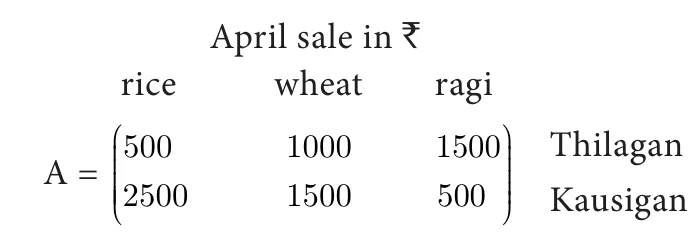
A 2×3 matrix A titled 'April sale in ₹' with column headings rice, wheat, ragi and row labels Thilagan (500, 1000, 1500) and Kausigan (2500, 1500, 500).
  1. May sale =2A=2A.

  2. Total of April and May =A+2A=3A=A+2A=3A

  3. 3A=(150030004500750045001500)3A=\begin{pmatrix} 1500 & 3000 & 4500 \\ 7500 & 4500 & 1500 \end{pmatrix}

  4. Average =3A2=\dfrac{3A}{2}

Answer

12(150030004500750045001500)=(7501500225037502250750)\dfrac{1}{2}\begin{pmatrix} 1500 & 3000 & 4500 \\ 7500 & 4500 & 1500 \end{pmatrix}=\begin{pmatrix} 750 & 1500 & 2250 \\ 3750 & 2250 & 750 \end{pmatrix} (Thilagan: ₹750, ₹1500, ₹2250; Kausigan: ₹3750, ₹2250, ₹750)

(ii)

If the sales continues to increase in the same way in the successive months, what will be sales in the month of August?

  1. Each month the sale doubles.

  2. April =A=A, May =2A=2A, June =22A=2^2A, July =23A=2^3A, August =24A=2^4A

  3. 16A=16(5001000150025001500500)16A=16\begin{pmatrix} 500 & 1000 & 1500 \\ 2500 & 1500 & 500 \end{pmatrix}

Answer

(8000160002400040000240008000)\begin{pmatrix} 8000 & 16000 & 24000 \\ 40000 & 24000 & 8000 \end{pmatrix} (Thilagan: ₹8000, ₹16000, ₹24000; Kausigan: ₹40000, ₹24000, ₹8000)

Q18. If cos⁡θ(cos⁡θsin⁡θ−sin⁡θcos⁡θ)+sin⁡θ(x−cos⁡θcos⁡θx)=I2\cos\theta \begin{pmatrix} \cos\theta & \sin\theta \\ -\sin\theta & \cos\theta \end{pmatrix} + \sin\theta \begin{pmatrix} x & -\cos\theta \\ \cos\theta & x \end{pmatrix} = I_2 , find xx .

  1. Multiply each matrix by its scalar and add.

  2. (cos⁡2θsin⁡θcos⁡θ−sin⁡θcos⁡θcos⁡2θ)+(xsin⁡θ−sin⁡θcos⁡θsin⁡θcos⁡θxsin⁡θ)\begin{pmatrix} \cos^2\theta & \sin\theta\cos\theta \\ -\sin\theta\cos\theta & \cos^2\theta \end{pmatrix}+\begin{pmatrix} x\sin\theta & -\sin\theta\cos\theta \\ \sin\theta\cos\theta & x\sin\theta \end{pmatrix}

  3. =(cos⁡2θ+xsin⁡θ00cos⁡2θ+xsin⁡θ)=\begin{pmatrix} \cos^2\theta+x\sin\theta & 0 \\ 0 & \cos^2\theta+x\sin\theta \end{pmatrix}

  4. This equals I2I_2, so cos⁡2θ+xsin⁡θ=1\cos^2\theta+x\sin\theta=1

  5. xsin⁡θ=1−cos⁡2θ=sin⁡2θx\sin\theta=1-\cos^2\theta=\sin^2\theta

Answer

x=sin⁡θx=\sin\theta

Q19. Given A=(p002), B=(0−q10), C=(2−222)A = \begin{pmatrix} p & 0 \\ 0 & 2 \end{pmatrix},\ B = \begin{pmatrix} 0 & -q \\ 1 & 0 \end{pmatrix},\ C = \begin{pmatrix} 2 & -2 \\ 2 & 2 \end{pmatrix} and if BA=C2BA = C^2 , find pp and qq .

  1. BA=(0−q10)(p002)=(0−2qp0)BA=\begin{pmatrix} 0 & -q \\ 1 & 0 \end{pmatrix}\begin{pmatrix} p & 0 \\ 0 & 2 \end{pmatrix}=\begin{pmatrix} 0 & -2q \\ p & 0 \end{pmatrix}

  2. C2=(2−222)(2−222)=(0−880)C^2=\begin{pmatrix} 2 & -2 \\ 2 & 2 \end{pmatrix}\begin{pmatrix} 2 & -2 \\ 2 & 2 \end{pmatrix}=\begin{pmatrix} 0 & -8 \\ 8 & 0 \end{pmatrix}

  3. Equating corresponding entries:

  4. −2q=−8⇒q=4-2q=-8 \Rightarrow q=4

  5. p=8p=8

Answer

p=8, q=4p=8,\ q=4

Q20. A=(3045), B=(6385), C=(3611)A = \begin{pmatrix} 3 & 0 \\ 4 & 5 \end{pmatrix},\ B = \begin{pmatrix} 6 & 3 \\ 8 & 5 \end{pmatrix},\ C = \begin{pmatrix} 3 & 6 \\ 1 & 1 \end{pmatrix} find the matrix DD , such that CD−AB=0CD - AB = 0

Show steps (8)
  1. CD−AB=0⇒CD=ABCD-AB=0 \Rightarrow CD=AB

  2. AB=(3045)(6385)=(1896437)AB=\begin{pmatrix} 3 & 0 \\ 4 & 5 \end{pmatrix}\begin{pmatrix} 6 & 3 \\ 8 & 5 \end{pmatrix}=\begin{pmatrix} 18 & 9 \\ 64 & 37 \end{pmatrix}

  3. Let D=(abcd)D=\begin{pmatrix} a & b \\ c & d \end{pmatrix}.

  4. CD=(3a+6c3b+6da+cb+d)=(1896437)CD=\begin{pmatrix} 3a+6c & 3b+6d \\ a+c & b+d \end{pmatrix}=\begin{pmatrix} 18 & 9 \\ 64 & 37 \end{pmatrix}

  5. a+c=64a+c=64 and 3a+6c=18⇒3(64−c)+6c=183a+6c=18 \Rightarrow 3(64-c)+6c=18

  6. 192+3c=18⇒c=−58, a=122192+3c=18 \Rightarrow c=-58,\ a=122

  7. b+d=37b+d=37 and 3b+6d=9⇒3(37−d)+6d=93b+6d=9 \Rightarrow 3(37-d)+6d=9

  8. 111+3d=9⇒d=−34, b=71111+3d=9 \Rightarrow d=-34,\ b=71

Answer

D=(12271−58−34)D=\begin{pmatrix} 122 & 71 \\ -58 & -34 \end{pmatrix}

Quick check

  1. y2+1y2y^2 + \dfrac{1}{y^2} is not equal to

    1. (1) y4+1y2\dfrac{y^4 + 1}{y^2}
    2. (2) (y+1y)2\left(y + \dfrac{1}{y}\right)^2
    3. (3) (y−1y)2+2\left(y - \dfrac{1}{y}\right)^2 + 2
    4. (4) (y+1y)2−2\left(y + \dfrac{1}{y}\right)^2 - 2
    Show answer

    Answer: (2) (y+1y)2\left(y + \dfrac{1}{y}\right)^2

    1. (y+1y)2=y2+2+1y2\left(y + \dfrac{1}{y}\right)^2 = y^2 + 2 + \dfrac{1}{y^2}, which is 22 more than y2+1y2y^2 + \dfrac{1}{y^2}.

    2. Options (A), (C), (D) all simplify to y2+1y2y^2 + \dfrac{1}{y^2}.

    3. So (B) is the one that is not equal.

    Question 1 of 5
  2. The number of points of intersection of the quadratic polynomial x2+4x+4x^2 + 4x + 4 with the XX axis is

    1. (1) 00
    2. (2) 11
    3. (3) 00 or 11
    4. (4) 22
    Show answer

    Answer: (2) 11

    1. x2+4x+4=(x+2)2x^2 + 4x + 4 = (x+2)^2.

    2. It has equal roots x=−2,−2x = -2, -2.

    3. So the curve touches the XX axis at exactly one point.

    Question 2 of 5
  3. Which of the following should be added to make x4+64x^4 + 64 a perfect square

    1. (1) 4x24x^2
    2. (2) 16x216x^2
    3. (3) 8x28x^2
    4. (4) −8x2-8x^2
    Show answer

    Answer: (2) 16x216x^2

    1. For (x2+8)2=x4+16x2+64(x^2 + 8)^2 = x^4 + 16x^2 + 64.

    2. Given expression has x4+64x^4 + 64, so the missing middle term is 16x216x^2.

    Question 3 of 5
  4. If number of columns and rows are not equal in a matrix then it is said to be a

    1. (1) diagonal matrix
    2. (2) rectangular matrix
    3. (3) square matrix
    4. (4) identity matrix
    Show answer

    Answer: (2) rectangular matrix

    1. A matrix with number of rows ≠\ne number of columns is a rectangular matrix.

    Question 4 of 5
  5. If (x−6)(x - 6) is the HCF of x2−2x−24x^2 - 2x - 24 and x2−kx−6x^2 - kx - 6 then the value of kk is

    1. (1) 33
    2. (2) 55
    3. (3) 66
    4. (4) 88
    Show answer

    Answer: (2) 55

    1. x2−2x−24=(x−6)(x+4)x^2 - 2x - 24 = (x-6)(x+4), so (x−6)(x-6) is a factor.

    2. Since (x−6)(x-6) is the HCF, it must divide x2−kx−6x^2 - kx - 6.

    3. So x=6x = 6 makes it zero: 36−6k−6=036 - 6k - 6 = 0.

    4. 6k=30⇒k=56k = 30 \Rightarrow k = 5.

    Question 5 of 5
Chapter 3 formulas
  • Roots of a quadratic equation

    ax2+bx+c=0,  (a≠0)  ⇒  x=−b±b2−4ac2aax^2 + bx + c = 0,\; (a \neq 0) \;\Rightarrow\; x = \dfrac{-b \pm \sqrt{b^2 - 4ac}}{2a}

  • Sum of the roots

    α+β=−ba=−Co-efficient of xCo-efficient of x2\alpha + \beta = \dfrac{-b}{a} = \dfrac{-\text{Co-efficient of } x}{\text{Co-efficient of } x^2}

  • Product of the roots

    αβ=ca=Constant termCo-efficient of x2\alpha\beta = \dfrac{c}{a} = \dfrac{\text{Constant term}}{\text{Co-efficient of } x^2}

  • Quadratic equation formed from its roots

    x2−(α+β)x+αβ=0x^2 - (\alpha + \beta)x + \alpha\beta = 0

  • Discriminant

    Δ=b2−4ac\Delta = b^2 - 4ac

  • Nature of roots: real and unequal

    Δ>0  ⇒  the roots are real and unequal\Delta > 0 \;\Rightarrow\; \text{the roots are real and unequal}

  • Nature of roots: real and equal

    Δ=0  ⇒  the roots are real and equal\Delta = 0 \;\Rightarrow\; \text{the roots are real and equal}

  • Nature of roots: no real roots

    Δ<0  ⇒  there are no real roots\Delta < 0 \;\Rightarrow\; \text{there are no real roots}

  • Cases for a system of linear equations in three variables

    (i) Unique solution(ii) Infinitely many solutions(iii) No solution\text{(i) Unique solution}\quad \text{(ii) Infinitely many solutions}\quad \text{(iii) No solution}

  • LCM of algebraic expressions

    LCM=expression of lowest degree that each given expression exactly divides\text{LCM} = \text{expression of lowest degree that each given expression exactly divides}

  • Quadratic polynomial and its zeroes

    p(x)=ax2+bx+c  (a≠0)  ⇒  p(x) has atmost two zeroes, which lie on the x-axisp(x) = ax^2 + bx + c \;(a \neq 0) \;\Rightarrow\; p(x) \text{ has atmost two zeroes, which lie on the } x\text{-axis}

  • Order of a matrix

    Order of A=(Number of rows)×(Number of columns)=m×n\text{Order of } A = (\text{Number of rows}) \times (\text{Number of columns}) = m \times n

  • Row matrix (row vector)

    A=(a11a12⋯a1n)1×nA = \begin{pmatrix} a_{11} & a_{12} & \cdots & a_{1n} \end{pmatrix}_{1 \times n}

  • Column matrix (column vector)

    A=(a11a21⋮am1)m×1A = \begin{pmatrix} a_{11} \\ a_{21} \\ \vdots \\ a_{m1} \end{pmatrix}_{m \times 1}

  • Square matrix

    Number of rows=Number of columns,  order n×n\text{Number of rows} = \text{Number of columns},\; \text{order } n \times n

  • Zero matrix (null matrix)

    aij=0 for all i, ja_{ij} = 0 \text{ for all } i,\, j

  • Transpose of a matrix

    (AT)ij=aji(rows and columns of A interchanged)\left(A^{T}\right)_{ij} = a_{ji} \quad (\text{rows and columns of } A \text{ interchanged})

  • Diagonal matrix

    aij=0 for i≠j(square matrix)a_{ij} = 0 \text{ for } i \neq j \quad (\text{square matrix})

  • Scalar matrix

    aij={k,i=j0,i≠ja_{ij} = \begin{cases} k, & i = j \\ 0, & i \neq j \end{cases}

  • Identity matrix (unit matrix)

    aij={1,i=j0,i≠ja_{ij} = \begin{cases} 1, & i = j \\ 0, & i \neq j \end{cases}

  • Lower triangular matrix

    aij=0 for i<j(all entries above the leading diagonal are zero)a_{ij} = 0 \text{ for } i < j \quad (\text{all entries above the leading diagonal are zero})

  • Upper triangular matrix

    aij=0 for i>j(all entries below the leading diagonal are zero)a_{ij} = 0 \text{ for } i > j \quad (\text{all entries below the leading diagonal are zero})

  • Equality of matrices

    A=B  ⟺  same order and aij=bij for all i, jA = B \iff \text{same order and } a_{ij} = b_{ij} \text{ for all } i,\, j

Answers checked against the Samacheer Kalvi textbook · Updated

Spotted a mistake? Email us at [email protected] and we will fix it.