Samacheer Kalvi 10th Maths Exercise 4.1 Solutions

10th Maths Exercise 4.1 solutions (Chapter 4 Geometry) with step-by-step answers for all 17 questions, as per the 2026-27 Samacheer Kalvi textbook.

Answers at a glance11 answers · full steps below
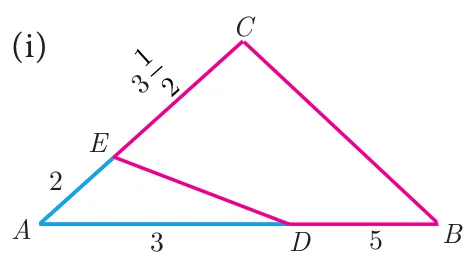
  1. Q1 (i)ΔADE\Delta ADE and ΔABC\Delta ABC are not similar, since ADAB=38≠411=AEAC\dfrac{AD}{AB}=\dfrac{3}{8}\neq\dfrac{4}{11}=\dfrac{AE}{AC}
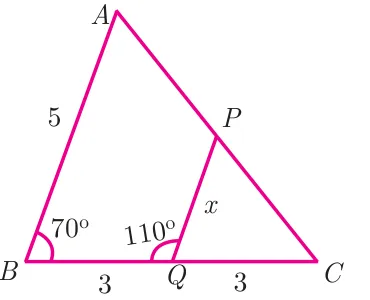
  2. Q1 (ii)ΔCQP∼ΔCBA\Delta CQP \sim \Delta CBA and x=2.5x = 2.5
  3. Q2Height of the lamp post =3.3= 3.3 m
  4. Q3Height of the tower =42= 42 m
  5. Q6CA=5.6CA = 5.6 cm and AQ=3.25AQ = 3.25 cm
  6. Q8EF=2.8EF = 2.8 cm
  7. Q9y=2y = 2 m
  8. Q10ΔP′QR′\Delta P'QR' whose sides are 23\dfrac{2}{3} of the corresponding sides of ΔPQR\Delta PQR
  9. Q11ΔL′MN′\Delta L'MN' whose sides are 45\dfrac{4}{5} of the corresponding sides of ΔLMN\Delta LMN
  10. Q12ΔA′BC′\Delta A'BC' whose sides are 65\dfrac{6}{5} of the corresponding sides of ΔABC\Delta ABC
  11. Q13ΔP′QR′\Delta P'QR' whose sides are 73\dfrac{7}{3} of the corresponding sides of ΔPQR\Delta PQR

Q1. In the given triangles, check which triangles are similar? Also find the …

In the given triangles, check which triangles are similar? Also find the value of xx.

(i)

Triangle ABC with A at bottom-left, B at bottom-right and C at top; E on AC with AE = 2 and EC = 3½, D on AB with AD = 3 and DB = 5, and segment EB drawn inside the triangle.
Show steps (7)
  1. AB=AD+DB=3+5=8AB = AD + DB = 3 + 5 = 8

  2. AC=AE+EC=2+312=112AC = AE + EC = 2 + 3\dfrac{1}{2} = \dfrac{11}{2}

  3. In ΔADE\Delta ADE and ΔABC\Delta ABC, ∠A\angle A is common.

  4. For similarity the sides about ∠A\angle A must be proportional.

  5. ADAB=38\dfrac{AD}{AB} = \dfrac{3}{8} and AEAC=211/2=411\dfrac{AE}{AC} = \dfrac{2}{11/2} = \dfrac{4}{11}

  6. 38≠411\dfrac{3}{8} \neq \dfrac{4}{11}, so the sides are not proportional.

  7. Hence ΔADE\Delta ADE is not similar to ΔABC\Delta ABC (so no value of xx arises from this figure; xx is marked in figure (ii)).

Answer

ΔADE\Delta ADE and ΔABC\Delta ABC are not similar, since ADAB=38≠411=AEAC\dfrac{AD}{AB}=\dfrac{3}{8}\neq\dfrac{4}{11}=\dfrac{AE}{AC}

(ii)

Triangle ABC with apex A, AB = 5, angle B = 70°, point Q on BC with BQ = QC = 3 and angle AQB = 110°, and segment QP = x drawn to point P on AC.
Show steps (9)
  1. ∠AQB=110∘\angle AQB = 110^\circ, and B,Q,CB,Q,C lie on a line.

  2. So ∠PQC=180∘−110∘=70∘\angle PQC = 180^\circ - 110^\circ = 70^\circ.

  3. In ΔCQP\Delta CQP and ΔCBA\Delta CBA:

  4. ∠PQC=∠ABC=70∘\angle PQC = \angle ABC = 70^\circ

  5. ∠C\angle C is common.

  6. By AA similarity, ΔCQP∼ΔCBA\Delta CQP \sim \Delta CBA.

  7. So CQCB=QPBA\dfrac{CQ}{CB} = \dfrac{QP}{BA}

  8. BC=BQ+QC=3+3=6BC = BQ + QC = 3 + 3 = 6

  9. 36=x5\dfrac{3}{6} = \dfrac{x}{5} gives x=52=2.5x = \dfrac{5}{2} = 2.5

Answer

ΔCQP∼ΔCBA\Delta CQP \sim \Delta CBA and x=2.5x = 2.5

Q2. A girl looks the reflection of the top of the lamp post …

A girl looks the reflection of the top of the lamp post on the mirror which is 6.66.6 m away from the foot of the lamppost. The girl whose height is 1.251.25 m is standing 2.52.5 m away from the mirror. Assuming the mirror is placed on the ground facing the sky and the girl, mirror and the lamppost are in a same line, find the height of the lamp post.

Show steps (9)
  1. Let ABAB be the lamp post of height hh m, CC the mirror, DEDE the girl.

  2. BC=6.6BC = 6.6 m, CD=2.5CD = 2.5 m, DE=1.25DE = 1.25 m.

  3. In ΔABC\Delta ABC and ΔEDC\Delta EDC:

  4. ∠ABC=∠EDC=90∘\angle ABC = \angle EDC = 90^\circ (post and girl stand vertically)

  5. ∠ACB=∠ECD\angle ACB = \angle ECD (angle of incidence = angle of reflection)

  6. By AA similarity, ΔABC∼ΔEDC\Delta ABC \sim \Delta EDC.

  7. ABED=BCDC\dfrac{AB}{ED} = \dfrac{BC}{DC}

  8. h1.25=6.62.5\dfrac{h}{1.25} = \dfrac{6.6}{2.5}

  9. h=1.25×6.62.5=3.3h = \dfrac{1.25 \times 6.6}{2.5} = 3.3

Answer

Height of the lamp post =3.3= 3.3 m

Q3. A vertical stick of length 66 m casts a shadow 400400 cm …

A vertical stick of length 66 m casts a shadow 400400 cm long on the ground and at the same time a tower casts a shadow 2828 m long. Using similarity, find the height of the tower.

  1. Shadow of the stick =400= 400 cm =4= 4 m.

  2. The stick and the tower are vertical and the sun's rays fall at the same angle, so the two triangles formed are similar (AA).

  3. height of towerheight of stick=shadow of towershadow of stick\dfrac{\text{height of tower}}{\text{height of stick}} = \dfrac{\text{shadow of tower}}{\text{shadow of stick}}

  4. h6=284\dfrac{h}{6} = \dfrac{28}{4}

  5. h=6×284=42h = \dfrac{6 \times 28}{4} = 42

Answer

Height of the tower =42= 42 m

Q4. Two triangles QPRQPR and QSRQSR , right angled at PP and SS …

Two triangles QPRQPR and QSRQSR, right angled at PP and SS respectively are drawn on the same base QRQR and on the same side of QRQR. If PRPR and SQSQ intersect at TT, prove that PT×TR=ST×TQPT \times TR = ST \times TQ.

Show steps (7)
  1. PRPR and SQSQ meet at TT.

  2. In ΔPTQ\Delta PTQ and ΔSTR\Delta STR:

  3. ∠TPQ=∠TSR=90∘\angle TPQ = \angle TSR = 90^\circ (given right angles at PP and SS)

  4. ∠PTQ=∠STR\angle PTQ = \angle STR (vertically opposite angles)

  5. By AA similarity, ΔPTQ∼ΔSTR\Delta PTQ \sim \Delta STR.

  6. Hence PTST=TQTR\dfrac{PT}{ST} = \dfrac{TQ}{TR}

  7. Cross multiplying, PT×TR=ST×TQPT \times TR = ST \times TQ.

Answer

ΔPTQ∼ΔSTR\Delta PTQ \sim \Delta STR, hence PT×TR=ST×TQPT \times TR = ST \times TQ

Q5. In the adjacent figure, ΔABC\Delta ABC is right angled at C and DE⊥ABDE \perp AB …

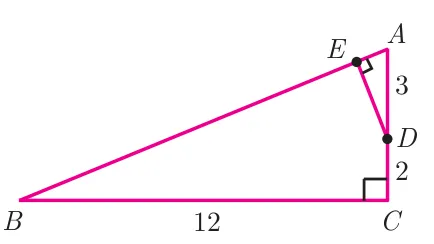
In the adjacent figure, ΔABC\Delta ABC is right angled at C and DE⊥ABDE \perp AB. Prove that ΔABC∼ΔADE\Delta ABC \sim \Delta ADE and hence find the lengths of AEAE and DEDE.

Right triangle ABC with the right angle at C, base BC = 12, point D on CA with AD = 3 and DC = 2, and DE drawn perpendicular to the hypotenuse AB at point E near A.
Show steps (9)
  1. In ΔABC\Delta ABC and ΔADE\Delta ADE:

  2. ∠A\angle A is common

  3. ∠ACB=∠AED=90∘\angle ACB = \angle AED = 90^\circ (given ∠C=90∘\angle C = 90^\circ, DE⊥ABDE \perp AB)

  4. By AA similarity, ΔABC∼ΔADE\Delta ABC \sim \Delta ADE.

  5. AC=AD+DC=3+2=5AC = AD + DC = 3 + 2 = 5

  6. In right ΔABC\Delta ABC, AB2=AC2+BC2=52+122=169AB^2 = AC^2 + BC^2 = 5^2 + 12^2 = 169, so AB=13AB = 13.

  7. From similarity, ABAD=ACAE=BCDE\dfrac{AB}{AD} = \dfrac{AC}{AE} = \dfrac{BC}{DE}

  8. 133=5AE\dfrac{13}{3} = \dfrac{5}{AE} gives AE=1513AE = \dfrac{15}{13}

  9. 133=12DE\dfrac{13}{3} = \dfrac{12}{DE} gives DE=3613DE = \dfrac{36}{13}

Answer

ΔABC∼ΔADE\Delta ABC \sim \Delta ADE, AE=1513AE = \dfrac{15}{13} cm and DE=3613DE = \dfrac{36}{13} cm

Q6. In the adjacent figure, ΔACB∼ΔAPQ\Delta ACB \sim \Delta APQ . If BC=8BC = 8 cm, PQ=4PQ = 4 cm, BA=6.5BA = 6.5 …

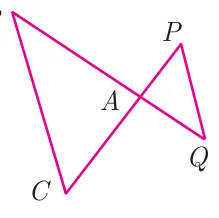
In the adjacent figure, ΔACB∼ΔAPQ\Delta ACB \sim \Delta APQ. If BC=8BC = 8 cm, PQ=4PQ = 4 cm, BA=6.5BA = 6.5 cm and AP=2.8AP = 2.8 cm, find CACA and AQAQ.

Two triangles ACB and APQ meeting at the common vertex A to form a bow-tie shape, with B and C on the left and P and Q on the right.
  1. ΔACB∼ΔAPQ\Delta ACB \sim \Delta APQ, so ACAP=CBPQ=ABAQ\dfrac{AC}{AP} = \dfrac{CB}{PQ} = \dfrac{AB}{AQ}

  2. CBPQ=84=2\dfrac{CB}{PQ} = \dfrac{8}{4} = 2

  3. CAAP=2⇒CA=2×2.8=5.6\dfrac{CA}{AP} = 2 \Rightarrow CA = 2 \times 2.8 = 5.6 cm

  4. ABAQ=2⇒AQ=6.52=3.25\dfrac{AB}{AQ} = 2 \Rightarrow AQ = \dfrac{6.5}{2} = 3.25 cm

Answer

CA=5.6CA = 5.6 cm and AQ=3.25AQ = 3.25 cm

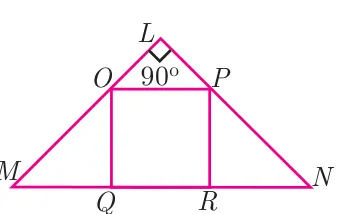
Q7. If figure OPRQOPRQ is a square and ∠MLN=90∘\angle MLN = 90^\circ . Prove that

If figure OPRQOPRQ is a square and ∠MLN=90∘\angle MLN = 90^\circ. Prove that

(i)

ΔLOP∼ΔQMO\Delta LOP \sim \Delta QMO

Triangle MLN with a right angle of 90° at apex L and a square OPRQ inscribed with O on LM, P on LN, and Q and R on the base MN.
Show steps (8)
  1. OPRQOPRQ is a square, so ∠POQ=90∘\angle POQ = 90^\circ and OQ⊥MNOQ \perp MN.

  2. In ΔLOP\Delta LOP and ΔQMO\Delta QMO:

  3. ∠OLP=90∘\angle OLP = 90^\circ (given ∠MLN=90∘\angle MLN = 90^\circ) and ∠OQM=90∘\angle OQM = 90^\circ, so ∠OLP=∠OQM\angle OLP = \angle OQM.

  4. Since L,O,ML, O, M are collinear, ∠LOP+∠POQ+∠QOM=180∘\angle LOP + \angle POQ + \angle QOM = 180^\circ

  5. As ∠POQ=90∘\angle POQ = 90^\circ, we get ∠LOP+∠QOM=90∘\angle LOP + \angle QOM = 90^\circ … (1)

  6. In ΔQMO\Delta QMO, ∠OQM=90∘\angle OQM = 90^\circ, so ∠QOM+∠QMO=90∘\angle QOM + \angle QMO = 90^\circ … (2)

  7. From (1) and (2), ∠LOP=∠QMO\angle LOP = \angle QMO.

  8. By AA similarity, ΔLOP∼ΔQMO\Delta LOP \sim \Delta QMO.

Answer

ΔLOP∼ΔQMO\Delta LOP \sim \Delta QMO (by AA similarity)

(ii)

ΔLOP∼ΔRPN\Delta LOP \sim \Delta RPN

Show steps (8)
  1. OPRQOPRQ is a square, so ∠OPR=90∘\angle OPR = 90^\circ and PR⊥MNPR \perp MN.

  2. In ΔLOP\Delta LOP and ΔRPN\Delta RPN:

  3. ∠OLP=90∘=∠PRN\angle OLP = 90^\circ = \angle PRN

  4. Since L,P,NL, P, N are collinear, ∠LPO+∠OPR+∠RPN=180∘\angle LPO + \angle OPR + \angle RPN = 180^\circ

  5. As ∠OPR=90∘\angle OPR = 90^\circ, ∠LPO+∠RPN=90∘\angle LPO + \angle RPN = 90^\circ … (1)

  6. In ΔRPN\Delta RPN, ∠PRN=90∘\angle PRN = 90^\circ, so ∠RPN+∠PNR=90∘\angle RPN + \angle PNR = 90^\circ … (2)

  7. From (1) and (2), ∠LPO=∠PNR\angle LPO = \angle PNR.

  8. By AA similarity, ΔLOP∼ΔRPN\Delta LOP \sim \Delta RPN.

Answer

ΔLOP∼ΔRPN\Delta LOP \sim \Delta RPN (by AA similarity)

(iii)

ΔQMO∼ΔRPN\Delta QMO \sim \Delta RPN

  1. From (i), ΔLOP∼ΔQMO\Delta LOP \sim \Delta QMO.

  2. From (ii), ΔLOP∼ΔRPN\Delta LOP \sim \Delta RPN.

  3. Two triangles similar to the same triangle are similar to each other.

  4. Hence ΔQMO∼ΔRPN\Delta QMO \sim \Delta RPN.

Answer

ΔQMO∼ΔRPN\Delta QMO \sim \Delta RPN

(iv)

QR2=MQ×RNQR^2 = MQ \times RN

  1. From (iii), ΔQMO∼ΔRPN\Delta QMO \sim \Delta RPN, so corresponding sides are proportional:

  2. QMRP=QORN\dfrac{QM}{RP} = \dfrac{QO}{RN}

  3. QM×RN=QO×RPQM \times RN = QO \times RP

  4. In the square OPRQOPRQ, QO=RP=QRQO = RP = QR.

  5. Therefore MQ×RN=QR×QR=QR2MQ \times RN = QR \times QR = QR^2.

Answer

QR2=MQ×RNQR^2 = MQ \times RN

Q8. If ΔABC∼ΔDEF\Delta ABC \sim \Delta DEF such that area of ΔABC\Delta ABC is 9cm2^2 and the area …

If ΔABC∼ΔDEF\Delta ABC \sim \Delta DEF such that area of ΔABC\Delta ABC is 9cm2^2 and the area of ΔDEF\Delta DEF is 16cm2^2 and BC=2.1BC = 2.1 cm. Find the length of EFEF.

  1. The ratio of areas of similar triangles equals the ratio of squares of corresponding sides.

  2. Area(ΔABC)Area(ΔDEF)=BC2EF2\dfrac{\text{Area}(\Delta ABC)}{\text{Area}(\Delta DEF)} = \dfrac{BC^2}{EF^2}

  3. 916=(2.1)2EF2\dfrac{9}{16} = \dfrac{(2.1)^2}{EF^2}

  4. 34=2.1EF\dfrac{3}{4} = \dfrac{2.1}{EF}

  5. EF=4×2.13=2.8EF = \dfrac{4 \times 2.1}{3} = 2.8

Answer

EF=2.8EF = 2.8 cm

Q9. Two vertical poles of heights 66 m and 33 m are erected …

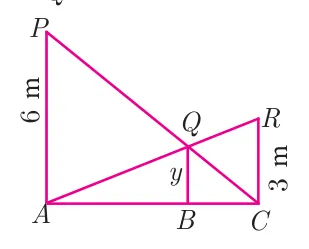
Two vertical poles of heights 66 m and 33 m are erected above a horizontal ground ACAC. Find the value of yy.

Two vertical poles, AP of height 6 m at A and CR of height 3 m at C, standing on horizontal ground AC, with lines PC and AR crossing at Q and the vertical distance QB from Q to the ground labelled y.
Show steps (8)
  1. Let AP=6AP = 6 m, CR=3CR = 3 m and QB=yQB = y, with AB=x1AB = x_1, BC=x2BC = x_2, AC=x1+x2AC = x_1 + x_2.

  2. In ΔABQ\Delta ABQ and ΔACR\Delta ACR: ∠A\angle A common, ∠ABQ=∠ACR=90∘\angle ABQ = \angle ACR = 90^\circ, so they are similar.

  3. QBRC=ABAC⇒y3=x1x1+x2\dfrac{QB}{RC} = \dfrac{AB}{AC} \Rightarrow \dfrac{y}{3} = \dfrac{x_1}{x_1+x_2}

  4. In ΔCBQ\Delta CBQ and ΔCAP\Delta CAP: ∠C\angle C common, ∠CBQ=∠CAP=90∘\angle CBQ = \angle CAP = 90^\circ, so they are similar.

  5. QBPA=CBCA⇒y6=x2x1+x2\dfrac{QB}{PA} = \dfrac{CB}{CA} \Rightarrow \dfrac{y}{6} = \dfrac{x_2}{x_1+x_2}

  6. Adding: y3+y6=x1+x2x1+x2=1\dfrac{y}{3} + \dfrac{y}{6} = \dfrac{x_1+x_2}{x_1+x_2} = 1

  7. y(13+16)=1⇒y×12=1y\left(\dfrac{1}{3} + \dfrac{1}{6}\right) = 1 \Rightarrow y \times \dfrac{1}{2} = 1

  8. y=2y = 2

Answer

y=2y = 2 m

Q10. Construct a triangle similar to a given triangle PQRPQR with its sides …

Construct a triangle similar to a given triangle PQRPQR with its sides equal to 23\frac{2}{3} of the corresponding sides of the triangle PQRPQR (scale factor 23<1\frac{2}{3} < 1).

Show steps (7)
  1. Scale factor 23<1\dfrac{2}{3} < 1, so the new triangle is smaller.

  2. Step 1: Construct ΔPQR\Delta PQR with any measurement.

  3. Step 2: Draw a ray QXQX making an acute angle with QRQR on the side opposite to the vertex PP.

  4. Step 3: Locate 3 points (greater of 2 and 3) Q1,Q2,Q3Q_1, Q_2, Q_3 on QXQX so that QQ1=Q1Q2=Q2Q3QQ_1 = Q_1Q_2 = Q_2Q_3.

  5. Step 4: Join Q3RQ_3R. Draw a line through Q2Q_2 (2 being smaller of 2 and 3) parallel to Q3RQ_3R meeting QRQR at R′R'.

  6. Step 5: Draw a line through R′R' parallel to RPRP meeting QPQP at P′P'.

  7. ΔP′QR′\Delta P'QR' is the required triangle.

Answer

ΔP′QR′\Delta P'QR' whose sides are 23\dfrac{2}{3} of the corresponding sides of ΔPQR\Delta PQR

Q11. Construct a triangle similar to a given triangle LMNLMN with its sides …

Construct a triangle similar to a given triangle LMNLMN with its sides equal to 45\frac{4}{5} of the corresponding sides of the triangle LMNLMN (scale factor 45<1\frac{4}{5} < 1).

Show steps (7)
  1. Scale factor 45<1\dfrac{4}{5} < 1, so the new triangle is smaller.

  2. Step 1: Construct ΔLMN\Delta LMN with any measurement.

  3. Step 2: Draw a ray MXMX making an acute angle with MNMN on the side opposite to the vertex LL.

  4. Step 3: Locate 5 points M1,M2,M3,M4,M5M_1, M_2, M_3, M_4, M_5 on MXMX so that MM1=M1M2=M2M3=M3M4=M4M5MM_1 = M_1M_2 = M_2M_3 = M_3M_4 = M_4M_5.

  5. Step 4: Join M5NM_5N. Draw a line through M4M_4 parallel to M5NM_5N meeting MNMN at N′N'.

  6. Step 5: Draw a line through N′N' parallel to NLNL meeting MLML at L′L'.

  7. ΔL′MN′\Delta L'MN' is the required triangle.

Answer

ΔL′MN′\Delta L'MN' whose sides are 45\dfrac{4}{5} of the corresponding sides of ΔLMN\Delta LMN

Q12. Construct a triangle similar to a given triangle ABCABC with its sides …

Construct a triangle similar to a given triangle ABCABC with its sides equal to 65\frac{6}{5} of the corresponding sides of the triangle ABCABC (scale factor 65>1\frac{6}{5} > 1).

Show steps (7)
  1. Scale factor 65>1\dfrac{6}{5} > 1, so the new triangle is larger.

  2. Step 1: Construct ΔABC\Delta ABC with any measurement.

  3. Step 2: Draw a ray BXBX making an acute angle with BCBC on the side opposite to the vertex AA.

  4. Step 3: Locate 6 points (greater of 6 and 5) B1,B2,…,B6B_1, B_2, \ldots, B_6 on BXBX with BB1=B1B2=⋯=B5B6BB_1 = B_1B_2 = \cdots = B_5B_6.

  5. Step 4: Join B5B_5 (5 being smaller of 6 and 5) to CC. Draw a line through B6B_6 parallel to B5CB_5C meeting the extended BCBC at C′C'.

  6. Step 5: Draw a line through C′C' parallel to CACA meeting the extended BABA at A′A'.

  7. ΔA′BC′\Delta A'BC' is the required triangle.

Answer

ΔA′BC′\Delta A'BC' whose sides are 65\dfrac{6}{5} of the corresponding sides of ΔABC\Delta ABC

Q13. Construct a triangle similar to a given triangle PQRPQR with its sides …

Construct a triangle similar to a given triangle PQRPQR with its sides equal to 73\frac{7}{3} of the corresponding sides of the triangle PQRPQR (scale factor 73>1\frac{7}{3} > 1).

Show steps (7)
  1. Scale factor 73>1\dfrac{7}{3} > 1, so the new triangle is larger.

  2. Step 1: Construct ΔPQR\Delta PQR with any measurement.

  3. Step 2: Draw a ray QXQX making an acute angle with QRQR on the side opposite to the vertex PP.

  4. Step 3: Locate 7 points Q1,Q2,…,Q7Q_1, Q_2, \ldots, Q_7 on QXQX with QQ1=Q1Q2=⋯=Q6Q7QQ_1 = Q_1Q_2 = \cdots = Q_6Q_7.

  5. Step 4: Join Q3RQ_3R (3 being smaller of 7 and 3). Draw a line through Q7Q_7 parallel to Q3RQ_3R meeting the extended QRQR at R′R'.

  6. Step 5: Draw a line through R′R' parallel to RPRP meeting the extended QPQP at P′P'.

  7. ΔP′QR′\Delta P'QR' is the required triangle.

Answer

ΔP′QR′\Delta P'QR' whose sides are 73\dfrac{7}{3} of the corresponding sides of ΔPQR\Delta PQR

Quick check

  1. How many tangents can be drawn to the circle from an exterior point?

    1. (1) one
    2. (2) two
    3. (3) infinite
    4. (4) zero
    Show answer

    Answer: (2) two

    1. From a point outside a circle exactly two tangent lines can be drawn.

    2. (From a point on the circle only one, from an interior point none.)

    Question 1 of 5
  2. In a given figure ST∥QRST \parallel QR, PS=2PS = 2 cm and SQ=3SQ = 3 cm. Then the ratio of the area of ΔPQR\Delta PQR to the area of ΔPST\Delta PST is

    1. (1) 25:425 : 4
    2. (2) 25:725 : 7
    3. (3) 25:1125 : 11
    4. (4) 25:1325 : 13
    Show answer

    Answer: (1) 25:425 : 4

    1. PQ=PS+SQ=2+3=5PQ=PS+SQ=2+3=5 cm.

    2. ST∥QR⇒ΔPST∼ΔPQRST\parallel QR \Rightarrow \Delta PST \sim \Delta PQR.

    3. [ΔPQR][ΔPST]=PQ2PS2=5222=254\dfrac{[\Delta PQR]}{[\Delta PST]}=\dfrac{PQ^2}{PS^2}=\dfrac{5^2}{2^2}=\dfrac{25}{4}.

    Question 2 of 5
  3. Two poles of heights 6 m and 11 m stand vertically on a plane ground. If the distance between their feet is 12 m, what is the distance between their tops?

    1. (1) 1313 m
    2. (2) 1414 m
    3. (3) 1515 m
    4. (4) 12.812.8 m
    Show answer

    Answer: (1) 1313 m

    1. Difference of heights =11−6=5=11-6=5 m.

    2. Distance between feet =12=12 m.

    3. Distance between tops =122+52=144+25=169=\sqrt{12^2+5^2}=\sqrt{144+25}=\sqrt{169}

    4. =13=13 m.

    Question 3 of 5
  4. In the given figure, PR=26PR = 26 cm, QR=24QR = 24 cm, ∠PAQ=90∘\angle PAQ = 90^\circ, PA=6PA = 6 cm and QA=8QA = 8 cm. Find ∠PQR\angle PQR

    1. (1) 80∘80^\circ
    2. (2) 85∘85^\circ
    3. (3) 75∘75^\circ
    4. (4) 90∘90^\circ
    Show answer

    Answer: (4) 90∘90^\circ

    1. In right ΔPAQ\Delta PAQ, PQ2=PA2+QA2=62+82=100PQ^2=PA^2+QA^2=6^2+8^2=100, so PQ=10PQ=10 cm.

    2. Now PQ2+QR2=102+242=100+576=676PQ^2+QR^2=10^2+24^2=100+576=676.

    3. PR2=262=676PR^2=26^2=676.

    4. Since PQ2+QR2=PR2PQ^2+QR^2=PR^2, by converse of Pythagoras theorem ∠PQR=90∘\angle PQR=90^\circ.

    Question 4 of 5
  5. In ΔLMN\Delta LMN, ∠L=60∘\angle L = 60^\circ, ∠M=50∘\angle M = 50^\circ. If ΔLMN∼ΔPQR\Delta LMN \sim \Delta PQR then the value of ∠R\angle R is

    1. (1) 40∘40^\circ
    2. (2) 70∘70^\circ
    3. (3) 30∘30^\circ
    4. (4) 110∘110^\circ
    Show answer

    Answer: (2) 70∘70^\circ

    1. In ΔLMN\Delta LMN, ∠N=180∘−(60∘+50∘)=70∘\angle N = 180^\circ-(60^\circ+50^\circ)=70^\circ.

    2. ΔLMN∼ΔPQR\Delta LMN \sim \Delta PQR gives ∠R=∠N\angle R = \angle N.

    3. ∠R=70∘\angle R = 70^\circ.

    Question 5 of 5
Chapter 4 formulas
  • Similar triangles — equal corresponding angles

    △ABC∼△PQR⇒∠A=∠P, ∠B=∠Q, ∠C=∠R\triangle ABC \sim \triangle PQR \Rightarrow \angle A = \angle P,\ \angle B = \angle Q,\ \angle C = \angle R

  • Similar triangles — proportional corresponding sides

    △ABC∼△PQR⇒ABPQ=BCQR=CARP\triangle ABC \sim \triangle PQR \Rightarrow \dfrac{AB}{PQ} = \dfrac{BC}{QR} = \dfrac{CA}{RP}

  • AA (same as AAA) similarity criterion

    ∠A=∠P, ∠B=∠Q⇒△ABC∼△PQR\angle A = \angle P,\ \angle B = \angle Q \Rightarrow \triangle ABC \sim \triangle PQR

  • SAS similarity criterion

    ∠A=∠P and ABPQ=ACPR⇒△ABC∼△PQR\angle A = \angle P \text{ and } \dfrac{AB}{PQ} = \dfrac{AC}{PR} \Rightarrow \triangle ABC \sim \triangle PQR

  • SSS similarity criterion

    ABPQ=BCQR=CARP⇒△ABC∼△PQR\dfrac{AB}{PQ} = \dfrac{BC}{QR} = \dfrac{CA}{RP} \Rightarrow \triangle ABC \sim \triangle PQR

  • Ratio of perimeters of similar triangles

    Perimeter of △ABCPerimeter of △PQR=ABPQ=BCQR=CARP\dfrac{\text{Perimeter of } \triangle ABC}{\text{Perimeter of } \triangle PQR} = \dfrac{AB}{PQ} = \dfrac{BC}{QR} = \dfrac{CA}{RP}

  • Ratio of areas of similar triangles

    Area of △ABCArea of △PQR=AB2PQ2=BC2QR2=CA2RP2\dfrac{\text{Area of } \triangle ABC}{\text{Area of } \triangle PQR} = \dfrac{AB^2}{PQ^2} = \dfrac{BC^2}{QR^2} = \dfrac{CA^2}{RP^2}

  • Tangent perpendicular to radius at the point of contact

    OP⊥PT, i.e. ∠OPT=90∘OP \perp PT,\ \text{i.e. } \angle OPT = 90^\circ

  • Number of tangents from an exterior point

    From an exterior point P, exactly 2 tangents can be drawn to a circle\text{From an exterior point } P,\ \text{exactly } 2 \text{ tangents can be drawn to a circle}

  • Lengths of tangents from an exterior point are equal

    PA=PBPA = PB

  • Direct common tangents to two circles

    AB=CD(the two direct common tangents are equal in length)AB = CD \quad (\text{the two direct common tangents are equal in length})

  • Median relation (Apollonius type) — part (i)

    b2=p2+ax+a24b^{2} = p^{2} + ax + \dfrac{a^{2}}{4}

  • Median relation (Apollonius type) — part (ii)

    c2=p2−ax+a24c^{2} = p^{2} - ax + \dfrac{a^{2}}{4}

  • Median relation (Apollonius type) — part (iii)

    b2+c2=2p2+a22b^{2} + c^{2} = 2p^{2} + \dfrac{a^{2}}{2}

Answers checked against the Samacheer Kalvi textbook · Updated

Spotted a mistake? Email us at [email protected] and we will fix it.