
Samacheer Kalvi 10th Maths Exercise 4.2 Solutions
10th Maths Exercise 4.2 solutions (Chapter 4 Geometry) with step-by-step answers for all 19 questions, as per the 2026-27 Samacheer Kalvi textbook.
Answers at a glance
- Q1 (i) cm
- Q1 (ii)
- Q2 cm
- Q5 cm
- Q8 (i) is not the bisector of .
- Q8 (ii) is the bisector of .
- Q11 with cm, and median cm is constructed.
- Q12The triangle is constructed and the altitude from to is cm (approximately).
- Q13 is constructed with cm, and altitude from to equal to cm.
- Q15 with cm, and cm is constructed.
- Q16 with cm, and cm is constructed.
In , and are points on the sides and respectively such that .
(i)
If and cm find .
Show steps (6)
, so by Thales theorem .
, so .
cm
cm
(ii)
If , , and , find the value of .
Show steps (8)
By Thales theorem .
or . Lengths must be positive, so .
is a trapezium in which and are points on and respectively, such that if cm, cm and cm, find .
Show steps (6)
In trapezium , .
So and divide and in the same ratio:
cm
cm
cm
In , and are points on the sides and respectively. Show that if cm, cm, cm and cm.
Show steps (6)
cm
cm
So .
By the converse of Basic Proportionality Theorem, .
Since , by the converse of BPT, .
(i)
.
In , .
By Basic Proportionality Theorem, … (1)
In , .
By Basic Proportionality Theorem, … (2)
From (1) and (2), .
is proved.
(ii)
.
From (i), .
Taking reciprocals, .
is proved.
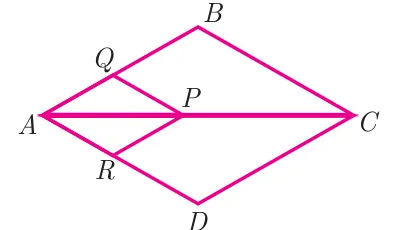
Rhombus PQRB is inscribed in such that is one of its angle. , and lie on , and respectively. If cm and cm, find the sides , of the rhombus.
Show steps (7)
Let each side of the rhombus be cm.
In a rhombus opposite sides are parallel, so , that is .
In , , so .
so
cm
In trapezium , , and are points on non-parallel sides and respectively, such that . Show that .
Show steps (6)
Join ; let it cut at .
In , (since ).
By BPT, … (1)
In , .
By BPT, … (2)
From (1) and (2), .
is proved.
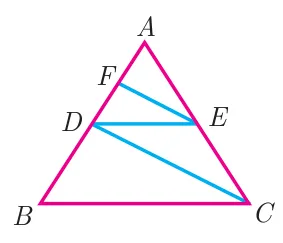
Show steps (6)
In , .
By BPT, … (1)
In , .
By BPT, … (2)
From (1) and (2), .
is proved.
Check whether is bisector of of in each of the following
(i)
cm, cm, cm and cm.
, so .
By the converse of Angle Bisector Theorem, is not the bisector of .
is not the bisector of .
(ii)
cm, cm, cm and cm.
By the converse of Angle Bisector Theorem, is the bisector of .
is the bisector of .
In figure , PS is its bisector. If , prove that .
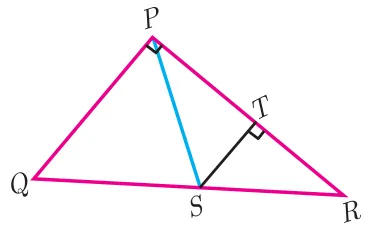
Show steps (8)
In , and is the bisector of , with on .
By the Angle Bisector Theorem, .
Adding to both sides, , that is , so … (1)
Since , ; also , hence .
In , lies on , lies on and , so (AA: common, ).
Hence … (2)
Substituting (1) in (2), .
Cross multiplying, . Hence proved.
is proved.
is a quadrilateral in which , the bisector of and intersect the sides and at the points and respectively. Prove that .
Show steps (7)
In , is the bisector of .
By Angle Bisector Theorem, … (1)
In , is the bisector of .
By Angle Bisector Theorem, … (2)
Given , so from (1) and (2), .
In , lies on and lies on dividing them in the same ratio.
By the converse of BPT, .
is proved.
Construct a which the base cm, and the median from to is cm.
Show steps (7)
Draw a line segment cm.
At , draw such that .
At , draw (i.e. ).
Draw the perpendicular bisector of ; it meets at and at .
With as centre and as radius, draw a circle. The major arc holds the angle .
With as centre and radius cm, draw an arc cutting the circle at (and at ).
Join and . Then is the required triangle.
with cm, and median cm is constructed.
Construct a in which cm, and the median from to is 4.4 cm. Find the length of the altitude from to .
Show steps (8)
Draw a line segment cm.
At , draw such that .
At , draw .
Draw the perpendicular bisector of ; it meets at and at .
With as centre and as radius, draw a circle.
With as centre and radius cm, draw an arc cutting the circle at .
Join and . Then is the required triangle.
From draw and measure .
The triangle is constructed and the altitude from to is cm (approximately).
Construct a such that cm, and the altitude from to is of length 4.5 cm.
Show steps (8)
Draw a line segment cm.
At , draw ray such that (this is the tangent to the required circumcircle at ).
At , draw , i.e. ; the centre of the circle lies on .
Draw the perpendicular bisector of ; let it cut at and at .
With as centre and as radius, draw a circle. Every point on the major arc sees at (angle in the alternate segment).
On , on the same side of as the major arc (the side of ), mark the point with cm.
Through draw the line (i.e. at ); it cuts the circle at and (possible, since the farthest point of the arc is about cm from ).
Join and . Then is the required triangle (taking instead of gives the mirror-image triangle).
is constructed with cm, and altitude from to equal to cm.
Construct a such that cm, and the altitude from to is 4 cm.
Show steps (8)
Draw a line segment cm.
At , draw a ray making with (so will be the tangent at ; by the tangent–chord property the angle in the alternate segment is ).
At , draw , i.e. , on the side of opposite to .
Draw the perpendicular bisector of ; let it meet at and at .
With as centre and () as radius, draw a circle; every point of the major arc on the side of containing sees at .
On , on the same side of as , mark the point with cm (this is the required height).
Through draw the line ; it cuts the circle at (it meets the circle in two points, either one gives the same triangle, the two being mirror images in ).
Join and . Then is the required triangle, since cm, the distance of from is cm, and (angle in the alternate segment).
with cm, and altitude cm from to is constructed as above (the two positions of on give congruent triangles).
Draw a triangle of base cm, and the bisector of meets at such that cm.
Show steps (8)
Draw a line segment cm.
At , draw such that .
At , draw .
Draw the perpendicular bisector of ; it meets at and at .
With as centre and as radius, draw a circle.
From , mark an arc of cm on to get (so cm).
The perpendicular bisector meets the circle at (on the side opposite to the major arc). Join .
Produce to meet the circle at . Join and . Then is the required triangle.
with cm, and cm is constructed.
Draw such that cm, vertical angle is and the bisector of the vertical angle meets the base at where cm.
Show steps (8)
Draw a line segment cm.
At , draw such that .
At , draw .
Draw the perpendicular bisector of ; it meets at and at .
With as centre and as radius, draw a circle.
From , mark an arc of cm on to get .
The perpendicular bisector meets the circle at . Join and produce it to meet the circle at .
Join and . Then is the required triangle, and bisects .
with cm, and cm is constructed.
Quick check
How many tangents can be drawn to the circle from an exterior point?
Question 1 of 5Show answer
Answer: (2) two
From a point outside a circle exactly two tangent lines can be drawn.
(From a point on the circle only one, from an interior point none.)
In a given figure , cm and cm. Then the ratio of the area of to the area of is
Question 2 of 5Show answer
Answer: (1)
cm.
.
.
Two poles of heights 6 m and 11 m stand vertically on a plane ground. If the distance between their feet is 12 m, what is the distance between their tops?
Question 3 of 5Show answer
Answer: (1) m
Difference of heights m.
Distance between feet m.
Distance between tops
m.
In the given figure, cm, cm, , cm and cm. Find
Question 4 of 5Show answer
Answer: (4)
In right , , so cm.
Now .
.
Since , by converse of Pythagoras theorem .
In , , . If then the value of is
Question 5 of 5Show answer
Answer: (2)
In , .
gives .
.
Chapter 4 formulas
- Similar triangles — equal corresponding angles
- Similar triangles — proportional corresponding sides
- AA (same as AAA) similarity criterion
- SAS similarity criterion
- SSS similarity criterion
- Ratio of perimeters of similar triangles
- Ratio of areas of similar triangles
- Tangent perpendicular to radius at the point of contact
- Number of tangents from an exterior point
- Lengths of tangents from an exterior point are equal
- Direct common tangents to two circles
- Median relation (Apollonius type) — part (i)
- Median relation (Apollonius type) — part (ii)
- Median relation (Apollonius type) — part (iii)