Samacheer Kalvi 10th Maths Exercise 4.5 Solutions

10th Maths Exercise 4.5 solutions (Chapter 4 Geometry) with step-by-step answers for all 15 questions, as per the 2026-27 Samacheer Kalvi textbook.

Answers at a glance15 answers · full steps below
  1. Q1(3) ∠B=∠D\angle B = \angle D
  2. Q2(2) 70∘70^\circ
  3. Q3(4) 525\sqrt{2} cm
  4. Q4(1) 25:425 : 4
  5. Q5(4) 1515 cm
  6. Q6(1) 1.41.4 cm
  7. Q7(2) 44 cm
  8. Q8(3) BD⋅CD=AD2BD \cdot CD = AD^2
  9. Q9(1) 1313 m
  10. Q10(4) 90∘90^\circ
  11. Q11(2) point of contact
  12. Q12(2) two
  13. Q13(2) 110∘110^\circ
  14. Q14(4) 44 cm
  15. Q15(1) 120∘120^\circ

Q1. If in triangles ABCABC and EDFEDF , ABDE=BCFD\dfrac{AB}{DE} = \dfrac{BC}{FD} then they will be …

If in triangles ABCABC and EDFEDF, ABDE=BCFD\dfrac{AB}{DE} = \dfrac{BC}{FD} then they will be similar, when

  1. (1) ∠B=∠E\angle B = \angle E
  2. (2) ∠A=∠D\angle A = \angle D
  3. (3) ∠B=∠D\angle B = \angle D
  4. (4) ∠A=∠F\angle A = \angle F
  1. ABDE=BCFD\dfrac{AB}{DE}=\dfrac{BC}{FD}

  2. In ΔABC\Delta ABC the sides ABAB, BCBC include ∠B\angle B.

  3. In ΔEDF\Delta EDF the sides DEDE, FDFD include ∠D\angle D.

  4. By SAS similarity, the included angles must be equal.

  5. So ∠B=∠D\angle B=\angle D.

Answer

(3) ∠B=∠D\angle B = \angle D

Q2. In ΔLMN\Delta LMN , ∠L=60∘\angle L = 60^\circ , ∠M=50∘\angle M = 50^\circ . If ΔLMN∼ΔPQR\Delta LMN \sim \Delta PQR then the value …

In ΔLMN\Delta LMN, ∠L=60∘\angle L = 60^\circ, ∠M=50∘\angle M = 50^\circ. If ΔLMN∼ΔPQR\Delta LMN \sim \Delta PQR then the value of ∠R\angle R is

  1. (1) 40∘40^\circ
  2. (2) 70∘70^\circ
  3. (3) 30∘30^\circ
  4. (4) 110∘110^\circ
  1. In ΔLMN\Delta LMN, ∠N=180∘−(60∘+50∘)=70∘\angle N = 180^\circ-(60^\circ+50^\circ)=70^\circ.

  2. ΔLMN∼ΔPQR\Delta LMN \sim \Delta PQR gives ∠R=∠N\angle R = \angle N.

  3. ∠R=70∘\angle R = 70^\circ.

Answer

(2) 70∘70^\circ

Q3. If ΔABC\Delta ABC is an isosceles triangle with ∠C=90∘\angle C = 90^\circ and AC=5AC = 5 cm, then …

If ΔABC\Delta ABC is an isosceles triangle with ∠C=90∘\angle C = 90^\circ and AC=5AC = 5 cm, then ABAB is

  1. (1) 2.52.5 cm
  2. (2) 55 cm
  3. (3) 1010 cm
  4. (4) 525\sqrt{2} cm
  1. ∠C=90∘\angle C=90^\circ, so ABAB is the hypotenuse and the equal sides are AC=BC=5AC=BC=5 cm.

  2. AB2=AC2+BC2=52+52=50AB^2=AC^2+BC^2=5^2+5^2=50

  3. AB=50=52AB=\sqrt{50}=5\sqrt{2} cm.

Answer

(4) 525\sqrt{2} cm

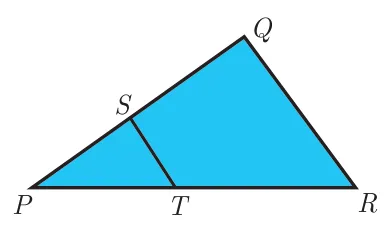
Q4. In a given figure ST∥QRST \parallel QR , PS=2PS = 2 cm and SQ=3SQ = 3 cm. Then …

In a given figure ST∥QRST \parallel QR, PS=2PS = 2 cm and SQ=3SQ = 3 cm. Then the ratio of the area of ΔPQR\Delta PQR to the area of ΔPST\Delta PST is

Triangle PQR with P at bottom-left, R at bottom-right and Q at top-right, with S on PQ and T on PR joined by segment ST parallel to QR; the triangle is shaded blue.
  1. (1) 25:425 : 4
  2. (2) 25:725 : 7
  3. (3) 25:1125 : 11
  4. (4) 25:1325 : 13
  1. PQ=PS+SQ=2+3=5PQ=PS+SQ=2+3=5 cm.

  2. ST∥QR⇒ΔPST∼ΔPQRST\parallel QR \Rightarrow \Delta PST \sim \Delta PQR.

  3. [ΔPQR][ΔPST]=PQ2PS2=5222=254\dfrac{[\Delta PQR]}{[\Delta PST]}=\dfrac{PQ^2}{PS^2}=\dfrac{5^2}{2^2}=\dfrac{25}{4}.

Answer

(1) 25:425 : 4

Q5. The perimeters of two similar triangles ΔABC\Delta ABC and ΔPQR\Delta PQR are 3636 cm …

The perimeters of two similar triangles ΔABC\Delta ABC and ΔPQR\Delta PQR are 3636 cm and 2424 cm respectively. If PQ=10PQ = 10 cm, then the length of ABAB is

  1. (1) 6236\dfrac{2}{3} cm
  2. (2) 1063\dfrac{10\sqrt{6}}{3} cm
  3. (3) 662366\dfrac{2}{3} cm
  4. (4) 1515 cm
  1. In similar triangles, ratio of perimeters = ratio of corresponding sides.

  2. ABPQ=3624\dfrac{AB}{PQ}=\dfrac{36}{24}

  3. AB=10×3624=15AB=10\times\dfrac{36}{24}=15 cm.

Answer

(4) 1515 cm

Q6. If in ΔABC\Delta ABC , DE∥BCDE \parallel BC . AB=3.6AB = 3.6 cm, AC=2.4AC = 2.4 cm and AD=2.1AD = 2.1 …

If in ΔABC\Delta ABC, DE∥BCDE \parallel BC. AB=3.6AB = 3.6 cm, AC=2.4AC = 2.4 cm and AD=2.1AD = 2.1 cm then the length of AEAE is

  1. (1) 1.41.4 cm
  2. (2) 1.81.8 cm
  3. (3) 1.21.2 cm
  4. (4) 1.051.05 cm
  1. DE∥BCDE\parallel BC, so by Thales theorem ADAB=AEAC\dfrac{AD}{AB}=\dfrac{AE}{AC}.

  2. 2.13.6=AE2.4\dfrac{2.1}{3.6}=\dfrac{AE}{2.4}

  3. AE=2.1×2.43.6=1.4AE=\dfrac{2.1\times 2.4}{3.6}=1.4 cm.

Answer

(1) 1.41.4 cm

Q7. In a ΔABC\Delta ABC , ADAD is the bisector of ∠BAC\angle BAC . If …

In a ΔABC\Delta ABC, ADAD is the bisector of ∠BAC\angle BAC. If AB=8AB = 8 cm, BD=6BD = 6 cm and DC=3DC = 3 cm. The length of the side ACAC is

  1. (1) 66 cm
  2. (2) 44 cm
  3. (3) 33 cm
  4. (4) 88 cm
  1. ADAD bisects ∠BAC\angle BAC, so ABAC=BDDC\dfrac{AB}{AC}=\dfrac{BD}{DC}.

  2. 8AC=63=2\dfrac{8}{AC}=\dfrac{6}{3}=2

  3. AC=82=4AC=\dfrac{8}{2}=4 cm.

Answer

(2) 44 cm

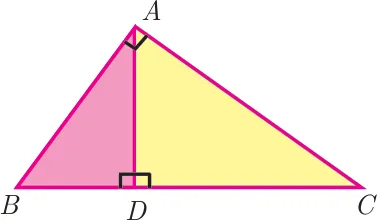
Q8. In the adjacent figure ∠BAC=90∘\angle BAC = 90^\circ and AD⊥BCAD \perp BC then

Right triangle ABC with the right angle at vertex A, B at bottom-left and C at bottom-right, and altitude AD drawn perpendicular to BC at D, dividing it into two differently shaded sub-triangles.
  1. (1) BD⋅CD=BC2BD \cdot CD = BC^2
  2. (2) AB.AC=BC2AB.AC = BC^2
  3. (3) BD⋅CD=AD2BD \cdot CD = AD^2
  4. (4) AB⋅AC=AD2AB \cdot AC = AD^2
  1. ∠BAC=90∘\angle BAC=90^\circ and AD⊥BCAD\perp BC, so ADAD is the altitude to the hypotenuse.

  2. Then ΔABD∼ΔCAD\Delta ABD \sim \Delta CAD.

  3. BDAD=ADCD\dfrac{BD}{AD}=\dfrac{AD}{CD}

  4. BD⋅CD=AD2BD\cdot CD = AD^2.

Answer

(3) BD⋅CD=AD2BD \cdot CD = AD^2

Q9. Two poles of heights 6 m and 11 m stand vertically on …

Two poles of heights 6 m and 11 m stand vertically on a plane ground. If the distance between their feet is 12 m, what is the distance between their tops?

  1. (1) 1313 m
  2. (2) 1414 m
  3. (3) 1515 m
  4. (4) 12.812.8 m
  1. Difference of heights =11−6=5=11-6=5 m.

  2. Distance between feet =12=12 m.

  3. Distance between tops =122+52=144+25=169=\sqrt{12^2+5^2}=\sqrt{144+25}=\sqrt{169}

  4. =13=13 m.

Answer

(1) 1313 m

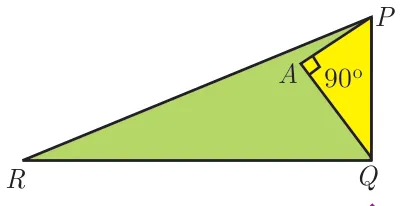
Q10. In the given figure, PR=26PR = 26 cm, QR=24QR = 24 cm, ∠PAQ=90∘\angle PAQ = 90^\circ , PA=6PA = 6 cm …

In the given figure, PR=26PR = 26 cm, QR=24QR = 24 cm, ∠PAQ=90∘\angle PAQ = 90^\circ, PA=6PA = 6 cm and QA=8QA = 8 cm. Find ∠PQR\angle PQR

Triangle PQR with R at bottom-left, Q at bottom-right and P at top-right, with point A on PR such that angle PAQ is marked 90 degrees, forming a small yellow triangle PAQ and a larger green region RAQ.
  1. (1) 80∘80^\circ
  2. (2) 85∘85^\circ
  3. (3) 75∘75^\circ
  4. (4) 90∘90^\circ
  1. In right ΔPAQ\Delta PAQ, PQ2=PA2+QA2=62+82=100PQ^2=PA^2+QA^2=6^2+8^2=100, so PQ=10PQ=10 cm.

  2. Now PQ2+QR2=102+242=100+576=676PQ^2+QR^2=10^2+24^2=100+576=676.

  3. PR2=262=676PR^2=26^2=676.

  4. Since PQ2+QR2=PR2PQ^2+QR^2=PR^2, by converse of Pythagoras theorem ∠PQR=90∘\angle PQR=90^\circ.

Answer

(4) 90∘90^\circ

Q11. A tangent is perpendicular to the radius at the

  1. (1) centre
  2. (2) point of contact
  3. (3) infinity
  4. (4) chord
  1. The radius drawn to the point where the tangent touches the circle is perpendicular to the tangent.

  2. So it is perpendicular at the point of contact.

Answer

(2) point of contact

Q12. How many tangents can be drawn to the circle from an exterior …

How many tangents can be drawn to the circle from an exterior point?

  1. (1) one
  2. (2) two
  3. (3) infinite
  4. (4) zero
  1. From a point outside a circle exactly two tangent lines can be drawn.

  2. (From a point on the circle only one, from an interior point none.)

Answer

(2) two

Q13. The two tangents from an external points PP to a circle with …

The two tangents from an external points PP to a circle with centre at OO are PAPA and PBPB. If ∠APB=70∘\angle APB = 70^\circ then the value of ∠AOB\angle AOB is

  1. (1) 100∘100^\circ
  2. (2) 110∘110^\circ
  3. (3) 120∘120^\circ
  4. (4) 130∘130^\circ
  1. OA⊥PAOA\perp PA and OB⊥PBOB\perp PB, so ∠OAP=∠OBP=90∘\angle OAP=\angle OBP=90^\circ.

  2. In quadrilateral OAPBOAPB, ∠AOB+∠APB+90∘+90∘=360∘\angle AOB+\angle APB+90^\circ+90^\circ=360^\circ.

  3. ∠AOB=360∘−180∘−70∘=110∘\angle AOB=360^\circ-180^\circ-70^\circ=110^\circ.

Answer

(2) 110∘110^\circ

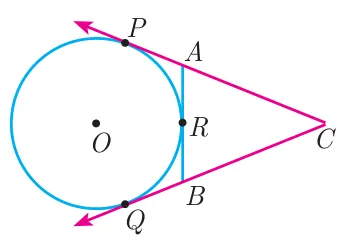
Q14. In figure CPCP and CQCQ are tangents to a circle with centre …

In figure CPCP and CQCQ are tangents to a circle with centre at OO. ARBARB is another tangent touching the circle at RR. If CP=11CP = 11 cm and BC=7BC = 7 cm, then the length of BRBR is

A circle with centre O and two tangents from external point C touching the circle at P and Q, plus a third tangent ARB touching at R and meeting the other tangents at A and B.
  1. (1) 66 cm
  2. (2) 55 cm
  3. (3) 88 cm
  4. (4) 44 cm
  1. Tangents from CC: CQ=CP=11CQ=CP=11 cm.

  2. BQ=CQ−BC=11−7=4BQ=CQ-BC=11-7=4 cm.

  3. Tangents from BB: BR=BQBR=BQ.

  4. BR=4BR=4 cm.

Answer

(4) 44 cm

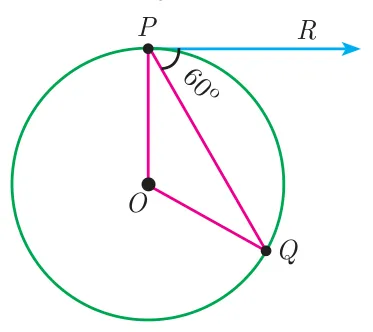
Q15. In figure if PRPR is tangent to the circle at PP and …

In figure if PRPR is tangent to the circle at PP and OO is the centre of the circle, then ∠POQ\angle POQ is

A circle with centre O, tangent line PR touching at the top point P, point Q on the circle at lower right, radii OP and OQ and segment PQ drawn, with the angle between PQ and tangent PR marked 60 degrees.
  1. (1) 120∘120^\circ
  2. (2) 100∘100^\circ
  3. (3) 110∘110^\circ
  4. (4) 90∘90^\circ
  1. OP⊥PROP\perp PR (radius ⊥\perp tangent), so ∠OPR=90∘\angle OPR=90^\circ.

  2. ∠OPQ=90∘−60∘=30∘\angle OPQ=90^\circ-60^\circ=30^\circ.

  3. OP=OQOP=OQ (radii), so ∠OQP=∠OPQ=30∘\angle OQP=\angle OPQ=30^\circ.

  4. ∠POQ=180∘−(30∘+30∘)=120∘\angle POQ=180^\circ-(30^\circ+30^\circ)=120^\circ.

Answer

(1) 120∘120^\circ

Chapter 4 formulas
  • Similar triangles — equal corresponding angles

    △ABC∼△PQR⇒∠A=∠P, ∠B=∠Q, ∠C=∠R\triangle ABC \sim \triangle PQR \Rightarrow \angle A = \angle P,\ \angle B = \angle Q,\ \angle C = \angle R

  • Similar triangles — proportional corresponding sides

    △ABC∼△PQR⇒ABPQ=BCQR=CARP\triangle ABC \sim \triangle PQR \Rightarrow \dfrac{AB}{PQ} = \dfrac{BC}{QR} = \dfrac{CA}{RP}

  • AA (same as AAA) similarity criterion

    ∠A=∠P, ∠B=∠Q⇒△ABC∼△PQR\angle A = \angle P,\ \angle B = \angle Q \Rightarrow \triangle ABC \sim \triangle PQR

  • SAS similarity criterion

    ∠A=∠P and ABPQ=ACPR⇒△ABC∼△PQR\angle A = \angle P \text{ and } \dfrac{AB}{PQ} = \dfrac{AC}{PR} \Rightarrow \triangle ABC \sim \triangle PQR

  • SSS similarity criterion

    ABPQ=BCQR=CARP⇒△ABC∼△PQR\dfrac{AB}{PQ} = \dfrac{BC}{QR} = \dfrac{CA}{RP} \Rightarrow \triangle ABC \sim \triangle PQR

  • Ratio of perimeters of similar triangles

    Perimeter of △ABCPerimeter of △PQR=ABPQ=BCQR=CARP\dfrac{\text{Perimeter of } \triangle ABC}{\text{Perimeter of } \triangle PQR} = \dfrac{AB}{PQ} = \dfrac{BC}{QR} = \dfrac{CA}{RP}

  • Ratio of areas of similar triangles

    Area of △ABCArea of △PQR=AB2PQ2=BC2QR2=CA2RP2\dfrac{\text{Area of } \triangle ABC}{\text{Area of } \triangle PQR} = \dfrac{AB^2}{PQ^2} = \dfrac{BC^2}{QR^2} = \dfrac{CA^2}{RP^2}

  • Tangent perpendicular to radius at the point of contact

    OP⊥PT, i.e. ∠OPT=90∘OP \perp PT,\ \text{i.e. } \angle OPT = 90^\circ

  • Number of tangents from an exterior point

    From an exterior point P, exactly 2 tangents can be drawn to a circle\text{From an exterior point } P,\ \text{exactly } 2 \text{ tangents can be drawn to a circle}

  • Lengths of tangents from an exterior point are equal

    PA=PBPA = PB

  • Direct common tangents to two circles

    AB=CD(the two direct common tangents are equal in length)AB = CD \quad (\text{the two direct common tangents are equal in length})

  • Median relation (Apollonius type) — part (i)

    b2=p2+ax+a24b^{2} = p^{2} + ax + \dfrac{a^{2}}{4}

  • Median relation (Apollonius type) — part (ii)

    c2=p2−ax+a24c^{2} = p^{2} - ax + \dfrac{a^{2}}{4}

  • Median relation (Apollonius type) — part (iii)

    b2+c2=2p2+a22b^{2} + c^{2} = 2p^{2} + \dfrac{a^{2}}{2}

Answers checked against the Samacheer Kalvi textbook · Updated

Spotted a mistake? Email us at [email protected] and we will fix it.