Samacheer Kalvi 10th Maths Exercise 4.4 Solutions

10th Maths Exercise 4.4 solutions (Chapter 4 Geometry) with step-by-step answers for all 16 questions, as per the 2026-27 Samacheer Kalvi textbook.

Answers at a glance15 answers · full steps below
  1. Q1Radius =7= 7 cm
  2. Q2Radius of the inscribed circle =2= 2 cm
  3. Q3AD=7AD = 7 cm, BE=5BE = 5 cm, CF=3CF = 3 cm
  4. Q4∠OPQ=30∘\angle OPQ = 30^\circ
  5. Q5∠AOB=130∘\angle AOB = 130^\circ
  6. Q6AB=203=6.67AB = \dfrac{20}{3} = 6.67 cm
  7. Q7Radius of the larger circle =10= 10 cm
  8. Q8PQ=4.8PQ = 4.8 cm
  9. Q10Length of the left out portion FB=2FB = 2 cm
  10. Q11TT′TT', the line drawn through RR perpendicular to the radius PRPR, is the required tangent.
  11. Q12TT′TT' drawn at LL with ∠TLM=∠MNL\angle TLM = \angle MNL is the required tangent.
  12. Q13Length of each tangent PA=PB=8.7PA = PB = 8.7 cm (approximately)
  13. Q14PA=PB=105≈10.25PA = PB = \sqrt{105} \approx 10.25 cm (measured length about 10.310.3 cm)
  14. Q15PA=PB=4PA = PB = 4 cm
  15. Q16PA=PB=38.88≈6.2PA = PB = \sqrt{38.88} \approx 6.2 cm (about 6.246.24 cm)

Q1. The length of the tangent to a circle from a point PP …

The length of the tangent to a circle from a point PP, which is 2525 cm away from the centre is 2424 cm. What is the radius of the circle?

Show steps (6)
  1. The tangent is perpendicular to the radius at the point of contact QQ.

  2. So △OQP\triangle OQP is right angled at QQ.

  3. OP2=OQ2+PQ2OP^2 = OQ^2 + PQ^2

  4. 252=r2+24225^2 = r^2 + 24^2

  5. r2=625−576=49r^2 = 625 - 576 = 49

  6. r=7r = 7 cm

Answer

Radius =7= 7 cm

Q2. △LMN\triangle LMN is a right angled triangle with ∠L=90∘\angle L = 90^\circ . A circle is …

△LMN\triangle LMN is a right angled triangle with ∠L=90∘\angle L = 90^\circ. A circle is inscribed in it. The lengths of the sides containing the right angle are 66 cm and 88 cm. Find the radius of the circle.

Show steps (7)
  1. Sides containing the right angle: LM=6LM = 6 cm, LN=8LN = 8 cm.

  2. Hypotenuse MN=62+82=100=10MN = \sqrt{6^2+8^2} = \sqrt{100} = 10 cm.

  3. Let the incircle of radius rr touch LMLM at PP and LNLN at QQ.

  4. OP⊥LMOP \perp LM, OQ⊥LNOQ \perp LN and OP=OQ=rOP = OQ = r, so OPLQOPLQ is a square, giving LP=LQ=rLP = LQ = r.

  5. Tangents from MM: MP=6−rMP = 6 - r; tangents from NN: NQ=8−rNQ = 8 - r.

  6. MN=MP+NQMN = MP + NQ gives 10=(6−r)+(8−r)10 = (6-r)+(8-r)

  7. 10=14−2r⇒r=210 = 14 - 2r \Rightarrow r = 2 cm

Answer

Radius of the inscribed circle =2= 2 cm

Q3. A circle is inscribed in ΔABC\Delta ABC having sides 88 cm, 1010 cm …

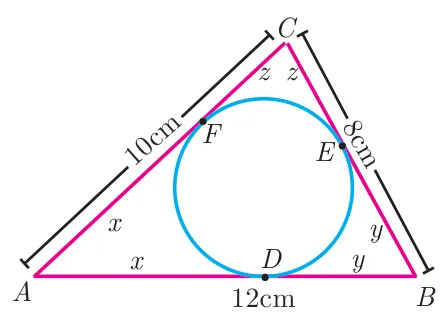
A circle is inscribed in ΔABC\Delta ABC having sides 88 cm, 1010 cm and 1212 cm as shown in figure, Find ADAD, BEBE and CFCF.

Triangle ABC with an inscribed circle touching AB at D, BC at E and AC at F; sides labelled 10 cm, 8 cm and 12 cm with equal tangent lengths marked x, x, y, y, z, z.
Show steps (9)
  1. Tangents from an external point are equal.

  2. From AA: AD=AF=xAD = AF = x; from BB: BD=BE=yBD = BE = y; from CC: CE=CF=zCE = CF = z.

  3. AB=x+y=12AB = x + y = 12 … (1)

  4. BC=y+z=8BC = y + z = 8 … (2)

  5. CA=z+x=10CA = z + x = 10 … (3)

  6. Adding, 2(x+y+z)=302(x+y+z) = 30, so x+y+z=15x+y+z = 15 … (4)

  7. (4)−(2)(4) - (2): x=15−8=7x = 15 - 8 = 7

  8. (4)−(3)(4) - (3): y=15−10=5y = 15 - 10 = 5

  9. (4)−(1)(4) - (1): z=15−12=3z = 15 - 12 = 3

Answer

AD=7AD = 7 cm, BE=5BE = 5 cm, CF=3CF = 3 cm

Q4. PQPQ is a tangent drawn from a point PP to a circle …

PQPQ is a tangent drawn from a point PP to a circle with centre OO and QORQOR is a diameter of the circle such that ∠POR=120∘\angle POR = 120^\circ. Find ∠OPQ\angle OPQ.

  1. QORQOR is a diameter, so QQ, OO, RR are collinear.

  2. ∠POQ=180∘−∠POR=180∘−120∘=60∘\angle POQ = 180^\circ - \angle POR = 180^\circ - 120^\circ = 60^\circ

  3. PQPQ is a tangent at QQ, so ∠OQP=90∘\angle OQP = 90^\circ.

  4. In △OQP\triangle OQP, ∠OPQ=180∘−90∘−60∘=30∘\angle OPQ = 180^\circ - 90^\circ - 60^\circ = 30^\circ

Answer

∠OPQ=30∘\angle OPQ = 30^\circ

Q5. A tangent STST to a circle touches it at BB . ABAB …

A tangent STST to a circle touches it at BB. ABAB is a chord such that ∠ABT=65∘\angle ABT = 65^\circ. Find ∠AOB\angle AOB, where “OO” is the centre of the circle.

  1. STST is a tangent at BB and ABAB is a chord, ∠ABT=65∘\angle ABT = 65^\circ.

  2. By the alternate segment theorem, the angle in the alternate segment ∠BCA=65∘\angle BCA = 65^\circ (where CC is on the major arc).

  3. The angle at the centre is twice the angle at the circumference on the same arc ABAB.

  4. ∠AOB=2×65∘=130∘\angle AOB = 2 \times 65^\circ = 130^\circ

Answer

∠AOB=130∘\angle AOB = 130^\circ

Q6. In figure, OO is the centre of the circle with radius 55 …

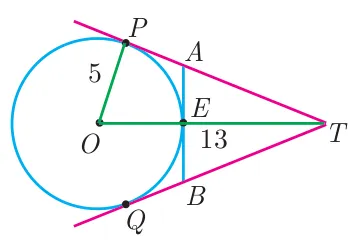
In figure, OO is the centre of the circle with radius 55 cm. TT is a point such that OT=13OT = 13 cm and OTOT intersects the circle EE, if ABAB is the tangent to the circle at EE, find the lenght of ABAB.

Circle with centre O and radius 5 cm, external point T with OT = 13 cm; tangents from T touch the circle at P and Q, and the tangent at E meets them at A and B.
Show steps (9)
  1. OP=5OP = 5 cm (radius), OT=13OT = 13 cm, TPTP is a tangent so ∠OPT=90∘\angle OPT = 90^\circ.

  2. PT=OT2−OP2=169−25=144=12PT = \sqrt{OT^2 - OP^2} = \sqrt{169 - 25} = \sqrt{144} = 12 cm.

  3. OE=5OE = 5 cm (radius), so ET=OT−OE=13−5=8ET = OT - OE = 13 - 5 = 8 cm.

  4. Tangents from AA: AP=AEAP = AE. Let AE=xAE = x, then AT=PT−AP=12−xAT = PT - AP = 12 - x.

  5. ABAB is a tangent at EE, so ∠AET=90∘\angle AET = 90^\circ.

  6. In △AET\triangle AET: AE2+ET2=AT2AE^2 + ET^2 = AT^2

  7. x2+64=(12−x)2=144−24x+x2x^2 + 64 = (12-x)^2 = 144 - 24x + x^2

  8. 24x=80⇒x=10324x = 80 \Rightarrow x = \dfrac{10}{3}

  9. By symmetry BE=AEBE = AE, so AB=2x=203AB = 2x = \dfrac{20}{3} cm.

Answer

AB=203=6.67AB = \dfrac{20}{3} = 6.67 cm

Q7. In two concentric circles, a chord of length 1616 cm of larger …

In two concentric circles, a chord of length 1616 cm of larger circle becomes a tangent to the smaller circle whose radius is 66 cm. Find the radius of the larger circle.

  1. Let OO be the common centre, ABAB the chord of the larger circle touching the smaller circle at PP.

  2. The radius OP=6OP = 6 cm is perpendicular to the tangent ABAB.

  3. A perpendicular from the centre bisects the chord, so AP=162=8AP = \dfrac{16}{2} = 8 cm.

  4. In right △OPA\triangle OPA, OA2=OP2+AP2=36+64=100OA^2 = OP^2 + AP^2 = 36 + 64 = 100

  5. OA=10OA = 10 cm

Answer

Radius of the larger circle =10= 10 cm

Q8. Two circles with centres OO and O′O' of radii 33 cm and …

Two circles with centres OO and O′O' of radii 33 cm and 44 cm, respectively intersect at two points PP and QQ, such that OPOP and O′PO'P are tangents to the two circles. Find the length of the common chord PQPQ.

Show steps (7)
  1. OPOP is a tangent to the circle with centre O′O' and O′PO'P is a tangent to the circle with centre OO.

  2. So ∠OPO′=90∘\angle OPO' = 90^\circ.

  3. OO′=OP2+O′P2=32+42=5OO' = \sqrt{OP^2 + O'P^2} = \sqrt{3^2 + 4^2} = 5 cm.

  4. PQPQ is the common chord and OO′OO' bisects PQPQ at right angles at MM.

  5. Area of △OPO′=12×OP×O′P=12×OO′×PM\triangle OPO' = \dfrac12 \times OP \times O'P = \dfrac12 \times OO' \times PM

  6. 12×3×4=12×5×PM⇒PM=125=2.4\dfrac12 \times 3 \times 4 = \dfrac12 \times 5 \times PM \Rightarrow PM = \dfrac{12}{5} = 2.4 cm

  7. PQ=2×PM=4.8PQ = 2 \times PM = 4.8 cm

Answer

PQ=4.8PQ = 4.8 cm

Q9. Show that the angle bisectors of a triangle are concurrent.

Show steps (8)
  1. Let △ABC\triangle ABC be given and let ADAD, BEBE, CFCF be the internal bisectors of ∠A\angle A, ∠B\angle B, ∠C\angle C, meeting the opposite sides at D∈BCD\in BC, E∈CAE\in CA, F∈ABF\in AB.

  2. Since ADAD bisects ∠A\angle A, by the Angle Bisector Theorem BDDC=ABAC\dfrac{BD}{DC}=\dfrac{AB}{AC} … (1)

  3. Since BEBE bisects ∠B\angle B, CEEA=BCBA\dfrac{CE}{EA}=\dfrac{BC}{BA} … (2)

  4. Since CFCF bisects ∠C\angle C, AFFB=CACB\dfrac{AF}{FB}=\dfrac{CA}{CB} … (3)

  5. Multiplying (1), (2) and (3): BDDC×CEEA×AFFB=ABAC×BCBA×CACB\dfrac{BD}{DC}\times\dfrac{CE}{EA}\times\dfrac{AF}{FB}=\dfrac{AB}{AC}\times\dfrac{BC}{BA}\times\dfrac{CA}{CB}

  6. All the factors cancel, so BDDC×CEEA×AFFB=1\dfrac{BD}{DC}\times\dfrac{CE}{EA}\times\dfrac{AF}{FB}=1.

  7. Since DD, EE, FF are interior points of the sides and the product of the ratios is 11, by the converse of Ceva's Theorem the cevians ADAD, BEBE, CFCF are concurrent.

  8. Hence the three angle bisectors of a triangle meet at a single point (the incentre II of the triangle).

Answer

BDDC⋅CEEA⋅AFFB=1\dfrac{BD}{DC}\cdot\dfrac{CE}{EA}\cdot\dfrac{AF}{FB}=1, so by the converse of Ceva's theorem the three angle bisectors of a triangle are concurrent (they meet at the incentre).

Q10. An artist has created a triangular stained glass window and has one …

An artist has created a triangular stained glass window and has one strip of small length left before completing the window. She needs to figure out the length of left out portion based on the lengths of the other sides as shown in the figure.
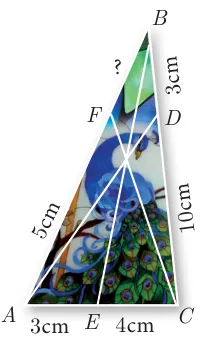
Triangular stained glass window ABC with points F on AB, D on BC and E on AC; lengths 5 cm, 3 cm, 10 cm, 3 cm and 4 cm marked and the unknown segment near B marked with a question mark.
Show steps (6)
  1. DD, EE, FF lie on BCBC, CACA, ABAB of △ABC\triangle ABC and they are collinear (the strip is a straight line).

  2. By Menelaus' theorem, BDDC×CEEA×AFFB=1\dfrac{BD}{DC}\times\dfrac{CE}{EA}\times\dfrac{AF}{FB} = 1 (in magnitude).

  3. Given BD=3BD = 3, DC=10DC = 10, CE=4CE = 4, EA=3EA = 3, AF=5AF = 5.

  4. 310×43×5FB=1\dfrac{3}{10}\times\dfrac{4}{3}\times\dfrac{5}{FB} = 1

  5. 25×5FB=1\dfrac{2}{5}\times\dfrac{5}{FB} = 1

  6. 2FB=1⇒FB=2\dfrac{2}{FB} = 1 \Rightarrow FB = 2 cm

Answer

Length of the left out portion FB=2FB = 2 cm

Q11. Draw a tangent at any point RR on the circle of radius …

Draw a tangent at any point RR on the circle of radius 3.43.4 cm and centre at PP ?

  1. Step 1: With PP as centre, draw a circle of radius 3.43.4 cm.

  2. Step 2: Take any point RR on the circle and join PRPR.

  3. Step 3: Draw a line TT′TT' through RR perpendicular to PRPR.

  4. Step 4: TT′TT' is the required tangent at RR.

Answer

TT′TT', the line drawn through RR perpendicular to the radius PRPR, is the required tangent.

Q12. Draw a circle of radius 4.54.5 cm. Take a point on the …

Draw a circle of radius 4.54.5 cm. Take a point on the circle. Draw the tangent at that point using the alternate segment theorem.

  1. Step 1: With OO as centre, draw a circle of radius 4.54.5 cm.

  2. Step 2: Take a point LL on the circle. Through LL draw any chord LMLM.

  3. Step 3: Take a point NN distinct from LL and MM on the circle so that LL, MM, NN are in anti-clockwise direction. Join LNLN and NMNM.

  4. Step 4: Through LL draw a tangent TT′TT' such that ∠TLM=∠MNL\angle TLM = \angle MNL (alternate segment theorem).

  5. Step 5: TT′TT' is the required tangent at LL.

Answer

TT′TT' drawn at LL with ∠TLM=∠MNL\angle TLM = \angle MNL is the required tangent.

Q13. Draw the two tangents from a point which is 1010 cm away …

Draw the two tangents from a point which is 1010 cm away from the centre of a circle of radius 55 cm. Also, measure the lengths of the tangents.

Show steps (7)
  1. Step 1: With centre OO, draw a circle of radius 55 cm.

  2. Step 2: Draw a line OPOP of length 1010 cm.

  3. Step 3: Draw the perpendicular bisector of OPOP, cutting OPOP at MM.

  4. Step 4: With MM as centre and MOMO as radius, draw a circle cutting the first circle at AA and BB.

  5. Step 5: Join PAPA and PBPB. These are the required tangents.

  6. Verification: In right △OAP\triangle OAP, PA2=OP2−OA2=100−25=75PA^2 = OP^2 - OA^2 = 100 - 25 = 75

  7. PA=75=8.7PA = \sqrt{75} = 8.7 cm (approximately)

Answer

Length of each tangent PA=PB=8.7PA = PB = 8.7 cm (approximately)

Q14. Take a point which is 1111 cm away from the centre of …

Take a point which is 1111 cm away from the centre of a circle of radius 44 cm and draw the two tangents to the circle from that point.

Show steps (7)
  1. Step 1: With centre OO and radius 44 cm, draw a circle.

  2. Step 2: Mark a point PP such that OP=11OP = 11 cm and join OPOP.

  3. Step 3: Draw the perpendicular bisector of OPOP; let it meet OPOP at MM (so MO=MP=5.5MO = MP = 5.5 cm).

  4. Step 4: With MM as centre and MOMO as radius, draw a circle which cuts the given circle at AA and BB.

  5. Step 5: Join PAPA and PBPB. Since ∠OAP=∠OBP=90∘\angle OAP = \angle OBP = 90^\circ (angle in a semicircle), PAPA and PBPB are the required tangents.

  6. Verification: ∠OAP=90∘\angle OAP = 90^\circ, so PA2=OP2−OA2=112−42=121−16=105PA^2 = OP^2 - OA^2 = 11^2 - 4^2 = 121 - 16 = 105.

  7. PA=PB=105≈10.25PA = PB = \sqrt{105} \approx 10.25 cm, which agrees with the measured length (≈10.3\approx 10.3 cm).

Answer

PA=PB=105≈10.25PA = PB = \sqrt{105} \approx 10.25 cm (measured length about 10.310.3 cm)

Q15. Draw the two tangents from a point which is 55 cm away …

Draw the two tangents from a point which is 55 cm away from the centre of a circle of diameter 66 cm. Also, measure the lengths of the tangents.

Show steps (7)
  1. Diameter =6= 6 cm, so radius =3= 3 cm.

  2. Step 1: With centre OO, draw a circle of radius 33 cm.

  3. Step 2: Draw a line OPOP of length 55 cm.

  4. Step 3: Draw the perpendicular bisector of OPOP, cutting OPOP at MM.

  5. Step 4: With MM as centre and MOMO as radius, draw a circle cutting the first circle at AA and BB.

  6. Step 5: Join PAPA and PBPB. These are the required tangents.

  7. Verification: PA2=OP2−OA2=25−9=16PA^2 = OP^2 - OA^2 = 25 - 9 = 16, so PA=4PA = 4 cm.

Answer

PA=PB=4PA = PB = 4 cm

Q16. Draw a tangent to the circle from the point PP having radius …

Draw a tangent to the circle from the point PP having radius 3.63.6 cm, and centre at OO. Point PP is at a distance 7.27.2 cm from the centre.

Show steps (7)
  1. Step 1: Draw a circle with centre OO and radius 3.63.6 cm.

  2. Step 2: Mark a point PP on the plane with OP=7.2OP = 7.2 cm and join OPOP.

  3. Step 3: Draw the perpendicular bisector of OPOP; let it meet OPOP at its mid-point MM (so OM=MP=3.6OM = MP = 3.6 cm).

  4. Step 4: With MM as centre and MO=3.6MO = 3.6 cm as radius, draw a circle; it cuts the given circle at AA and BB.

  5. Step 5: Join PAPA and PBPB. Since ∠OAP=∠OBP=90∘\angle OAP = \angle OBP = 90^\circ (angle in a semicircle), PAPA and PBPB are the required tangents.

  6. Verification: PA2=OP2−OA2=(7.2)2−(3.6)2=51.84−12.96=38.88PA^2 = OP^2 - OA^2 = (7.2)^2 - (3.6)^2 = 51.84 - 12.96 = 38.88.

  7. So PA=38.88≈6.24PA = \sqrt{38.88} \approx 6.24 cm, i.e. about 6.26.2 cm, and PB=PAPB = PA (equal tangents from an external point).

Answer

PA=PB=38.88≈6.2PA = PB = \sqrt{38.88} \approx 6.2 cm (about 6.246.24 cm)

Quick check

  1. How many tangents can be drawn to the circle from an exterior point?

    1. (1) one
    2. (2) two
    3. (3) infinite
    4. (4) zero
    Show answer

    Answer: (2) two

    1. From a point outside a circle exactly two tangent lines can be drawn.

    2. (From a point on the circle only one, from an interior point none.)

    Question 1 of 5
  2. In a given figure ST∥QRST \parallel QR, PS=2PS = 2 cm and SQ=3SQ = 3 cm. Then the ratio of the area of ΔPQR\Delta PQR to the area of ΔPST\Delta PST is

    1. (1) 25:425 : 4
    2. (2) 25:725 : 7
    3. (3) 25:1125 : 11
    4. (4) 25:1325 : 13
    Show answer

    Answer: (1) 25:425 : 4

    1. PQ=PS+SQ=2+3=5PQ=PS+SQ=2+3=5 cm.

    2. ST∥QR⇒ΔPST∼ΔPQRST\parallel QR \Rightarrow \Delta PST \sim \Delta PQR.

    3. [ΔPQR][ΔPST]=PQ2PS2=5222=254\dfrac{[\Delta PQR]}{[\Delta PST]}=\dfrac{PQ^2}{PS^2}=\dfrac{5^2}{2^2}=\dfrac{25}{4}.

    Question 2 of 5
  3. Two poles of heights 6 m and 11 m stand vertically on a plane ground. If the distance between their feet is 12 m, what is the distance between their tops?

    1. (1) 1313 m
    2. (2) 1414 m
    3. (3) 1515 m
    4. (4) 12.812.8 m
    Show answer

    Answer: (1) 1313 m

    1. Difference of heights =11−6=5=11-6=5 m.

    2. Distance between feet =12=12 m.

    3. Distance between tops =122+52=144+25=169=\sqrt{12^2+5^2}=\sqrt{144+25}=\sqrt{169}

    4. =13=13 m.

    Question 3 of 5
  4. In the given figure, PR=26PR = 26 cm, QR=24QR = 24 cm, ∠PAQ=90∘\angle PAQ = 90^\circ, PA=6PA = 6 cm and QA=8QA = 8 cm. Find ∠PQR\angle PQR

    1. (1) 80∘80^\circ
    2. (2) 85∘85^\circ
    3. (3) 75∘75^\circ
    4. (4) 90∘90^\circ
    Show answer

    Answer: (4) 90∘90^\circ

    1. In right ΔPAQ\Delta PAQ, PQ2=PA2+QA2=62+82=100PQ^2=PA^2+QA^2=6^2+8^2=100, so PQ=10PQ=10 cm.

    2. Now PQ2+QR2=102+242=100+576=676PQ^2+QR^2=10^2+24^2=100+576=676.

    3. PR2=262=676PR^2=26^2=676.

    4. Since PQ2+QR2=PR2PQ^2+QR^2=PR^2, by converse of Pythagoras theorem ∠PQR=90∘\angle PQR=90^\circ.

    Question 4 of 5
  5. In ΔLMN\Delta LMN, ∠L=60∘\angle L = 60^\circ, ∠M=50∘\angle M = 50^\circ. If ΔLMN∼ΔPQR\Delta LMN \sim \Delta PQR then the value of ∠R\angle R is

    1. (1) 40∘40^\circ
    2. (2) 70∘70^\circ
    3. (3) 30∘30^\circ
    4. (4) 110∘110^\circ
    Show answer

    Answer: (2) 70∘70^\circ

    1. In ΔLMN\Delta LMN, ∠N=180∘−(60∘+50∘)=70∘\angle N = 180^\circ-(60^\circ+50^\circ)=70^\circ.

    2. ΔLMN∼ΔPQR\Delta LMN \sim \Delta PQR gives ∠R=∠N\angle R = \angle N.

    3. ∠R=70∘\angle R = 70^\circ.

    Question 5 of 5
Chapter 4 formulas
  • Similar triangles — equal corresponding angles

    △ABC∼△PQR⇒∠A=∠P, ∠B=∠Q, ∠C=∠R\triangle ABC \sim \triangle PQR \Rightarrow \angle A = \angle P,\ \angle B = \angle Q,\ \angle C = \angle R

  • Similar triangles — proportional corresponding sides

    △ABC∼△PQR⇒ABPQ=BCQR=CARP\triangle ABC \sim \triangle PQR \Rightarrow \dfrac{AB}{PQ} = \dfrac{BC}{QR} = \dfrac{CA}{RP}

  • AA (same as AAA) similarity criterion

    ∠A=∠P, ∠B=∠Q⇒△ABC∼△PQR\angle A = \angle P,\ \angle B = \angle Q \Rightarrow \triangle ABC \sim \triangle PQR

  • SAS similarity criterion

    ∠A=∠P and ABPQ=ACPR⇒△ABC∼△PQR\angle A = \angle P \text{ and } \dfrac{AB}{PQ} = \dfrac{AC}{PR} \Rightarrow \triangle ABC \sim \triangle PQR

  • SSS similarity criterion

    ABPQ=BCQR=CARP⇒△ABC∼△PQR\dfrac{AB}{PQ} = \dfrac{BC}{QR} = \dfrac{CA}{RP} \Rightarrow \triangle ABC \sim \triangle PQR

  • Ratio of perimeters of similar triangles

    Perimeter of △ABCPerimeter of △PQR=ABPQ=BCQR=CARP\dfrac{\text{Perimeter of } \triangle ABC}{\text{Perimeter of } \triangle PQR} = \dfrac{AB}{PQ} = \dfrac{BC}{QR} = \dfrac{CA}{RP}

  • Ratio of areas of similar triangles

    Area of △ABCArea of △PQR=AB2PQ2=BC2QR2=CA2RP2\dfrac{\text{Area of } \triangle ABC}{\text{Area of } \triangle PQR} = \dfrac{AB^2}{PQ^2} = \dfrac{BC^2}{QR^2} = \dfrac{CA^2}{RP^2}

  • Tangent perpendicular to radius at the point of contact

    OP⊥PT, i.e. ∠OPT=90∘OP \perp PT,\ \text{i.e. } \angle OPT = 90^\circ

  • Number of tangents from an exterior point

    From an exterior point P, exactly 2 tangents can be drawn to a circle\text{From an exterior point } P,\ \text{exactly } 2 \text{ tangents can be drawn to a circle}

  • Lengths of tangents from an exterior point are equal

    PA=PBPA = PB

  • Direct common tangents to two circles

    AB=CD(the two direct common tangents are equal in length)AB = CD \quad (\text{the two direct common tangents are equal in length})

  • Median relation (Apollonius type) — part (i)

    b2=p2+ax+a24b^{2} = p^{2} + ax + \dfrac{a^{2}}{4}

  • Median relation (Apollonius type) — part (ii)

    c2=p2−ax+a24c^{2} = p^{2} - ax + \dfrac{a^{2}}{4}

  • Median relation (Apollonius type) — part (iii)

    b2+c2=2p2+a22b^{2} + c^{2} = 2p^{2} + \dfrac{a^{2}}{2}

Answers checked against the Samacheer Kalvi textbook · Updated

Spotted a mistake? Email us at [email protected] and we will fix it.