Samacheer Kalvi 10th Maths Exercise 4.3 Solutions

10th Maths Exercise 4.3 solutions (Chapter 4 Geometry) with step-by-step answers for all 8 questions, as per the 2026-27 Samacheer Kalvi textbook.

Answers at a glance6 answers · full steps below
  1. Q13030 m
  2. Q2The direct path along C street is 11 mile shorter
  3. Q32222 m would be saved
  4. Q4Length =12= 12 cm, breadth =5= 5 cm
  5. Q5The sides are 1010 m, 2424 m and 2626 m
  6. Q6The top of the ladder slides up by 0.80.8 m

Q1. A man goes 18 m due east and then 24 m due …

A man goes 18 m due east and then 24 m due north. Find the distance of his current position from the starting point?

  1. East and north directions are perpendicular, so the path forms a right triangle.

  2. Let the required distance be xx.

  3. x2=182+242x^2 = 18^2 + 24^2

  4. x2=324+576=900x^2 = 324 + 576 = 900

  5. x=30x = 30

Answer

3030 m

Q2. There are two paths that one can choose to go from Sarah's …

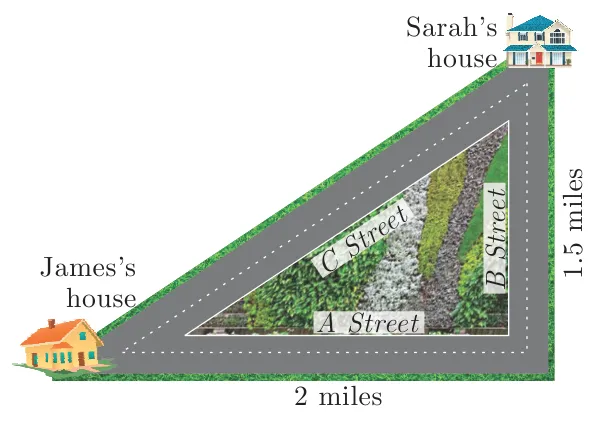
There are two paths that one can choose to go from Sarah's house to James house. One way is to take CC street, and the other way requires to take BB street and then AA street. How much shorter is the direct path along CC street? (Using figure).

A right angled triangle of three streets: James's house at the bottom-left, Sarah's house at the top-right, with 'A Street' along the 2 mile horizontal base, 'B Street' along the 1.5 mile vertical right side, and 'C Street' as the slanting hypotenuse.
  1. A street and B street meet at right angles, C street is the hypotenuse.

  2. C2=22+(1.5)2=4+2.25=6.25C^2 = 2^2 + (1.5)^2 = 4 + 2.25 = 6.25

  3. C=2.5C = 2.5 miles

  4. Path along B and A streets =1.5+2=3.5= 1.5 + 2 = 3.5 miles

  5. Difference =3.5−2.5=1= 3.5 - 2.5 = 1 mile

Answer

The direct path along C street is 11 mile shorter

Q3. To get from point AA to point BB you must avoid walking …

To get from point AA to point BB you must avoid walking through a pond. You must walk 3434 m south and 4141 m east. To the nearest meter, how many meters would be saved if it were possible to make a way through the pond?

  1. South and east are perpendicular, so ABAB is the hypotenuse.

  2. AB2=342+412=1156+1681=2837AB^2 = 34^2 + 41^2 = 1156 + 1681 = 2837

  3. AB=2837≈53.26≈53AB = \sqrt{2837} \approx 53.26 \approx 53 m

  4. Distance walked around the pond =34+41=75= 34 + 41 = 75 m

  5. Saving =75−53=22= 75 - 53 = 22 m

Answer

2222 m would be saved

Q4. In the rectangle WXYZWXYZ , XY+YZ=17XY+YZ=17 cm, and XZ+YW=26XZ+YW=26 cm. Calculate the …

In the rectangle WXYZWXYZ, XY+YZ=17XY+YZ=17 cm, and XZ+YW=26XZ+YW=26 cm. Calculate the length and breadth of the rectangle?
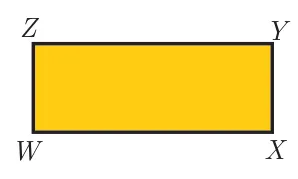
A rectangle with vertices labelled Z top-left, Y top-right, W bottom-left and X bottom-right.
Show steps (8)
  1. The diagonals of a rectangle are equal, so XZ=YWXZ = YW.

  2. XZ+YW=26⇒2XZ=26⇒XZ=13XZ + YW = 26 \Rightarrow 2XZ = 26 \Rightarrow XZ = 13 cm

  3. In right triangle XYZXYZ, XY2+YZ2=XZ2=169XY^2 + YZ^2 = XZ^2 = 169

  4. (XY+YZ)2=XY2+YZ2+2 XY⋅YZ(XY + YZ)^2 = XY^2 + YZ^2 + 2\,XY\cdot YZ

  5. 172=169+2 XY⋅YZ⇒289−169=2 XY⋅YZ17^2 = 169 + 2\,XY\cdot YZ \Rightarrow 289 - 169 = 2\,XY\cdot YZ

  6. XY⋅YZ=60XY \cdot YZ = 60

  7. So XYXY and YZYZ are roots of t2−17t+60=0t^2 - 17t + 60 = 0

  8. (t−12)(t−5)=0⇒t=12(t-12)(t-5) = 0 \Rightarrow t = 12 or t=5t = 5

Answer

Length =12= 12 cm, breadth =5= 5 cm

Q5. The hypotenuse of a right triangle is 66 m more than twice …

The hypotenuse of a right triangle is 66 m more than twice of the shortest side. If the third side is 22 m less than the hypotenuse, find the sides of the triangle.

Show steps (7)
  1. Let the shortest side be xx m.

  2. Hypotenuse =2x+6= 2x + 6, third side =(2x+6)−2=2x+4= (2x+6) - 2 = 2x + 4

  3. By Pythagoras theorem, (2x+6)2=x2+(2x+4)2(2x+6)^2 = x^2 + (2x+4)^2

  4. 4x2+24x+36=x2+4x2+16x+164x^2 + 24x + 36 = x^2 + 4x^2 + 16x + 16

  5. 0=x2−8x−200 = x^2 - 8x - 20

  6. (x−10)(x+2)=0⇒x=10(x-10)(x+2) = 0 \Rightarrow x = 10 (length cannot be negative)

  7. Hypotenuse =2(10)+6=26= 2(10)+6 = 26, third side =24= 24

Answer

The sides are 1010 m, 2424 m and 2626 m

Q6. 55 m long ladder is placed leaning towards a vertical wall such …

55 m long ladder is placed leaning towards a vertical wall such that it reaches the wall at a point 44m high. If the foot of the ladder is moved 1.61.6 m towards the wall, then find the distance by which the top of the ladder would slide upwards on the wall.

  1. Ladder =5= 5 m, height reached =4= 4 m.

  2. Distance of foot from wall =52−42=25−16=3= \sqrt{5^2 - 4^2} = \sqrt{25-16} = 3 m

  3. Foot moved 1.61.6 m towards the wall, so new distance =3−1.6=1.4= 3 - 1.6 = 1.4 m

  4. New height =52−(1.4)2=25−1.96=23.04=4.8= \sqrt{5^2 - (1.4)^2} = \sqrt{25 - 1.96} = \sqrt{23.04} = 4.8 m

  5. Slide upwards =4.8−4=0.8= 4.8 - 4 = 0.8 m

Answer

The top of the ladder slides up by 0.80.8 m

Q7. The perpendicular PSPS on the base QRQR of a ΔPQR\Delta PQR intersects QRQR …

The perpendicular PSPS on the base QRQR of a ΔPQR\Delta PQR intersects QRQR at SS, such that QS=3 SRQS = 3\ SR. Prove that 2PQ2=2PR2+QR22PQ^2 = 2PR^2 + QR^2

Show steps (7)
  1. Let SR=aSR = a. Then QS=3aQS = 3a and QR=QS+SR=4aQR = QS + SR = 4a.

  2. PS⊥QRPS \perp QR, so △PSQ\triangle PSQ and △PSR\triangle PSR are right angled at SS.

  3. In △PSQ\triangle PSQ: PQ2=PS2+QS2=PS2+9a2PQ^2 = PS^2 + QS^2 = PS^2 + 9a^2

  4. In △PSR\triangle PSR: PR2=PS2+SR2=PS2+a2PR^2 = PS^2 + SR^2 = PS^2 + a^2

  5. LHS =2PQ2=2PS2+18a2= 2PQ^2 = 2PS^2 + 18a^2

  6. RHS =2PR2+QR2=2(PS2+a2)+(4a)2=2PS2+2a2+16a2=2PS2+18a2= 2PR^2 + QR^2 = 2(PS^2 + a^2) + (4a)^2 = 2PS^2 + 2a^2 + 16a^2 = 2PS^2 + 18a^2

  7. LHS == RHS

Answer

Hence 2PQ2=2PR2+QR22PQ^2 = 2PR^2 + QR^2 is proved

Q8. In the adjacent figure, ABCABC is a right angled triangle with right …

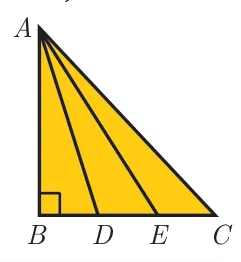
In the adjacent figure, ABCABC is a right angled triangle with right angle at BB and points DD, EE trisect BCBC. Prove that 8AE2=3AC2+5AD28AE^2 = 3AC^2 + 5AD^2

Right angled triangle ABC with the right angle at B, base BC horizontal, points D and E trisecting BC, and segments AD and AE drawn from apex A.
Show steps (9)
  1. DD, EE trisect BCBC, so let BD=DE=EC=xBD = DE = EC = x.

  2. Then BD=xBD = x, BE=2xBE = 2x, BC=3xBC = 3x. Let AB=bAB = b.

  3. ∠B=90∘\angle B = 90^\circ, so by Pythagoras theorem:

  4. AD2=AB2+BD2=b2+x2AD^2 = AB^2 + BD^2 = b^2 + x^2

  5. AE2=AB2+BE2=b2+4x2AE^2 = AB^2 + BE^2 = b^2 + 4x^2

  6. AC2=AB2+BC2=b2+9x2AC^2 = AB^2 + BC^2 = b^2 + 9x^2

  7. RHS =3AC2+5AD2=3(b2+9x2)+5(b2+x2)= 3AC^2 + 5AD^2 = 3(b^2+9x^2) + 5(b^2+x^2)

  8. =3b2+27x2+5b2+5x2=8b2+32x2= 3b^2 + 27x^2 + 5b^2 + 5x^2 = 8b^2 + 32x^2

  9. =8(b2+4x2)=8AE2== 8(b^2 + 4x^2) = 8AE^2 = LHS

Answer

Hence 8AE2=3AC2+5AD28AE^2 = 3AC^2 + 5AD^2 is proved

Quick check

  1. How many tangents can be drawn to the circle from an exterior point?

    1. (1) one
    2. (2) two
    3. (3) infinite
    4. (4) zero
    Show answer

    Answer: (2) two

    1. From a point outside a circle exactly two tangent lines can be drawn.

    2. (From a point on the circle only one, from an interior point none.)

    Question 1 of 5
  2. In a given figure ST∥QRST \parallel QR, PS=2PS = 2 cm and SQ=3SQ = 3 cm. Then the ratio of the area of ΔPQR\Delta PQR to the area of ΔPST\Delta PST is

    1. (1) 25:425 : 4
    2. (2) 25:725 : 7
    3. (3) 25:1125 : 11
    4. (4) 25:1325 : 13
    Show answer

    Answer: (1) 25:425 : 4

    1. PQ=PS+SQ=2+3=5PQ=PS+SQ=2+3=5 cm.

    2. ST∥QR⇒ΔPST∼ΔPQRST\parallel QR \Rightarrow \Delta PST \sim \Delta PQR.

    3. [ΔPQR][ΔPST]=PQ2PS2=5222=254\dfrac{[\Delta PQR]}{[\Delta PST]}=\dfrac{PQ^2}{PS^2}=\dfrac{5^2}{2^2}=\dfrac{25}{4}.

    Question 2 of 5
  3. Two poles of heights 6 m and 11 m stand vertically on a plane ground. If the distance between their feet is 12 m, what is the distance between their tops?

    1. (1) 1313 m
    2. (2) 1414 m
    3. (3) 1515 m
    4. (4) 12.812.8 m
    Show answer

    Answer: (1) 1313 m

    1. Difference of heights =11−6=5=11-6=5 m.

    2. Distance between feet =12=12 m.

    3. Distance between tops =122+52=144+25=169=\sqrt{12^2+5^2}=\sqrt{144+25}=\sqrt{169}

    4. =13=13 m.

    Question 3 of 5
  4. In the given figure, PR=26PR = 26 cm, QR=24QR = 24 cm, ∠PAQ=90∘\angle PAQ = 90^\circ, PA=6PA = 6 cm and QA=8QA = 8 cm. Find ∠PQR\angle PQR

    1. (1) 80∘80^\circ
    2. (2) 85∘85^\circ
    3. (3) 75∘75^\circ
    4. (4) 90∘90^\circ
    Show answer

    Answer: (4) 90∘90^\circ

    1. In right ΔPAQ\Delta PAQ, PQ2=PA2+QA2=62+82=100PQ^2=PA^2+QA^2=6^2+8^2=100, so PQ=10PQ=10 cm.

    2. Now PQ2+QR2=102+242=100+576=676PQ^2+QR^2=10^2+24^2=100+576=676.

    3. PR2=262=676PR^2=26^2=676.

    4. Since PQ2+QR2=PR2PQ^2+QR^2=PR^2, by converse of Pythagoras theorem ∠PQR=90∘\angle PQR=90^\circ.

    Question 4 of 5
  5. In ΔLMN\Delta LMN, ∠L=60∘\angle L = 60^\circ, ∠M=50∘\angle M = 50^\circ. If ΔLMN∼ΔPQR\Delta LMN \sim \Delta PQR then the value of ∠R\angle R is

    1. (1) 40∘40^\circ
    2. (2) 70∘70^\circ
    3. (3) 30∘30^\circ
    4. (4) 110∘110^\circ
    Show answer

    Answer: (2) 70∘70^\circ

    1. In ΔLMN\Delta LMN, ∠N=180∘−(60∘+50∘)=70∘\angle N = 180^\circ-(60^\circ+50^\circ)=70^\circ.

    2. ΔLMN∼ΔPQR\Delta LMN \sim \Delta PQR gives ∠R=∠N\angle R = \angle N.

    3. ∠R=70∘\angle R = 70^\circ.

    Question 5 of 5
Chapter 4 formulas
  • Similar triangles — equal corresponding angles

    △ABC∼△PQR⇒∠A=∠P, ∠B=∠Q, ∠C=∠R\triangle ABC \sim \triangle PQR \Rightarrow \angle A = \angle P,\ \angle B = \angle Q,\ \angle C = \angle R

  • Similar triangles — proportional corresponding sides

    △ABC∼△PQR⇒ABPQ=BCQR=CARP\triangle ABC \sim \triangle PQR \Rightarrow \dfrac{AB}{PQ} = \dfrac{BC}{QR} = \dfrac{CA}{RP}

  • AA (same as AAA) similarity criterion

    ∠A=∠P, ∠B=∠Q⇒△ABC∼△PQR\angle A = \angle P,\ \angle B = \angle Q \Rightarrow \triangle ABC \sim \triangle PQR

  • SAS similarity criterion

    ∠A=∠P and ABPQ=ACPR⇒△ABC∼△PQR\angle A = \angle P \text{ and } \dfrac{AB}{PQ} = \dfrac{AC}{PR} \Rightarrow \triangle ABC \sim \triangle PQR

  • SSS similarity criterion

    ABPQ=BCQR=CARP⇒△ABC∼△PQR\dfrac{AB}{PQ} = \dfrac{BC}{QR} = \dfrac{CA}{RP} \Rightarrow \triangle ABC \sim \triangle PQR

  • Ratio of perimeters of similar triangles

    Perimeter of △ABCPerimeter of △PQR=ABPQ=BCQR=CARP\dfrac{\text{Perimeter of } \triangle ABC}{\text{Perimeter of } \triangle PQR} = \dfrac{AB}{PQ} = \dfrac{BC}{QR} = \dfrac{CA}{RP}

  • Ratio of areas of similar triangles

    Area of △ABCArea of △PQR=AB2PQ2=BC2QR2=CA2RP2\dfrac{\text{Area of } \triangle ABC}{\text{Area of } \triangle PQR} = \dfrac{AB^2}{PQ^2} = \dfrac{BC^2}{QR^2} = \dfrac{CA^2}{RP^2}

  • Tangent perpendicular to radius at the point of contact

    OP⊥PT, i.e. ∠OPT=90∘OP \perp PT,\ \text{i.e. } \angle OPT = 90^\circ

  • Number of tangents from an exterior point

    From an exterior point P, exactly 2 tangents can be drawn to a circle\text{From an exterior point } P,\ \text{exactly } 2 \text{ tangents can be drawn to a circle}

  • Lengths of tangents from an exterior point are equal

    PA=PBPA = PB

  • Direct common tangents to two circles

    AB=CD(the two direct common tangents are equal in length)AB = CD \quad (\text{the two direct common tangents are equal in length})

  • Median relation (Apollonius type) — part (i)

    b2=p2+ax+a24b^{2} = p^{2} + ax + \dfrac{a^{2}}{4}

  • Median relation (Apollonius type) — part (ii)

    c2=p2−ax+a24c^{2} = p^{2} - ax + \dfrac{a^{2}}{4}

  • Median relation (Apollonius type) — part (iii)

    b2+c2=2p2+a22b^{2} + c^{2} = 2p^{2} + \dfrac{a^{2}}{2}

Answers checked against the Samacheer Kalvi textbook · Updated

Spotted a mistake? Email us at [email protected] and we will fix it.